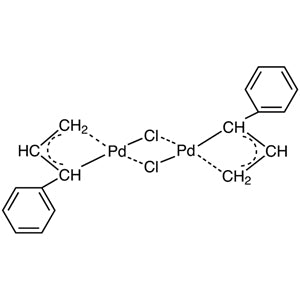
Allylpalladium(II) Chloride Dimer (TCI A1479) is a chemical compound widely used in catalytic reactions, particularly in C-H activation processes. This material plays a crucial role in organic and inorganic chemistry by enabling the selective activation of carbon-hydrogen bonds, which is essential for the synthesis of complex molecules. Its unique structure allows it to interact effectively with various organic substrates, making it a valuable tool in modern laboratory research. In catalytic systems, it helps accelerate chemical reactions that require metal-based catalysts, such as hydro silation or oxidation processes. Due to its reactivity and versatility, it is a key component in the development of new synthetic methodologies.
The compound is preferred for its ability to form complexes with a wide range of ligands, which enhances its adaptability in different catalytic environments. It exhibits good solubility in organic solvents, facilitating its use in various reaction conditions. Additionally, it maintains chemical stability under specific conditions, although it is sensitive to moisture and oxidation. These properties make it a reliable choice for researchers seeking efficient and effective catalytic solutions. Its reactivity and compatibility with multiple substrates further contribute to its popularity in both academic and industrial settings.
In Indonesian laboratories, Allylpalladium(II) Chloride Dimer is commonly used in research focused on catalytic processes and synthetic chemistry. It is particularly favored for its role in C-H activation, which is a key area of study in both organic and inorganic chemistry. Its application extends to various experimental setups where precise control over reaction conditions is required. As a result, it is an essential material for researchers working on advanced chemical synthesis and catalytic mechanisms.
TCI brochures (PDF)
- Phosphine Ligand immobilizable on Silica and Metal Oxide Surfaces 2026-07-23 · p. 2
- Easily-preparable N-Heterocyclic Carbene (NHC) Precursors 2021-09-14 · p. 2
- C-H Bond Activation Reaction 2025-06-20 · p. 4
- Transition Metal Catalysts 2026-04-10 · p. 14
- Suzuki-Miyaura Cross Coupling Reaction 2025-12-01 · p. 22
Related TCI products
- TCI P2017 12131-44-1 Palladium(II)(pi-cinnamyl) Chloride Dimer
- TCI P1489 7647-10-1 Palladium(II) Chloride
- TCI B2064 95464-05-4 [1,1'-Bis(diphenylphosphino)ferrocene]palladium(II) Dichloride Dichloromethane Adduct
- TCI B2042 14588-08-0 Bis(triphenylphosphine)palladium(II) Diacetate
- TCI B2026 40691-33-6 Bis(tri-o-tolylphosphine)palladium(II) Dichloride
- TCI B1668 14220-64-5 Bis(benzonitrile)palladium(II) Dichloride
- C-H Activation Reactions: This compound is ideal for C-H activation due to its ability to selectively activate carbon-hydrogen bonds, making it a key reagent in synthetic chemistry.
- Catalytic Hydrogenation: Its metal-based structure allows it to act as an effective catalyst in hydrogenation reactions, enhancing reaction efficiency and selectivity.
- Organic Synthesis Research: It is widely used in the synthesis of complex organic molecules, offering versatility in reaction conditions and substrate compatibility.
- Oxidation Processes: The compound's reactivity makes it suitable for oxidation reactions, where it can facilitate the transformation of organic substrates under controlled conditions.
- Ligand Complex Formation: Its ability to form complexes with various ligands makes it a valuable tool in studying catalytic mechanisms and reaction pathways.
From the TCI brochure
- Palladium source for preparing PP-Pd by mixing with B5594 in 1:1 molar ratio
- 0.50 mmol (THF, RT, 4 h)
| Brand | TCI |
|---|---|
| CAS number | 12012-95-2 |
| Molecular formula | — |
| Purity | — |
| Category | Chemistry > Catalysis and Inorganic Chemistry > C-H Activation [Catalysis] |
| Pack sizes | Available in various quantities as per supplier specifications |
| Physical form | Solid or powder, depending on the batch |
| Storage | Store in a dry, cool place away from moisture and oxidizing agents |
Allylpalladium(II) Chloride Dimer should be stored in a dry, cool environment to prevent moisture exposure, which can lead to degradation. It is recommended to use airtight containers made of inert materials such as glass or polyethylene to minimize contact with air and moisture. Due to its sensitivity to oxidation, it should be kept away from strong oxidizing agents. In laboratory settings, it is important to handle the compound with care, using appropriate personal protective equipment. It is best stored in a controlled environment to maintain its chemical stability and ensure safe handling during experiments. Always ensure proper ventilation when working with this compound to avoid inhalation of vapors.
References cited in the TCI brochure
- Maréva Fèvre. Imidazol(in)ium Hydrogen Carbonates as a Genuine Source of N-Heterocyclic Carbenes (NHCs): Applications to the Facile Preparation of NHC Metal Complexes and to NHC-Organocatalyzed Molecular and Macromolecular Syntheses Journal of the American Chemical Society, 2012. doi:10.1021/ja3005804
Product Categories
- Catalysis and Inorganic ChemistryC-H Activation [Catalysis]Palladium Compounds [C-H Activation]
- Catalysis and Inorganic ChemistryTransition Elements [Catalysis and Inorganic Chemistry]Palladium [Catalysis and Inorganic Chemistry]
- Catalysis and Inorganic ChemistryCross-coupling Reaction using Transition Metal Catalysts [C-C Bond Formation]Palladium Catalysts [Cross-coupling Reaction using Transition Metal Catalysts]
- Synthetic ReagentsC-C Bond Formation [Synthetic Reagents]Cross-coupling Reaction using Transition Metal Catalysts [C-C Bond Formation]
- Synthetic ReagentsC-X(Non-Halogen) Bond Formation [Synthetic Reagents]C-H Bond Activation Reaction [Synthetic Reagents]
Produk Terkait
-
Palladium(II)(pi-cinnamyl)ChlorideDimer TCI P2017
Regular price Rp 1.483.650,00Regular priceRp 1.053.150,00Sale price Rp 1.483.650,00 -
Palladium(II)Chloride TCI P1489
Regular price From Rp 3.127.950,00Regular priceRp 2.202.900,00Sale price From Rp 3.127.950,00 -
[1,1'-Bis(diphenylphosphino)ferrocene]palladium(II)DichlorideDichloromethaneAdduct TCI B2064
Regular price From Rp 2.121.000,00Regular priceRp 1.498.350,00Sale price From Rp 2.121.000,00 -
Bis(triphenylphosphine)palladium(II)Diacetate TCI B2042
Regular price From Rp 2.942.100,00Regular priceRp 2.072.700,00Sale price From Rp 2.942.100,00 -
Bis(tri-o-tolylphosphine)palladium(II)Dichloride TCI B2026
Regular price From Rp 2.121.000,00Regular priceRp 1.498.350,00Sale price From Rp 2.121.000,00 -
Bis(benzonitrile)palladium(II)Dichloride TCI B1668
Regular price From Rp 2.942.100,00Regular priceRp 2.072.700,00Sale price From Rp 2.942.100,00 -
Bis(triphenylphosphine)palladium(II)Dichloride TCI B1667
Regular price From Rp 1.618.050,00Regular priceRp 1.146.600,00Sale price From Rp 1.618.050,00 -
Di-mu-chlorobis[5-hydroxy-2-[1-(hydroxyimino)ethyl]phenyl]palladium(II)Dimer TCI D3807
Regular price From Rp 1.563.450,00Regular priceRp 1.108.800,00Sale price From Rp 1.563.450,00