Bis(tri-tert-butylphosphine)palladium(0) is a chemical compound widely used as a catalyst in organic reactions, particularly in the synthesis of complex compounds. This material plays a crucial role in laboratory settings where catalytic processes are essential for activating electron transfer or promoting chemical coupling reactions. Its unique structure allows it to interact effectively with various substrates, making it an essential component in many synthetic pathways. As a transition metal-based catalyst, it is especially valuable in reactions that require precise control over reaction mechanisms and product formation.
The compound is preferred due to its stability under specific conditions and its ability to form stable complexes with ligands such as tri-tert-butylphosphine. These interactions enhance the efficiency and selectivity of catalytic processes, making the compound highly effective in a range of applications. Its molecular structure enables specific interactions with substrates, which is critical in achieving high reaction yields and minimizing byproducts. This makes it a reliable choice for researchers working in catalysis and inorganic chemistry.
In Indonesian laboratories, this compound is extensively used in organic chemistry research, particularly in the fields of catalysis and the synthesis of complex compounds. Researchers in both academic and industrial settings rely on this material to accelerate reaction processes and achieve desired chemical outcomes. Its consistent performance and reliability make it a staple in many laboratory workflows across Indonesia.
Advantages (TCI brochure)
- Used at 0.5 mol% loading in the printed coupling example at room temperature
TCI brochures (PDF)
- Coupling Polymerization Catalysts 2025-02-18 · p. 1
- Sulfonium Salt for Both Trifluoromethylation and Mesitylation 2025-01-07 · p. 1
- Environmentally-Friendly Deep Eutectic Solvents with Versatile Applications 2025-12-22 · p. 2
- Palladium Catalysts for Cross-Coupling Reaction 2025-05-01 · p. 1
- Transition Metal Catalysts 2026-04-10 · p. 13
- Suzuki-Miyaura Cross Coupling Reaction 2025-12-01 · p. 23
Related TCI products
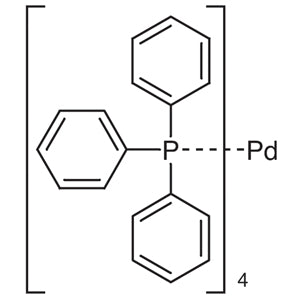
- TCI T1350 14221-01-3 Tetrakis(triphenylphosphine)palladium(0)
- TCI C2734 1375325-71-5 Chloro[(tri-tert-butylphosphine)-2-(2-aminobiphenyl)]palladium(II)
- TCI B3160 95408-45-0 [1,1'-Bis(di-tert-butylphosphino)ferrocene]palladium(II) Dichloride
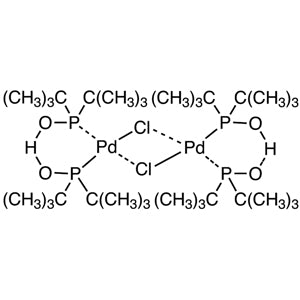
- TCI D3706 386706-31-6 Dihydrogen Di-mu-chlorotetrakis(di-tert-butylphosphinito)dipalladate
- TCI B3224 31277-98-2 Bis[1,2-bis(diphenylphosphino)ethane]palladium(0)
- TCI B2064 95464-05-4 [1,1'-Bis(diphenylphosphino)ferrocene]palladium(II) Dichloride Dichloromethane Adduct
- Organic synthesis reactions benefit from this catalyst's ability to promote selective coupling reactions, enhancing reaction efficiency and product yield.
- Catalytic cross-coupling reactions, such as Suzuki and Heck, utilize this compound for its capacity to activate substrates and facilitate bond formation.
- Inorganic chemistry experiments often require this material for its role in stabilizing transition metal complexes and enabling controlled redox processes.
- Laboratory-scale synthesis of complex organic molecules relies on this compound for its effectiveness in promoting multi-step reaction sequences.
- Research in catalytic mechanisms and reaction kinetics frequently employs this material to study the behavior of transition metal-based catalysts under various conditions.
From the TCI brochure
- Coupling polymerization of a boronate-functionalized monomer with an aryl bromide (ArBr)
| Brand | TCI |
|---|---|
| CAS number | 53199-31-8 |
| Molecular formula | — |
| Purity | — |
| Category | Chemistry > Catalysis and Inorganic Chemistry > Transition Elements [Catalysis and Inorganic Chemistry] |
| Pack sizes | Available in various quantities as per standard laboratory requirements |
| Physical form | Solid or powder, depending on the specific formulation |
| Storage | Store in a cool, dry place away from moisture and direct sunlight |
Data from the TCI brochure
| Katalis | 0.5 mol% (ArBr (0.5 mol%), Na2CO3, THF/water, rt) |
|---|
Source: TCI brochure FF025 (2025-02-18)
This compound should be stored in a cool, dry environment, away from moisture and direct sunlight to maintain its stability and effectiveness. It is recommended to use airtight containers made of materials that are chemically inert, such as glass or high-density polyethylene, to prevent any unwanted reactions. In laboratory settings, it is important to handle the compound with care, using appropriate personal protective equipment to minimize exposure. Due to its chemical nature, it should be kept in a secure location that is inaccessible to unauthorized personnel. Regular monitoring of storage conditions is essential to ensure the compound remains in optimal condition for use in chemical reactions.
References cited in the TCI brochure
- Shi‐Meng Wang. Palladium‐Catalyzed Arylation of Arylboronic Acids with Yagupolskii–Umemoto Reagents Chemistry – A European Journal, 2016. doi:10.1002/chem.201600991
Product Categories
- Catalysis and Inorganic ChemistryTransition Elements [Catalysis and Inorganic Chemistry]Palladium [Catalysis and Inorganic Chemistry]
- Catalysis and Inorganic ChemistryCross-coupling Reaction using Transition Metal Catalysts [C-C Bond Formation]Palladium Catalysts [Cross-coupling Reaction using Transition Metal Catalysts]
- Synthetic ReagentsC-C Bond Formation [Synthetic Reagents]Cross-coupling Reaction using Transition Metal Catalysts [C-C Bond Formation]
Produk Terkait
-
Tetrakis(triphenylphosphine)palladium(0) TCI T1350
Regular price From Rp 1.458.450,00Regular priceRp 1.035.300,00Sale price From Rp 1.458.450,00 -
Chloro[(tri-tert-butylphosphine)-2-(2-aminobiphenyl)]palladium(II) TCI C2734
Regular price Rp 7.261.800,00Regular priceRp 5.093.550,00Sale price Rp 7.261.800,00 -
[1,1'-Bis(di-tert-butylphosphino)ferrocene]palladium(II)Dichloride TCI B3160
Regular price From Rp 6.811.350,00Regular priceRp 4.778.550,00Sale price From Rp 6.811.350,00 -
DihydrogenDi-mu-chlorotetrakis(di-tert-butylphosphinito)dipalladate TCI D3706
Regular price Rp 2.411.850,00Regular priceRp 1.702.050,00Sale price Rp 2.411.850,00 -
Bis[1,2-bis(diphenylphosphino)ethane]palladium(0) TCI B3224
Regular price Rp 2.359.350,00Regular priceRp 1.665.300,00Sale price Rp 2.359.350,00 -
[1,1'-Bis(diphenylphosphino)ferrocene]palladium(II)DichlorideDichloromethaneAdduct TCI B2064
Regular price From Rp 2.121.000,00Regular priceRp 1.498.350,00Sale price From Rp 2.121.000,00 -
Bis(tricyclohexylphosphine)palladium(II)Dichloride TCI B2055
Regular price From Rp 2.199.750,00Regular priceRp 1.554.000,00Sale price From Rp 2.199.750,00 -
Bis(triphenylphosphine)palladium(II)Diacetate TCI B2042
Regular price From Rp 2.942.100,00Regular priceRp 2.072.700,00Sale price From Rp 2.942.100,00