
![(S)-1-(Diphenylphosphino)-2-[(S)-4-isopropyloxazolin-2-yl]ferrocene (CAS 163169-10-6) - TCI D3822 - AMI Scientific](http://amiscientific.com/cdn/shop/files/TCI2510D3822.jpg?v=1767106619&width=1946)
![(S)-1-(Diphenylphosphino)-2-[(S)-4-isopropyloxazolin-2-yl]ferrocene (CAS 163169-10-6) - TCI D3822 - AMI Scientific](http://amiscientific.com/cdn/shop/files/TCI2510D3822.jpg?v=1767106619&width=1445)
TCI D3822, CAS 163169-10-6, is (S)-1-(Diphenylphosphino)-2-[(S)-4-isopropyloxazolin-2-yl]ferrocene, a bidentate chiral ligand of the phosphine–oxazoline type built on a ferrocene backbone. The compound brings together three design elements at once: a phosphorus atom acting as a soft donor, an oxazoline nitrogen atom acting as a hard donor, and a rigid ferrocene framework serving as the structural support. In the laboratory, it is used together with transition metal precursors to form chiral catalysts that control the direction of reaction approach, so that products are formed with a preference for one enantiomer.
The structural advantage of this ligand lies in the differing electronic character of its two donor atoms, a feature often described as electronic dissymmetry. The difference in donor properties between phosphorus and nitrogen creates a non-uniform trans influence around the metal centre, and this sharpens the distinction between two competing reaction pathways. The ferrocene backbone adds geometric rigidity along with an element of spatial chirality, while the isopropyl group at the four-position of the oxazoline ring provides directed steric hindrance that becomes the primary determinant of enantioselectivity. This combination makes the ligand a considered choice for asymmetric transformations.
In Indonesian laboratories, this ligand is generally handled by university research groups, graduate-level synthetic chemistry programmes, and institutional research centres working on asymmetric synthesis. It is typically used at small scale for method development and ligand screening work, where several chiral ligands are compared against the same substrate to identify which structure gives the best stereochemical outcome. Because it is supplied by TCI, it is normally ordered as part of a chiral ligand set assembled for a specific research project.
TCI brochures (PDF)
- Chiral Ligands 2024-12-13 · p. 2
- Asymmetric Synthesis 2026-03-18 · p. 4
- Ligands 2025-12-01 · p. 2
Related TCI products
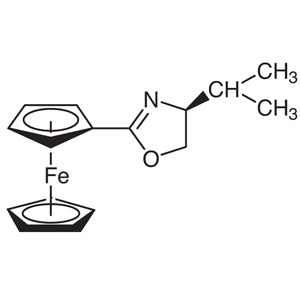
- TCI I0749 162157-03-1 (S)-(4-Isopropyloxazolin-2-yl)ferrocene
- TCI B3197 190601-12-8 (S,S'')-2,2''-Bis[(S)-4-isopropyloxazolin-2-yl]-1,1''-biferrocene
- TCI M2103 1229444-44-3 1-Methyl-1-[4-(diphenylphosphino)benzyl]pyrrolidinium Bromide
- TCI B4104 117408-98-7 (S)-4-tert-Butyl-2-(2-pyridyl)oxazoline
- TCI B2064 95464-05-4 [1,1'-Bis(diphenylphosphino)ferrocene]palladium(II) Dichloride Dichloromethane Adduct
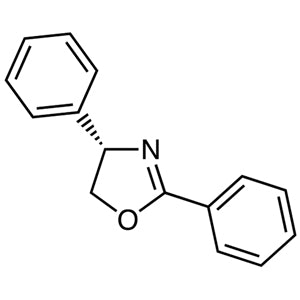
- TCI D5368 475571-19-8 (S)-2,4-Diphenyl-4,5-dihydrooxazole
- Asymmetric hydrogenation research: the phosphorus and nitrogen donor pair coordinates transition metal precursors and creates the chiral environment needed to favour formation of one enantiomer of the product.
- Chiral ligand screening studies: the compound serves as one defined member of a phosphine–oxazoline ligand series, allowing researchers to compare stereochemical outcomes across different backbone and substituent combinations.
- Asymmetric catalysis method development: the rigid ferrocene framework gives a predictable coordination geometry, which makes it easier to interpret how structural changes affect the observed enantiomeric preference.
- Stereoselective carbon–carbon bond formation work: the directed steric hindrance from the four-position isopropyl group biases substrate approach, supporting selective construction of new stereocentres.
- Graduate-level synthetic chemistry teaching and research: the compound illustrates the practical use of electronic dissymmetry in ligand design, making it useful for advanced coursework and thesis-level investigations.
| Brand | TCI (Tokyo Chemical Industry) |
|---|---|
| CAS number | 163169-10-6 |
| Molecular formula | — |
| Purity | — |
| Category | Chemistry > Asymmetric Synthesis > Chiral Catalysts, Chiral Ligands, Chiral Reagents |
| Pack sizes | available in TCI research-scale pack sizes; please confirm the currently offered size when ordering |
| Physical form | — |
| Storage | store according to the storage conditions stated on the manufacturer label and in the accompanying safety data sheet |
- Chemical name: (S)-1-(Diphenylphosphino)-2-[(S)-4-isopropyloxazolin-2-yl]ferrocene
Store the container in a cool, dry place, tightly closed and protected from light, following the storage conditions stated on the manufacturer label and in the safety data sheet. As a phosphine-containing ligand, it should be kept away from air and moisture as far as practicable; use of an inert atmosphere and a desiccator or sealed secondary container is advisable for material that will be opened repeatedly. Handle in a fume hood using appropriate personal protective equipment, including safety glasses, a laboratory coat, and chemically resistant gloves. Weigh and transfer with clean, dry glassware or spatulas to avoid contamination of the remaining stock, and keep the container separate from strong oxidising agents. Review the manufacturer safety data sheet before first use, and dispose of residues and contaminated consumables through the laboratory's chemical waste procedures.
—
Product Categories
- Asymmetric SynthesisChiral Catalysts, Chiral Ligands, Chiral ReagentsChiral Ligands (Other)
- Catalysis and Inorganic ChemistryNitrogen-Donor Ligands [Catalysis]Oxazole Ligands, Oxazoline Ligands, Thiazole Ligands
- Catalysis and Inorganic ChemistryPhosphorous Compounds [Catalysis and Inorganic Chemistry]Monodentate Phosphine Ligands, Phosphine Oxide Ligands [Catalysis]
Produk Terkait
-
(S)-(4-Isopropyloxazolin-2-yl)ferrocene TCI I0749
Regular price Rp 2.995.650,00Regular price -
(S,S'')-2,2''-Bis[(S)-4-isopropyloxazolin-2-yl]-1,1''-biferrocene TCI B3197
Regular price Rp 7.659.750,00Regular price -
1-Methyl-1-[4-(diphenylphosphino)benzyl]pyrrolidiniumBromide TCI M2103
Regular price Rp 6.891.150,00Regular price -
(S)-4-tert-Butyl-2-(2-pyridyl)oxazoline TCI B4104
Regular price From Rp 4.240.950,00Regular price -
[1,1'-Bis(diphenylphosphino)ferrocene]palladium(II)DichlorideDichloromethaneAdduct TCI B2064
Regular price From Rp 2.068.500,00Regular price -
(S)-2,4-Diphenyl-4,5-dihydrooxazole TCI D5368
Regular price From Rp 1.220.100,00Regular price -
1-[2-(Di-tert-butylphosphino)phenyl]-3,5-diphenyl-1H-pyrazole TCI D3834
Regular price From Rp 1.458.450,00Regular price -
[1,1'-Bis(di-tert-butylphosphino)ferrocene]palladium(II)Dichloride TCI B3160
Regular price From Rp 6.758.850,00Regular price
![190601-12-8 (S,S'')-2,2''-Bis[(S)-4-isopropyloxazolin-2-yl]-1,1''-biferrocene - AMI Scientific](http://amiscientific.com/cdn/shop/files/TCI2510B3197.jpg?v=1767089511&width=533)
![1229444-44-3 1-Methyl-1-[4-(diphenylphosphino)benzyl]pyrrolidinium Bromide - AMI Scientific](http://amiscientific.com/cdn/shop/files/TCI2510M2103.jpg?v=1767126064&width=533)

![95464-05-4 [1,1'-Bis(diphenylphosphino)ferrocene]palladium(II) Dichloride Dichloromethane Adduct - AMI Scientific](http://amiscientific.com/cdn/shop/files/TCI2510B2064_55725750-1d93-4607-a5e5-5c490594863a.jpg?v=1767330765&width=533)
![1-[2-(Di-tert-butylphosphino)phenyl]-3,5-diphenyl-1H-pyrazole (CAS 628333-86-8) - TCI D3834 - AMI Scientific](http://amiscientific.com/cdn/shop/files/TCI2510D3834.jpg?v=1767106644&width=533)
![95408-45-0 [1,1'-Bis(di-tert-butylphosphino)ferrocene]palladium(II) Dichloride - AMI Scientific](http://amiscientific.com/cdn/shop/files/TCI2510B3160_a4c0b85c-059a-4cb6-9b5d-8c432346ca89.jpg?v=1767431571&width=533)