

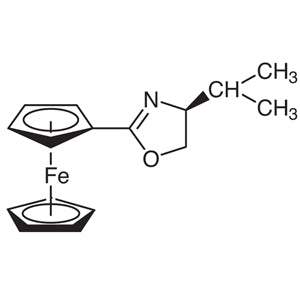
TCI I0749 (S)-(4-Isopropyloxazolin-2-yl)ferrocene is a chiral organometallic compound that combines a ferrocene core with an oxazoline ring bearing an isopropyl substituent in the S configuration. The compound occupies a special position in asymmetric synthesis laboratories as a key precursor to the well-known family of ferrocenyl oxazoline ligands. Through ortho-lithiation directed by the oxazoline group, it can be converted into a wide range of bidentate phosphine-oxazoline ligands and other donor ligands, which are then used to control stereochemistry in transition metal-catalysed reactions with a high rate of success.
The property that makes this compound so highly valued is the ability of the oxazoline group to direct deprotonation to the ortho position of the cyclopentadienyl ring in a diastereoselective manner. This process creates planar chirality on the ferrocene in addition to the central chirality already present at the oxazoline carbon, so the resulting ligands carry two cooperating elements of chirality. The ferrocene core itself provides a robust framework that is air-stable in its neutral form and offers tunable electronic properties, while the isopropyl group supplies a balanced degree of steric hindrance.
In Indonesian laboratories, the compound is typically handled in university and institutional research groups working on asymmetric catalysis, chiral ligand design, and methodology development in organic synthesis. It is usually ordered in small research quantities and used at the bench under inert-atmosphere technique, since the directed lithiation step that follows requires strictly anhydrous conditions. Laboratories preparing publications or graduate theses on stereoselective transformations are the most common users of this material.
TCI brochures (PDF)
- Ligands 2025-12-01 · p. 4
Related TCI products
- TCI D3822 163169-10-6 (S)-1-(Diphenylphosphino)-2-[(S)-4-isopropyloxazolin-2-yl]ferrocene
- TCI B3197 190601-12-8 (S,S'')-2,2''-Bis[(S)-4-isopropyloxazolin-2-yl]-1,1''-biferrocene
- TCI B3160 95408-45-0 [1,1'-Bis(di-tert-butylphosphino)ferrocene]palladium(II) Dichloride
- TCI B2064 95464-05-4 [1,1'-Bis(diphenylphosphino)ferrocene]palladium(II) Dichloride Dichloromethane Adduct
- TCI T3942 53152-69-5 (1R,2R)-N,N,N',N'-Tetramethyl-1,2-cyclohexanediamine
- TCI B4104 117408-98-7 (S)-4-tert-Butyl-2-(2-pyridyl)oxazoline
- Synthesis of ferrocenyl phosphine-oxazoline ligands: the oxazoline group directs ortho-lithiation on the cyclopentadienyl ring, allowing a phosphine donor to be introduced at a defined position to give a bidentate P,N ligand.
- Construction of planar-chiral building blocks: diastereoselective deprotonation at the ortho position installs planar chirality on the ferrocene backbone, giving access to scaffolds carrying two distinct chirality elements at once.
- Preparation of catalyst systems for transition metal-catalysed asymmetric reactions: ligands derived from this precursor are used to control the stereochemical outcome of metal-mediated transformations with high levels of success.
- Chiral ligand design and structure-activity studies: the isopropyl substituent provides a balanced steric environment that researchers can compare against other oxazoline substituents when tuning selectivity.
- Methodology development in asymmetric synthesis: the robust, electronically tunable ferrocene framework serves as a reliable platform for developing and benchmarking new stereoselective synthetic procedures in research laboratories.
| Brand | TCI (Tokyo Chemical Industry) |
|---|---|
| CAS number | 162157-03-1 |
| Molecular formula | — |
| Purity | — |
| Category | Chemistry > Asymmetric Synthesis > Chiral Catalysts, Chiral Ligands, Chiral Reagents |
| Pack sizes | available in standard TCI research-scale catalogue pack sizes; please confirm the current option when ordering |
| Physical form | — |
| Storage | keep in a cool, dry place in the tightly closed original container |
- Product code: I0749
- Chemical name: (S)-(4-Isopropyloxazolin-2-yl)ferrocene
Store the container tightly closed in a cool, dry, well-ventilated area, away from direct sunlight, moisture, and sources of ignition. The original manufacturer packaging is the preferred container; if the material is transferred, use clean, dry, tightly sealed glass vessels and label them clearly. Because the ortho-lithiation chemistry this compound is intended for requires strictly anhydrous conditions, handling under an inert atmosphere and with dried glassware is recommended to protect both the material and the subsequent reaction. Handle in a fume hood, wear safety glasses, a laboratory coat, and chemically resistant gloves, avoid the formation and inhalation of dust, and consult the manufacturer's safety data sheet before use. Keep away from incompatible materials and dispose of residues in accordance with applicable laboratory waste procedures.
—
Produk Terkait
-
(S)-1-(Diphenylphosphino)-2-[(S)-4-isopropyloxazolin-2-yl]ferrocene TCI D3822
Regular price From Rp 3.790.500,00Regular price -
(S,S'')-2,2''-Bis[(S)-4-isopropyloxazolin-2-yl]-1,1''-biferrocene TCI B3197
Regular price Rp 7.659.750,00Regular price -
[1,1'-Bis(di-tert-butylphosphino)ferrocene]palladium(II)Dichloride TCI B3160
Regular price From Rp 6.758.850,00Regular price -
[1,1'-Bis(diphenylphosphino)ferrocene]palladium(II)DichlorideDichloromethaneAdduct TCI B2064
Regular price From Rp 2.068.500,00Regular price -
(1R,2R)-N,N,N',N'-Tetramethyl-1,2-cyclohexanediamine TCI T3942
Regular price From Rp 2.094.750,00Regular price -
(S)-4-tert-Butyl-2-(2-pyridyl)oxazoline TCI B4104
Regular price From Rp 4.240.950,00Regular price -
1,2-Bis[(2R,5R)-2,5-dimethylphospholano]benzene TCI B2436
Regular price From Rp 3.021.900,00Regular price -
(S)-(+)-1,1'-Binaphthyl-2,2'-diylHydrogenPhosphate TCI B1144
Regular price From Rp 505.050,00Regular price
![(S)-1-(Diphenylphosphino)-2-[(S)-4-isopropyloxazolin-2-yl]ferrocene (CAS 163169-10-6) - TCI D3822 - AMI Scientific](http://amiscientific.com/cdn/shop/files/TCI2510D3822.jpg?v=1767106619&width=533)
![190601-12-8 (S,S'')-2,2''-Bis[(S)-4-isopropyloxazolin-2-yl]-1,1''-biferrocene - AMI Scientific](http://amiscientific.com/cdn/shop/files/TCI2510B3197.jpg?v=1767089511&width=533)
![95408-45-0 [1,1'-Bis(di-tert-butylphosphino)ferrocene]palladium(II) Dichloride - AMI Scientific](http://amiscientific.com/cdn/shop/files/TCI2510B3160_a4c0b85c-059a-4cb6-9b5d-8c432346ca89.jpg?v=1767431571&width=533)
![95464-05-4 [1,1'-Bis(diphenylphosphino)ferrocene]palladium(II) Dichloride Dichloromethane Adduct - AMI Scientific](http://amiscientific.com/cdn/shop/files/TCI2510B2064_55725750-1d93-4607-a5e5-5c490594863a.jpg?v=1767330765&width=533)


![147253-67-6 1,2-Bis[(2R,5R)-2,5-dimethylphospholano]benzene - AMI Scientific](http://amiscientific.com/cdn/shop/files/TCI2510B2436_a3600543-d5a2-4557-84b0-d86f00e01649.jpg?v=1767337226&width=533)
