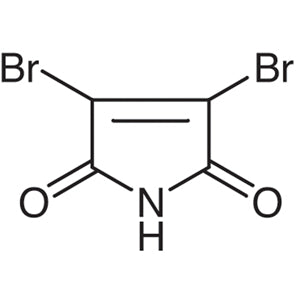
TCI D3910 3,4-Dibromomaleimide is a non-heterocyclic building block built around a maleimide core carrying two bromine atoms at the 3 and 4 positions. In laboratory work it is widely used as a linking reagent and molecular labelling agent, particularly in procedures that involve thiol groups. The compound plays an important role in bioconjugation chemistry, in the synthesis of functional compounds, and in the preparation of maleimide derivatives that serve as the basic framework for a range of molecular probes as well as materials designed to exhibit specific optical and electronic properties.
The property that makes this reagent attractive is the reactivity pattern of the dibromomaleimide group, which allows the bromine atoms to be exchanged by nucleophiles, including thiols and amines. Because of this, substituted derivatives can be formed in a stepwise and controlled manner rather than all at once. The combination of an electron-accepting maleimide ring with bromine substituents also opens a route to metal-catalysed cross-coupling reactions. As a TCI product, its consistent quality helps researchers obtain repeatable results in conjugation experiments that are sensitive to the quality of the starting material.
In Indonesian laboratories, this compound is used in biochemistry and biotechnology research, by materials chemistry research groups, and in laboratories carrying out synthetic work of a similar nature. It suits settings where a reliable, well-characterised maleimide building block is needed for conjugation and derivatisation studies, and where reproducibility between batches matters to the outcome of an experimental programme that may run over an extended period.
Related TCI products
- Thiol-directed bioconjugation: the dibromomaleimide group reacts readily with thiol groups, making it suitable for linking biomolecules under controlled conditions in conjugation workflows.
- Molecular labelling: the compound acts as a labelling reagent that attaches a maleimide-based tag to a target, supporting detection and tracking work in biochemistry research.
- Molecular probe synthesis: maleimide derivatives prepared from this building block form the basic framework of probes used in biochemical and biotechnological investigations by research groups.
- Functional materials preparation: the electron-accepting maleimide ring combined with bromine substituents supports the synthesis of materials with specific optical and electronic properties for materials chemistry.
- Metal-catalysed cross-coupling: the bromine substituents on the maleimide ring provide reactive handles for cross-coupling reactions used to extend and elaborate the molecular framework.
| Brand | TCI |
|---|---|
| CAS number | 1122-10-7 |
| Molecular formula | — |
| Purity | — |
| Category | Chemistry > Building Blocks > Non-Heterocyclic Building Blocks |
| Pack sizes | available in the pack sizes offered by the manufacturer; please confirm the current options when ordering |
| Physical form | — |
| Storage | store according to the manufacturer's instructions stated on the product label and safety data sheet |
- Product code: D3910
- Chemical name: 3,4-Dibromomaleimide
Store the material in its original tightly closed container, kept in a cool, dry and well-ventilated area away from moisture, direct sunlight and sources of heat or ignition. Keep it separated from incompatible substances, particularly nucleophilic reagents such as thiols and amines, which can react with the dibromomaleimide group. Handle the compound in a fume hood using appropriate personal protective equipment, including gloves, safety glasses and a laboratory coat, and avoid inhalation of dust or contact with skin and eyes. Use clean, dry glassware and spatulas when weighing to prevent contamination, reseal the container promptly after use, and dispose of residues and contaminated materials as chemical waste in accordance with institutional procedures. Always consult the manufacturer's safety data sheet before use.
—
Produk Terkait
-
Bromomalonaldehyde TCI B3699
Regular price Rp 1.670.550,00Regular price -
N-tert-Butylmaleimide TCI B3638
Regular price From Rp 1.458.450,00Regular price -
DiethylBromomalonate TCI B1205
Regular price From Rp 1.008.000,00Regular price -
N-Succinimidyl3-Maleimidopropionate[Cross-linkingReagent] TCI S0427
Regular price From Rp 1.458.450,00Regular price -
N-Phenylmaleimide TCI P0900
Regular price From Rp 505.050,00Regular price -
N-Methoxycarbonylmaleimide TCI M2333
Regular price From Rp 1.988.700,00Regular price -
3-MaleimidopropionicAcid TCI M1962
Regular price From Rp 1.829.100,00Regular price -
N-Methylmaleimide TCI M0807
Regular price From Rp 2.625.000,00Regular price


![55750-62-4 N-Succinimidyl 3-Maleimidopropionate [Cross-linking Reagent] - AMI Scientific](http://amiscientific.com/cdn/shop/files/TCI2510S0427.jpg?v=1767138756&width=533)