TCI D4106 2,4-Dimethoxyphenylacetic Acid, CAS 6496-89-5, is an arylacetic acid carrying two methoxy groups at the 2- and 4-positions of the benzene ring. In organic synthesis laboratories, this compound serves as a building block that supplies a reactive carboxyl group together with an electron-rich aromatic ring. The carboxyl group can be converted into amides, esters, acid chlorides, alcohols, or aldehydes, while the aromatic ring is ready to undergo electrophilic substitution. This combination makes the material a practical starting point for assembling target molecules in medicinal chemistry and natural product chemistry research.
The property that makes this compound a preferred choice is its methoxy substitution pattern at the ortho and para positions, which gives the ring a high electron density. As a result, cyclization reactions such as the Pictet-Spengler and Bischler-Napieralski reactions proceed more readily on its derivatives. The same substitution pattern is frequently encountered in the skeletons of natural product compounds, so this material is often used for the synthesis of analogues. It is supplied as a solid that is easy to weigh out and to store, with good solubility in polar organic solvents and in dilute basic solutions, so that preparing reaction mixtures is straightforward.
In Indonesian laboratories, this building block is typically used in university and institutional research settings where multi-step organic synthesis is carried out, particularly in medicinal chemistry and natural product chemistry programmes. Its solid form makes it convenient to weigh accurately on an analytical balance and to keep on the shelf between experiments, while its solubility behaviour suits the polar organic solvents and dilute base solutions commonly stocked in synthetic laboratories. Researchers preparing analogues of natural product skeletons regularly select it as a starting material.
Related TCI products
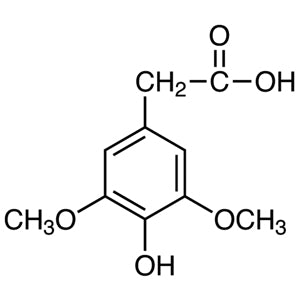
- TCI H1477 4385-56-2 4-Hydroxy-3,5-dimethoxyphenylacetic Acid
- TCI D2950 4670-10-4 3,5-Dimethoxyphenylacetic Acid
- TCI D1445 1758-25-4 2,5-Dimethoxyphenylacetic Acid
- TCI V0052 776-99-8 3,4-Dimethoxyphenylacetone
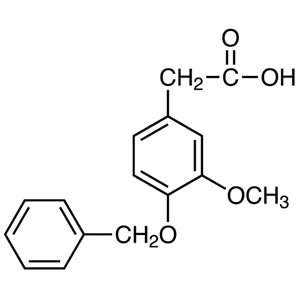
- TCI B4800 29973-91-9 4-Benzyloxy-3-methoxyphenylacetic Acid
- TCI B4742 4547-57-3 4-Butoxyphenylacetic Acid
- Medicinal chemistry synthesis — the reactive carboxyl group allows conversion into amides and esters, giving researchers a direct route to build target molecules for structure-activity studies.
- Natural product analogue preparation — the 2,4-dimethoxy substitution pattern is commonly found in natural product skeletons, making this acid a logical starting material for analogue synthesis programmes.
- Pictet-Spengler cyclization work — the electron-rich aromatic ring resulting from the ortho and para methoxy groups allows this cyclization to proceed more readily on derivatives of the compound.
- Bischler-Napieralski cyclization work — the same high electron density on the benzene ring makes derivatives of this acid suitable substrates for constructing isoquinoline-type ring systems.
- Carboxyl group functionalization studies — the acid function can be transformed into acid chlorides, alcohols, or aldehydes, supporting multi-step routes that require sequential modification of one handle.
| Brand | TCI |
|---|---|
| CAS number | 6496-89-5 |
| Molecular formula | — |
| Purity | — |
| Category | Chemistry > Building Blocks > Non-Heterocyclic Building Blocks |
| Pack sizes | available in the standard TCI catalogue pack sizes; please confirm the size required when ordering |
| Physical form | solid, convenient to weigh and to store |
| Storage | keep in a tightly closed container in a cool, dry place away from moisture |
Store the container tightly closed in a cool, dry, well-ventilated place, away from moisture and from direct sunlight. Keep the material in its original supplier container or in a clean, chemically resistant, well-labelled bottle with a secure closure, and reseal it promptly after each use so the solid remains easy to weigh accurately. Handle in a fume hood using standard laboratory personal protective equipment, including safety glasses, gloves, and a laboratory coat. Avoid generating dust when weighing, keep the material away from incompatible substances, and consult the supplier safety data sheet before use and disposal.
—
Produk Terkait
-
4-Hydroxy-3,5-dimethoxyphenylaceticAcid TCI H1477
Regular price From Rp 2.121.000,00Regular price -
3,5-DimethoxyphenylaceticAcid TCI D2950
Regular price From Rp 1.035.300,00Regular price -
2,5-DimethoxyphenylaceticAcid TCI D1445
Regular price From Rp 1.273.650,00Regular price -
3,4-Dimethoxyphenylacetone TCI V0052
Regular price From Rp 1.193.850,00Regular price -
4-Benzyloxy-3-methoxyphenylaceticAcid TCI B4800
Regular price Rp 2.518.950,00Regular price -
4-ButoxyphenylaceticAcid TCI B4742
Regular price From Rp 1.060.500,00Regular price -
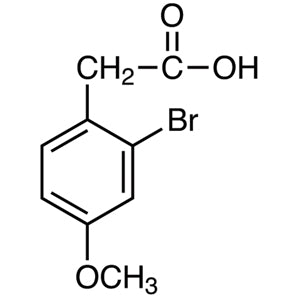
2-Bromo-4-methoxyphenylaceticAcid TCI B4737
Regular price From Rp 848.400,00Regular price -
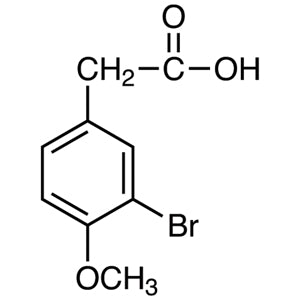
3-Bromo-4-methoxyphenylaceticAcid TCI B4677
Regular price From Rp 689.850,00Regular price