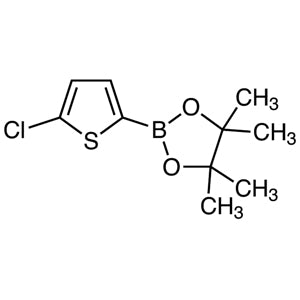
TCI D4290 is 3-Dodecyl-2-(4,4,5,5-tetramethyl-1,3,2-dioxaborolan-2-yl)thiophene, a thiophene derivative carrying a pinacol boronate ester group at the 2-position and a long dodecyl alkyl chain at the 3-position. The compound belongs to the family of material building blocks for small molecule semiconductors and acts as the boron partner in cross-coupling reactions. In materials and organic electronics laboratories, reagents of this type serve as the primary building blocks used to construct the conjugated chains that become the active layer of optoelectronic devices.
The main advantage of this material lies in its pinacol boronate group, which is considerably more stable and easier to handle than a free boronic acid, so weighing and storage become far more practical without excessive concern over dehydration or the formation of boroxine anhydrides. This group reacts cleanly under Suzuki–Miyaura conditions with palladium catalysts, delivering carbon–carbon bonds directed to a specific position on the thiophene ring. The long dodecyl chain provides high solubility in common organic solvents, an essential requirement if the resulting polymers or oligomers are to be processed by solution techniques such as spin coating.
In Indonesian laboratories, a building block of this kind is typically used by university and institutional research groups working on organic electronics, conjugated polymers, and semiconducting thin films. It fits synthetic workflows where a defined thiophene fragment must be coupled reproducibly into a larger conjugated backbone, and where the resulting material has to remain soluble enough for solution processing and subsequent device fabrication and characterisation.
TCI brochures (PDF)
- Thiophenes 2026-06-29 · p. 3
- Boron Compounds 2025-10-07 · p. 18
- Building Blocks for Organic Semiconductor 2026-03-24 · p. 26
Related TCI products
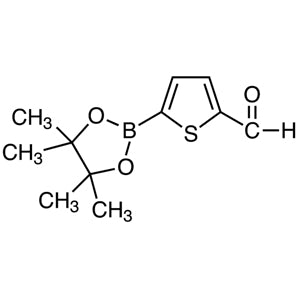
- TCI T3485 1040281-83-1 5-(4,4,5,5-Tetramethyl-1,3,2-dioxaborolan-2-yl)thiophene-2-carboxaldehyde
- TCI O0411 405165-12-0 4-n-Octyl-2-(4,4,5,5-tetramethyl-1,3,2-dioxaborolan-2-yl)thiophene
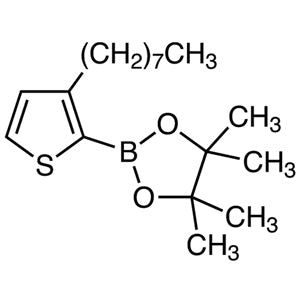
- TCI O0410 405165-14-2 3-n-Octyl-2-(4,4,5,5-tetramethyl-1,3,2-dioxaborolan-2-yl)thiophene
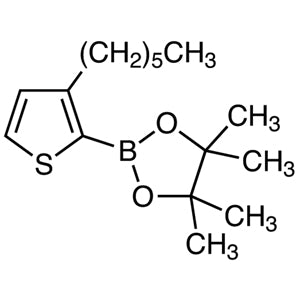
- TCI H1298 850881-09-3 3-Hexyl-2-(4,4,5,5-tetramethyl-1,3,2-dioxaborolan-2-yl)thiophene
- TCI H1294 883742-29-8 4-Hexyl-2-(4,4,5,5-tetramethyl-1,3,2-dioxaborolan-2-yl)thiophene
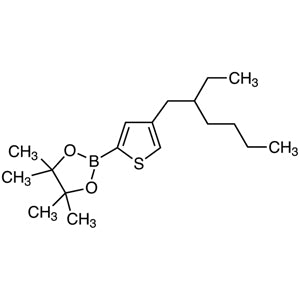
- TCI E1355 1224430-50-5 4-(2-Ethylhexyl)-2-(4,4,5,5-tetramethyl-1,3,2-dioxaborolan-2-yl)thiophene
- Suzuki–Miyaura cross-coupling synthesis: the pinacol boronate group reacts cleanly with palladium catalysts, giving directed carbon–carbon bond formation at a defined thiophene position.
- Conjugated polymer preparation: serves as a boron-bearing monomer for building extended conjugated chains used as the active layer in optoelectronic devices.
- Small molecule semiconductor construction: functions as a defined thiophene building block that can be assembled into larger semiconducting molecular architectures for organic electronics research.
- Solution-processable material development: the long dodecyl chain confers high solubility in common organic solvents, supporting spin coating and other solution deposition techniques.
- Regiodefined thiophene functionalisation: substitution at the 2- and 3-positions allows researchers to control where coupling occurs along the thiophene unit during synthesis.
| Brand | TCI |
|---|---|
| CAS number | 960524-18-9 |
| Molecular formula | — |
| Purity | — |
| Category | Materials Science > Material Building Blocks > Small Molecule Semiconductor Building Blocks |
| Pack sizes | available in standard laboratory research pack sizes; please confirm the currently offered packaging when ordering. |
| Physical form | — |
| Storage | keep in a tightly closed original container under the conditions stated on the manufacturer's label and safety data sheet. |
- Chemical name: 3-Dodecyl-2-(4,4,5,5-tetramethyl-1,3,2-dioxaborolan-2-yl)thiophene
Store the material in its original tightly closed container, protected from moisture and direct sunlight, and follow the storage conditions specified on the manufacturer's label and safety data sheet. Boronate esters are best kept dry and, where recommended, under an inert atmosphere to preserve reagent quality. Handle the compound in a fume hood using appropriate personal protective equipment, including safety glasses, gloves, and a laboratory coat. Weigh and transfer with clean, dry glassware or spatulas to avoid contamination, keep containers away from ignition sources and incompatible chemicals, and dispose of residues and contaminated materials according to institutional chemical waste procedures.
—
Produk Terkait
-
5-(4,4,5,5-Tetramethyl-1,3,2-dioxaborolan-2-yl)thiophene-2-carboxaldehyde TCI T3485
Regular price Rp 1.961.400,00Regular price -
4-n-Octyl-2-(4,4,5,5-tetramethyl-1,3,2-dioxaborolan-2-yl)thiophene TCI O0411
Regular price From Rp 2.199.750,00Regular price -
3-n-Octyl-2-(4,4,5,5-tetramethyl-1,3,2-dioxaborolan-2-yl)thiophene TCI O0410
Regular price From Rp 3.392.550,00Regular price -
3-Hexyl-2-(4,4,5,5-tetramethyl-1,3,2-dioxaborolan-2-yl)thiophene TCI H1298
Regular price From Rp 1.724.100,00Regular price -
4-Hexyl-2-(4,4,5,5-tetramethyl-1,3,2-dioxaborolan-2-yl)thiophene TCI H1294
Regular price From Rp 3.976.350,00Regular price -
4-(2-Ethylhexyl)-2-(4,4,5,5-tetramethyl-1,3,2-dioxaborolan-2-yl)thiophene TCI E1355
Regular price From Rp 3.367.350,00Regular price -
4-Dodecyl-2-(4,4,5,5-tetramethyl-1,3,2-dioxaborolan-2-yl)thiophene TCI D4291
Regular price From Rp 1.988.700,00Regular price -
5-Chloro-2-(4,4,5,5-tetramethyl-1,3,2-dioxaborolan-2-yl)thiophene TCI C3301
Regular price From Rp 1.035.300,00Regular price