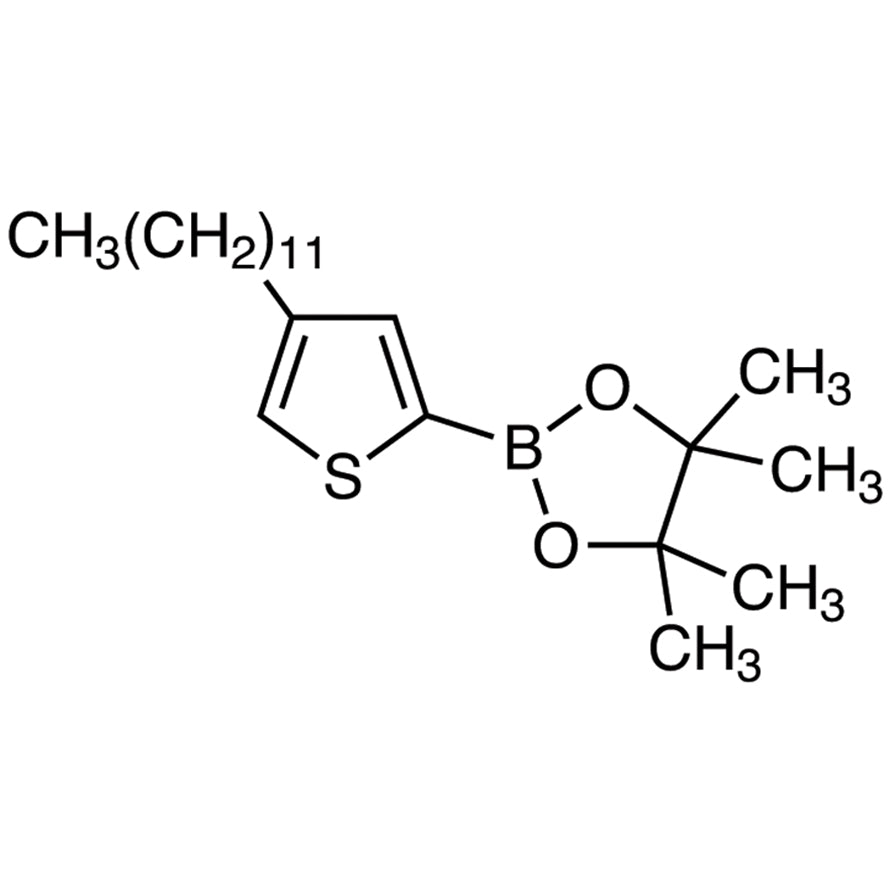
TCI D4291 is 4-Dodecyl-2-(4,4,5,5-tetramethyl-1,3,2-dioxaborolan-2-yl)thiophene, a thiophene isomer that carries a pinacol boronate ester group at the 2-position and a dodecyl chain at the 4-position. The compound belongs to the family of material building blocks for small molecule semiconductors and is used as the boron component in palladium-catalysed cross-coupling reactions. Because the alkyl chain sits in a different position than in the 3-dodecyl isomer, it represents a distinct choice for researchers who want to control the substitution pattern and the side-chain arrangement of the conjugated materials they design.
The properties that make this building block attractive are the stability of the pinacol boronate group towards routine laboratory handling combined with its good reactivity under Suzuki–Miyaura conditions. Because the dodecyl chain is located at the 4-position, the distance between the alkyl group and the boron reaction centre is larger, so the steric environment around the newly formed bond differs from that of the other isomers. This in turn influences the torsion angle between units, the arrangement of chains in the solid state, and the effective conjugation length of the final material. The long alkyl chain still provides adequate solubility for solution processing.
In Indonesian laboratories, this reagent is typically used in academic and institutional research groups working on organic electronics and conjugated polymer chemistry, where thiophene-based monomers are coupled step by step to build defined molecular architectures. It suits work carried out at the synthesis scale, where a boronate partner with a known substitution pattern is required to compare isomers, and it fits laboratories that already run palladium-catalysed coupling chemistry and need a well-defined side-chain-bearing thiophene boronate for their material design programmes.
TCI brochures (PDF)
- Thiophenes 2026-06-29 · p. 4
- Boron Compounds 2025-10-07 · p. 18
- Building Blocks for Organic Semiconductor 2026-03-24 · p. 26
Related TCI products
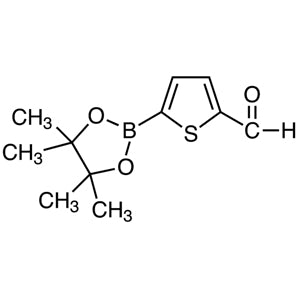
- TCI T3485 1040281-83-1 5-(4,4,5,5-Tetramethyl-1,3,2-dioxaborolan-2-yl)thiophene-2-carboxaldehyde
- TCI O0411 405165-12-0 4-n-Octyl-2-(4,4,5,5-tetramethyl-1,3,2-dioxaborolan-2-yl)thiophene
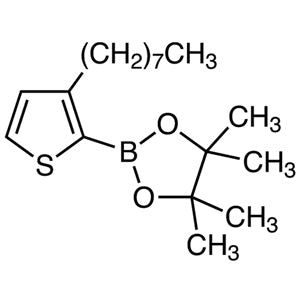
- TCI O0410 405165-14-2 3-n-Octyl-2-(4,4,5,5-tetramethyl-1,3,2-dioxaborolan-2-yl)thiophene
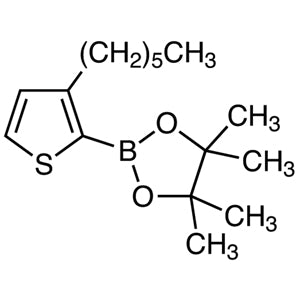
- TCI H1298 850881-09-3 3-Hexyl-2-(4,4,5,5-tetramethyl-1,3,2-dioxaborolan-2-yl)thiophene
- TCI H1294 883742-29-8 4-Hexyl-2-(4,4,5,5-tetramethyl-1,3,2-dioxaborolan-2-yl)thiophene
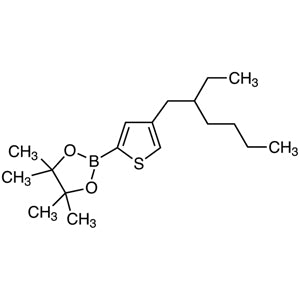
- TCI E1355 1224430-50-5 4-(2-Ethylhexyl)-2-(4,4,5,5-tetramethyl-1,3,2-dioxaborolan-2-yl)thiophene
- Suzuki–Miyaura cross-coupling: the pinacol boronate group at the 2-position transfers the thiophene unit efficiently under palladium catalysis while remaining stable enough for routine weighing and transfer in the laboratory.
- Conjugated polymer synthesis: the reagent serves as the boron-bearing monomer that couples with halogenated partners, allowing researchers to extend conjugation length in a controlled, stepwise manner.
- Small molecule semiconductor construction: as a material building block, it introduces an alkylated thiophene unit into defined molecular architectures intended for organic electronic applications and structure–property studies.
- Isomer comparison studies: the 4-dodecyl substitution pattern lets researchers evaluate how alkyl chain placement, rather than chain length, affects torsion angles and solid-state chain packing relative to the 3-dodecyl isomer.
- Solution-processable material preparation: the long dodecyl chain imparts adequate solubility to the resulting materials, supporting synthetic routes that end in solution-based processing and film formation work.
| Brand | TCI |
|---|---|
| CAS number | 1173788-58-3 |
| Molecular formula | — |
| Purity | — |
| Category | Materials Science > Material Building Blocks > Small Molecule Semiconductor Building Blocks |
| Pack sizes | please refer to the packaging options listed for this catalogue item |
| Physical form | — |
| Storage | store as indicated on the manufacturer's label and in the accompanying documentation |
- Chemical name: 4-Dodecyl-2-(4,4,5,5-tetramethyl-1,3,2-dioxaborolan-2-yl)thiophene
Store the container in a cool, dry place, tightly closed and protected from moisture, following the storage conditions stated on the manufacturer's label. Keep the material in its original supplier container, or in a clean, well-sealed and clearly labelled vessel of compatible material, and return it promptly after each use to limit exposure to air and humidity. Handle the compound in a well-ventilated area or fume hood, wear gloves, safety glasses and a laboratory coat, and avoid contact with skin, eyes and clothing. Weigh and transfer with clean, dry tools to preserve the integrity of the boronate group, and consult the safety data sheet before use and for waste disposal.
—
Produk Terkait
-
5-(4,4,5,5-Tetramethyl-1,3,2-dioxaborolan-2-yl)thiophene-2-carboxaldehyde TCI T3485
Regular price Rp 1.961.400,00Regular price -
4-n-Octyl-2-(4,4,5,5-tetramethyl-1,3,2-dioxaborolan-2-yl)thiophene TCI O0411
Regular price From Rp 2.199.750,00Regular price -
3-n-Octyl-2-(4,4,5,5-tetramethyl-1,3,2-dioxaborolan-2-yl)thiophene TCI O0410
Regular price From Rp 3.392.550,00Regular price -
3-Hexyl-2-(4,4,5,5-tetramethyl-1,3,2-dioxaborolan-2-yl)thiophene TCI H1298
Regular price From Rp 1.724.100,00Regular price -
4-Hexyl-2-(4,4,5,5-tetramethyl-1,3,2-dioxaborolan-2-yl)thiophene TCI H1294
Regular price From Rp 3.976.350,00Regular price -
4-(2-Ethylhexyl)-2-(4,4,5,5-tetramethyl-1,3,2-dioxaborolan-2-yl)thiophene TCI E1355
Regular price From Rp 3.367.350,00Regular price -
3-Dodecyl-2-(4,4,5,5-tetramethyl-1,3,2-dioxaborolan-2-yl)thiophene TCI D4290
Regular price From Rp 3.446.100,00Regular price -
5-Chloro-2-(4,4,5,5-tetramethyl-1,3,2-dioxaborolan-2-yl)thiophene TCI C3301
Regular price From Rp 1.035.300,00Regular price