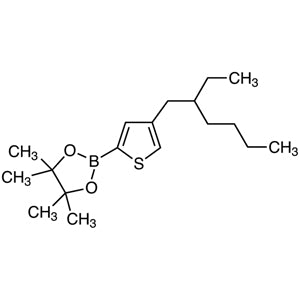
4-(2-Ethylhexyl)-2-(4,4,5,5-tetramethyl-1,3,2-dioxaborolan-2-yl)thiophene is a specialized organoboron compound widely used in chemical laboratories for its reactivity and structural versatility. This reagent plays a crucial role in synthetic chemistry, particularly in the development of complex organic molecules. Its unique molecular structure makes it an essential component in various coupling reactions, such as the Suzuki-Miyaura reaction, which is fundamental in the synthesis of pharmaceuticals and advanced materials. Due to its functional group diversity, it is a key tool for chemists aiming to create new compounds with tailored properties.
The compound's stability under controlled conditions, combined with its reactivity in specific environments, makes it a preferred choice for researchers. It is particularly sensitive to moisture and oxidation, which necessitates careful handling and storage. Its ability to participate in a wide range of chemical transformations, including cross-coupling and functional group modifications, enhances its utility in synthetic pathways. This reagent is also valued for its compatibility with inert atmospheres and low-temperature conditions, which are common in advanced organic synthesis protocols.
In Indonesian laboratories, this compound is frequently used in organic chemistry research, especially in institutions focused on the synthesis of complex molecules. Its availability and effectiveness in producing high-quality results make it a go-to reagent for scientists working on drug development, material science, and other specialized fields. Its role in enabling precise and efficient chemical reactions underscores its importance in modern laboratory practices.
Related TCI products
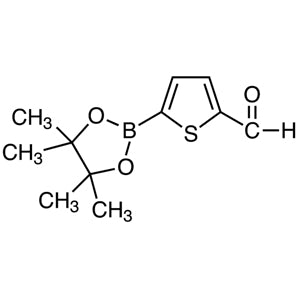
- TCI T3485 1040281-83-1 5-(4,4,5,5-Tetramethyl-1,3,2-dioxaborolan-2-yl)thiophene-2-carboxaldehyde
- TCI O0411 405165-12-0 4-n-Octyl-2-(4,4,5,5-tetramethyl-1,3,2-dioxaborolan-2-yl)thiophene
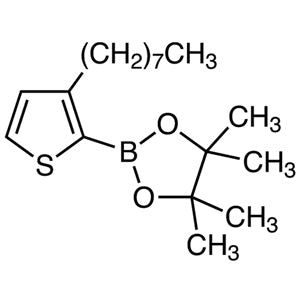
- TCI O0410 405165-14-2 3-n-Octyl-2-(4,4,5,5-tetramethyl-1,3,2-dioxaborolan-2-yl)thiophene
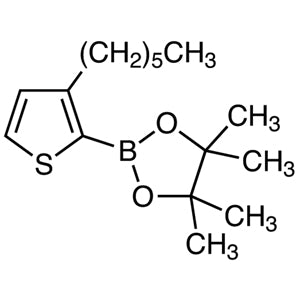
- TCI H1298 850881-09-3 3-Hexyl-2-(4,4,5,5-tetramethyl-1,3,2-dioxaborolan-2-yl)thiophene
- TCI H1294 883742-29-8 4-Hexyl-2-(4,4,5,5-tetramethyl-1,3,2-dioxaborolan-2-yl)thiophene
- TCI E1295 1390584-88-9 2-[5-(2-Ethylhexyl)-2-thienyl]-4,4,5,5-tetramethyl-1,3,2-dioxaborolane
- Organic synthesis in pharmaceutical research due to its role in coupling reactions that produce complex molecular structures.
- Development of advanced materials where precise functional group modifications are required for enhanced properties.
- Drug discovery projects that rely on the synthesis of bioactive compounds with specific molecular frameworks.
- Academic research in chemical engineering focusing on the design of novel synthetic methodologies.
- Industrial applications in chemical manufacturing where stable and reactive reagents are essential for process optimization.
| Brand | TCI |
|---|---|
| CAS number | 1224430-50-5 |
| Molecular formula | — |
| Purity | — |
| Category | Chemistry > Organometallic Reagents > Organoboron [Organometallic Reagents] |
| Pack sizes | Available in various quantities as per standard laboratory supply practices. |
| Physical form | Solid or liquid depending on the specific formulation and supplier packaging. |
| Storage | Requires dry, cool, and inert atmosphere storage to prevent degradation. |
This compound should be stored in a dry, cool environment away from moisture and oxidizing agents to maintain its chemical integrity. It is recommended to use sealed containers made of inert materials such as glass or polyethylene to prevent exposure to air and humidity. Laboratory personnel should handle the material with care, using appropriate personal protective equipment to avoid direct contact. Due to its sensitivity, it should be kept in a controlled atmosphere, such as under nitrogen, to minimize the risk of oxidation. Proper labeling and storage conditions are essential to ensure safety and effectiveness in research applications.
—
Produk Terkait
-
5-(4,4,5,5-Tetramethyl-1,3,2-dioxaborolan-2-yl)thiophene-2-carboxaldehyde TCI T3485
Regular price Rp 1.961.400,00Regular price -
4-n-Octyl-2-(4,4,5,5-tetramethyl-1,3,2-dioxaborolan-2-yl)thiophene TCI O0411
Regular price From Rp 2.199.750,00Regular price -
3-n-Octyl-2-(4,4,5,5-tetramethyl-1,3,2-dioxaborolan-2-yl)thiophene TCI O0410
Regular price From Rp 3.392.550,00Regular price -
3-Hexyl-2-(4,4,5,5-tetramethyl-1,3,2-dioxaborolan-2-yl)thiophene TCI H1298
Regular price From Rp 1.724.100,00Regular price -
4-Hexyl-2-(4,4,5,5-tetramethyl-1,3,2-dioxaborolan-2-yl)thiophene TCI H1294
Regular price From Rp 3.976.350,00Regular price -
2-[5-(2-Ethylhexyl)-2-thienyl]-4,4,5,5-tetramethyl-1,3,2-dioxaborolane TCI E1295
Regular price Rp 5.539.800,00Regular price -
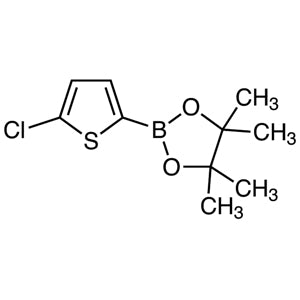
5-Chloro-2-(4,4,5,5-tetramethyl-1,3,2-dioxaborolan-2-yl)thiophene TCI C3301
Regular price From Rp 1.035.300,00Regular price -
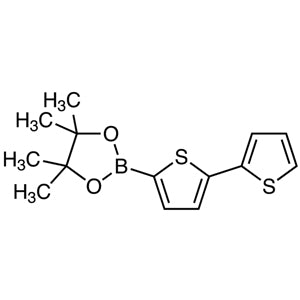
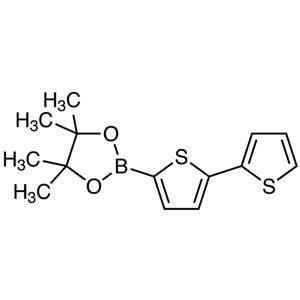
5-(4,4,5,5-Tetramethyl-1,3,2-dioxaborolan-2-yl)-2,2'-bithiophene TCI T2518
Regular price From Rp 1.644.300,00Regular price



![2-[5-(2-Ethylhexyl)-2-thienyl]-4,4,5,5-tetramethyl-1,3,2-dioxaborolane (CAS 1390584-88-9) - TCI E1295 - AMI Scientific](http://amiscientific.com/cdn/shop/files/TCI2510E1295.jpg?v=1768205282&width=533)