
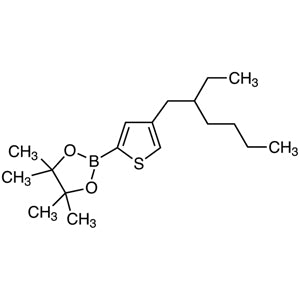
![2-[5-(2-Ethylhexyl)-2-thienyl]-4,4,5,5-tetramethyl-1,3,2-dioxaborolane (CAS 1390584-88-9) - TCI E1295 - AMI Scientific](http://amiscientific.com/cdn/shop/files/TCI2510E1295.jpg?v=1768205282&width=1946)
![2-[5-(2-Ethylhexyl)-2-thienyl]-4,4,5,5-tetramethyl-1,3,2-dioxaborolane (CAS 1390584-88-9) - TCI E1295 - AMI Scientific](http://amiscientific.com/cdn/shop/files/TCI2510E1295.jpg?v=1768205282&width=1445)
This chemical compound, TCI E1295 1390584-88-9, is an organoboron reagent with a complex molecular structure featuring a thienyl group and a tetramethylcycloborane moiety. It plays a crucial role in organic chemistry, particularly in the synthesis of heterocyclic compounds and coupling reactions. Its unique structure enables it to participate in a wide range of chemical transformations, making it a valuable tool in modern synthetic chemistry. In laboratory settings, it is widely used for its reactivity and specificity in various synthetic pathways.
The compound is known for its chemical stability under controlled conditions, although it is sensitive to oxidation and moisture. Its high reactivity and ability to form stable complexes with transition metals make it a preferred choice for advanced synthetic applications. The presence of the thienyl group enhances its versatility, allowing it to be used in multiple reaction types. These properties contribute to its popularity among chemists working on complex molecule synthesis.
In Indonesian laboratories, this reagent is commonly used by researchers and scientists in the field of organic synthesis. Its reliability and effectiveness in producing high-quality chemical compounds make it a key component in both academic and industrial research settings. The compound's application in various synthetic processes underscores its importance in the chemical research landscape of Indonesia.
TCI brochures (PDF)
- Suzuki-Miyaura Cross Coupling Reaction 2025-12-01 · p. 19
- Boron Compounds 2025-10-07 · p. 20
- Building Blocks for Organic Semiconductor 2026-03-24 · p. 26
Related TCI products
- TCI E1355 1224430-50-5 4-(2-Ethylhexyl)-2-(4,4,5,5-tetramethyl-1,3,2-dioxaborolan-2-yl)thiophene
- TCI E1325 448955-87-1 9-(2-Ethylhexyl)-3,6-bis(4,4,5,5-tetramethyl-1,3,2-dioxaborolan-2-yl)-9H-carbazole
- TCI E1324 476360-83-5 9-(2-Ethylhexyl)-2,7-bis(4,4,5,5-tetramethyl-1,3,2-dioxaborolan-2-yl)-9H-carbazole
- TCI E1323 856422-41-8 9-(2-Ethylhexyl)-3-(4,4,5,5-tetramethyl-1,3,2-dioxaborolan-2-yl)-9H-carbazole
- TCI B5993 1821433-54-8 N,N'-Bis(2-ethylhexyl)-6,6'-bis(4,4,5,5-tetramethyl-1,3,2-dioxaborolan-2-yl)isoindigo
- TCI T3875 1080632-76-3 2-([1,1':4',1''-Terphenyl]-4-yl)-4,4,5,5-tetramethyl-1,3,2-dioxaborolane
- Suzuki-Miyaura Coupling Reactions: This reagent is ideal for coupling reactions due to its ability to form stable boronic acid derivatives, enhancing the efficiency of cross-coupling processes.
- Heterocyclic Compound Synthesis: Its complex structure allows it to participate in the formation of various heterocyclic rings, making it essential for the synthesis of bioactive molecules.
- Organic Synthesis of Aromatic Compounds: The compound's reactivity supports the creation of aromatic structures, which are fundamental in pharmaceutical and material science research.
- Transition Metal Complex Formation: Its capacity to bind with transition metals expands its utility in catalytic systems and advanced synthetic methodologies.
- High-Specificity Reaction Pathways: The compound's unique properties enable it to be used in reactions requiring precise control and selectivity, enhancing the success rate of complex syntheses.
| Brand | TCI |
|---|---|
| CAS number | 1390584-88-9 |
| Molecular formula | — |
| Purity | — |
| Category | Chemistry > Organometallic Reagents > Organoboron [Organometallic Reagents] |
| Pack sizes | Available in various quantities as per standard laboratory supply |
| Physical form | Solid or liquid, depending on the specific formulation |
| Storage | Should be stored in a dry, cool, and well-ventilated area away from moisture and oxidizing agents |
This compound should be stored in a dry, cool, and well-ventilated environment to prevent moisture exposure and oxidation. It is recommended to use airtight containers made of glass or inert plastic to maintain its stability. Due to its sensitivity to moisture, it should be handled with care, and all operations should be conducted in a controlled atmosphere. Proper personal protective equipment, such as gloves and safety goggles, should be worn during handling. Regular monitoring of storage conditions is essential to ensure the compound remains effective for laboratory use.
—
Produk Terkait
-
4-(2-Ethylhexyl)-2-(4,4,5,5-tetramethyl-1,3,2-dioxaborolan-2-yl)thiophene TCI E1355
Regular price From Rp 3.367.350,00Regular price -
9-(2-Ethylhexyl)-3,6-bis(4,4,5,5-tetramethyl-1,3,2-dioxaborolan-2-yl)-9H-carbazole TCI E1325
Regular price From Rp 2.545.200,00Regular price -
9-(2-Ethylhexyl)-2,7-bis(4,4,5,5-tetramethyl-1,3,2-dioxaborolan-2-yl)-9H-carbazole TCI E1324
Regular price From Rp 3.100.650,00Regular price -
9-(2-Ethylhexyl)-3-(4,4,5,5-tetramethyl-1,3,2-dioxaborolan-2-yl)-9H-carbazole TCI E1323
Regular price From Rp 1.803.900,00Regular price -
N,N'-Bis(2-ethylhexyl)-6,6'-bis(4,4,5,5-tetramethyl-1,3,2-dioxaborolan-2-yl)isoindigo TCI B5993
Regular price Rp 5.830.650,00Regular price -
2-([1,1':4',1''-Terphenyl]-4-yl)-4,4,5,5-tetramethyl-1,3,2-dioxaborolane TCI T3875
Regular price Rp 3.340.050,00Regular price -
4,4,5,5-Tetramethyl-2-[10-(2-naphthyl)anthracen-9-yl]-1,3,2-dioxaborolane TCI T3674
Regular price From Rp 2.625.000,00Regular price -
4,4,5,5-Tetramethyl-2-(10-phenylanthracen-9-yl)-1,3,2-dioxaborolane TCI T3665
Regular price From Rp 3.976.350,00Regular price


![1080632-76-3 2-([1,1':4',1''-Terphenyl]-4-yl)-4,4,5,5-tetramethyl-1,3,2-dioxaborolane - AMI Scientific](http://amiscientific.com/cdn/shop/files/TCI2510T3875.jpg?v=1769143785&width=533)
![922518-84-1 4,4,5,5-Tetramethyl-2-[10-(2-naphthyl)anthracen-9-yl]-1,3,2-dioxaborolane - AMI Scientific](http://amiscientific.com/cdn/shop/files/TCI2510T3674.jpg?v=1769143759&width=533)
