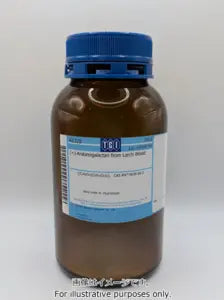
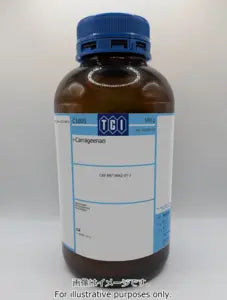
TCI D4657 Dextrin is a mixture of polysaccharides obtained through the partial hydrolysis of starch, consisting of chains of glucose units that are shorter than those of the parent starch. Within the field of glycoscience, dextrin holds an important position as a versatile carbohydrate material: it serves as an enzyme substrate, as a carbon source in microbial growth media, as a binding agent in formulation work, and as a comparative or reference substance in carbohydrate analysis. Its role in the laboratory is broad because of its practicality in use and its compatibility with many routine analytical methods.
The properties that make dextrin such a widely chosen material begin with its solubility in water, which is considerably better than that of intact starch, allowing solutions to be prepared without the difficulties associated with less soluble starch preparations. It forms solutions or pastes whose viscosity can be adjusted simply by changing the concentration, giving the analyst direct control over working consistency. As a powder, it is easy to weigh accurately and straightforward to handle. Being a glucose polymer joined by glycosidic linkages, dextrin is a natural substrate for amylase and glucoamylase, which makes it especially useful in enzyme activity assays. Its relatively inert, non-toxic character and its ready digestibility by microorganisms also allow it to be used as a carrier, filler, or stabilising agent in a variety of preparations.
In Indonesian laboratories, dextrin is typically encountered in academic, research, and industrial quality-control settings where carbohydrate work is routine. Microbiology laboratories use it in the preparation of growth media, biochemistry and enzymology groups use it when characterising amylolytic enzymes, and food and agricultural laboratories use it in carbohydrate-related testing. Because it is a stable powder that is convenient to store and dispense, it fits well into teaching laboratories and routine testing workflows alike, where consistent handling and simple preparation are valued.
TCI brochures (PDF)
- Polysaccharides 2025-02-13 · p. 1
- Drug Delivery System (DDS) Research Reagents 2025-01-29 · p. 1
- Reagents for Glyco Chemistry & Biology 5th Edition · p. 116
- Biomaterials Research Reagents 2025-02-19 · p. 4
- Reagents for Biological Research 2025-03-11 · p. 54
- Enzyme activity assays — dextrin acts as a natural substrate for amylase and glucoamylase, so hydrolysis of its glycosidic linkages provides a direct and measurable readout of enzyme performance.
- Microbial culture media preparation — as a readily digestible carbohydrate, dextrin supplies a usable carbon source that supports the growth of microorganisms in laboratory-prepared growth media.
- Carbohydrate analysis reference material — dextrin serves as a comparative substance in carbohydrate testing, giving analysts a consistent polysaccharide reference against which sample behaviour can be assessed.
- Binder in formulation work — its ability to form pastes and solutions of adjustable viscosity makes dextrin an effective binding agent when preparing formulated laboratory or pilot-scale preparations.
- Carrier, filler, and stabiliser applications — because it is relatively inert and non-toxic, dextrin can be incorporated as a bulking or stabilising component without interfering with the active constituents present.
| Brand | TCI |
|---|---|
| CAS number | 9004-53-9 |
| Molecular formula | — |
| Purity | — |
| Category | Chemistry > Chemical Biology > Glycoscience |
| Pack sizes | available in standard TCI catalogue pack sizes; please confirm the required size when ordering |
| Physical form | powder |
| Storage | store in a tightly closed container in a cool, dry place |
- Product code: D4657
Dextrin should be stored in a cool, dry location in its original tightly closed container, protected from moisture, since the powder can take up water from humid air and become difficult to weigh or dispense accurately. Glass or chemically compatible plastic containers with well-sealing closures are suitable for transfer and short-term working quantities. Use a clean, dry spatula for each withdrawal to avoid introducing moisture or contamination into the bulk material, and reseal the container promptly after use. Although dextrin is relatively inert and non-toxic, standard laboratory practice still applies: wear a lab coat, safety glasses, and gloves, avoid generating or inhaling airborne dust when weighing, work in a well-ventilated area, and clean any spilled powder immediately to prevent slippery surfaces and cross-contamination between preparations.
—
Product Categories
- GlycoscienceApplications Using Glyco-materialsGlyco-engeneering [Applications Using Glyco-materials]
- GlycoscienceApplications Using Glyco-materialsGlyco-chemical Analysis [Applications Using Glyco-materials]
- GlycoscienceFunctional OligosaccharidesPolysaccharides [Functional Oligosaccharides]
- GlycosciencePolysaccharides [Glycoscience]
- Biochemicals and ReagentsCarbohydrates
- Pharmaceutical Development and Drug Discovery ResearchDrug Delivery Systems (DDS)Natural Polymers (for DDS)
Produk Terkait
-
XylanfromCornCore TCI X0078
Regular price From Rp 1.458.450,00Regular priceRp 1.035.300,00Sale price From Rp 1.458.450,00 -
(+)-ArabinogalactanfromLarchWood TCI A1328
Regular price From Rp 1.246.350,00Regular priceRp 887.250,00Sale price From Rp 1.246.350,00 -
PectinfromCitrus TCI P0024
Regular price From Rp 637.350,00Regular priceRp 460.950,00Sale price From Rp 637.350,00 -
GuarGum TCI G0478
Regular price From Rp 662.550,00Regular priceRp 478.800,00Sale price From Rp 662.550,00 -
Dextran70(Mw.=ca.70000) TCI D1449
Regular price From Rp 1.749.300,00Regular priceRp 1.239.000,00Sale price From Rp 1.749.300,00 -
Dextran40(Mw.=ca.40000) TCI D1448
Regular price From Rp 1.749.300,00Regular priceRp 1.239.000,00Sale price From Rp 1.749.300,00 -
lambda-Carrageenan(High-viscosity) TCI C3313
Regular price From Rp 1.033.200,00Regular priceRp 738.150,00Sale price From Rp 1.033.200,00 -
iota-Carrageenan TCI C1805
Regular price From Rp 848.400,00Regular priceRp 609.000,00Sale price From Rp 848.400,00