

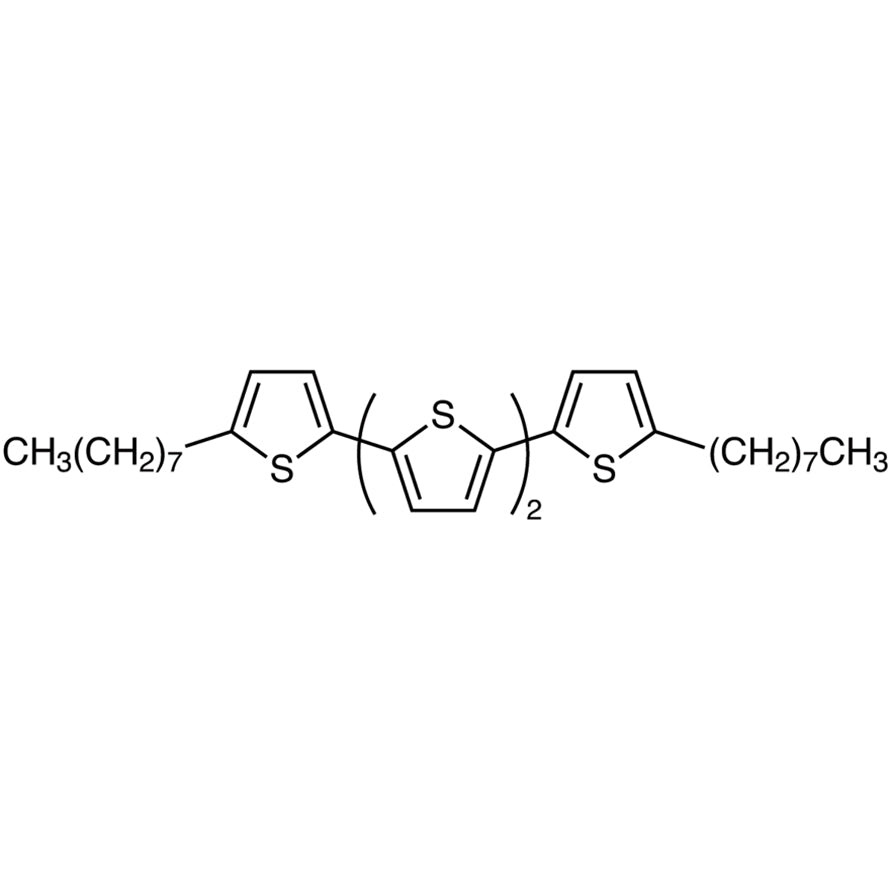
TCI D4877, with the CAS number 882659-01-0, is a specialized organic chemical compound known as 5,5''-Di-n-octyl-2,2':5',2'':5'',2'''-quaterthiophene. This material is widely used in electronic materials research, particularly in the development of organic field-effect transistors (OFETs). As a quaterthiophene derivative, it plays a crucial role in the synthesis of high-performance organic semiconductors. Its molecular structure is designed to enhance charge transport properties, making it a key component in the fabrication of flexible and lightweight electronic devices.
The compound is favored for its unique molecular architecture, which includes covalently linked thiophene rings. This structure enables strong intermolecular interactions, contributing to improved electrical conductivity and stability. Additionally, its solubility in various organic solvents simplifies processing and application in laboratory settings. These properties make it an ideal choice for researchers working on advanced electronic materials.
In Indonesian laboratories, this compound is commonly used in materials science and electrochemical research. It supports the development of next-generation electronic devices, including flexible displays and sensors. Its relevance extends to academic and industrial research, where it is employed to explore new applications in organic electronics. Institutions and research centers in Indonesia rely on this material for innovative technological advancements.
TCI brochures (PDF)
- Organic Transistor (OFET) Materials 2026-05-07 · p. 10
- Thiophenes 2026-06-29 · p. 15
Related TCI products
- TCI D4889 153561-79-6 5,5'''-Didodecyl-2,2':5',2'':5'',2'''-quaterthiophene
- TCI D4888 514188-77-3 5,5'''-Didecyl-2,2':5',2'':5'',2'''-quaterthiophene
- TCI O0576 1781261-95-7 2-Octyl-7-phenyl-benzo[d][1]benzothieno[3,2-b]thiophene [for organic electronics]
- TCI Q0078 5632-29-1 alpha-Quaterthiophene
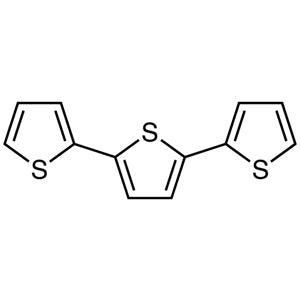
- TCI T1196 1081-34-1 2,2':5',2''-Terthiophene (purified by sublimation)
- TCI H1450 70351-87-0 2,3,6,7,10,11-Hexakis[(n-octyl)oxy]triphenylene
- Organic Field-Effect Transistor (OFET) Development: This compound is ideal for fabricating OFETs due to its high charge carrier mobility and stability, enabling efficient electronic performance in flexible devices.
- Organic Semiconductor Research: Its unique molecular structure makes it a preferred material for studying charge transport mechanisms in organic semiconductors, supporting fundamental research in electronic materials.
- Flexible Electronics Innovation: The compound's compatibility with flexible substrates allows researchers to develop lightweight and bendable electronic systems, suitable for wearable technology and sensors.
- Electrochemical Device Fabrication: Its solubility and conductivity properties make it suitable for creating electrochemical sensors and energy storage components with enhanced performance.
- Material Characterization Studies: It is widely used in analytical techniques such as UV-Vis spectroscopy and electrochemical impedance spectroscopy to evaluate its electronic and optical properties.
| Brand | TCI |
|---|---|
| CAS number | 882659-01-0 |
| Molecular formula | — |
| Purity | — |
| Category | Materials Science > Electronic Materials > Organic Transistor (OFET) Materials |
| Pack sizes | Available in various quantities as per standard laboratory supply options |
| Physical form | Solid, typically in crystalline or amorphous form depending on synthesis conditions |
| Storage | Store in a cool, dry place away from light and moisture |
This compound should be stored in a cool, dry environment, away from direct sunlight and moisture to maintain its chemical integrity. It is recommended to use airtight containers made of glass or high-density polyethylene to prevent contamination and degradation. Due to its organic nature, it is important to handle it with appropriate personal protective equipment, including gloves and safety goggles, to avoid skin contact and inhalation. In laboratory settings, it should be kept in a well-ventilated area to minimize exposure. Proper labeling of storage containers is essential for safety and traceability. Always follow standard laboratory safety protocols when handling and storing chemical substances.
—
Produk Terkait
-
5,5'''-Didodecyl-2,2':5',2'':5'',2'''-quaterthiophene TCI D4889
Regular price Rp 4.823.700,00Regular price -
5,5'''-Didecyl-2,2':5',2'':5'',2'''-quaterthiophene TCI D4888
Regular price Rp 5.034.750,00Regular price -
2-Octyl-7-phenyl-benzo[d][1]benzothieno[3,2-b]thiophene[fororganicelectronics] TCI O0576
Regular price From Rp 5.274.150,00Regular price -
alpha-Quaterthiophene TCI Q0078
Regular price Rp 2.121.000,00Regular price -
2,2':5',2''-Terthiophene(purifiedbysublimation) TCI T1196
Regular price From Rp 2.199.750,00Regular price -
2,3,6,7,10,11-Hexakis[(n-octyl)oxy]triphenylene TCI H1450
Regular price From Rp 3.922.800,00Regular price -
2-Hexyl-7-phenyl[1]benzothieno[3,2-b][1]benzothiophene[fororganicelectronics] TCI H1769
Regular price From Rp 7.632.450,00Regular price -
2-Dodecyl-7-phenyl[1]benzothieno[3,2-b][1]benzothiophene[fororganicelectronics] TCI D5910
Regular price From Rp 4.743.900,00Regular price


![1781261-95-7 2-Octyl-7-phenyl-benzo[d][1]benzothieno[3,2-b]thiophene [for organic electronics] - AMI Scientific](http://amiscientific.com/cdn/shop/files/TCI2510O0576.jpg?v=1769181135&width=533)

![70351-87-0 2,3,6,7,10,11-Hexakis[(n-octyl)oxy]triphenylene - AMI Scientific](http://amiscientific.com/cdn/shop/files/TCI2510H1450.jpg?v=1769056410&width=533)
![1781261-93-5 2-Hexyl-7-phenyl[1]benzothieno[3,2-b][1]benzothiophene [for organic electronics] - AMI Scientific](http://amiscientific.com/cdn/shop/files/TCI2510H1769.jpg?v=1771058969&width=533)
![2-Dodecyl-7-phenyl[1]benzothieno[3,2-b][1]benzothiophene [for organic electronics] (CAS 1627606-00-1) - TCI D5910 - AMI Scientific](http://amiscientific.com/cdn/shop/files/TCI2510D5910.jpg?v=1768818530&width=533)