

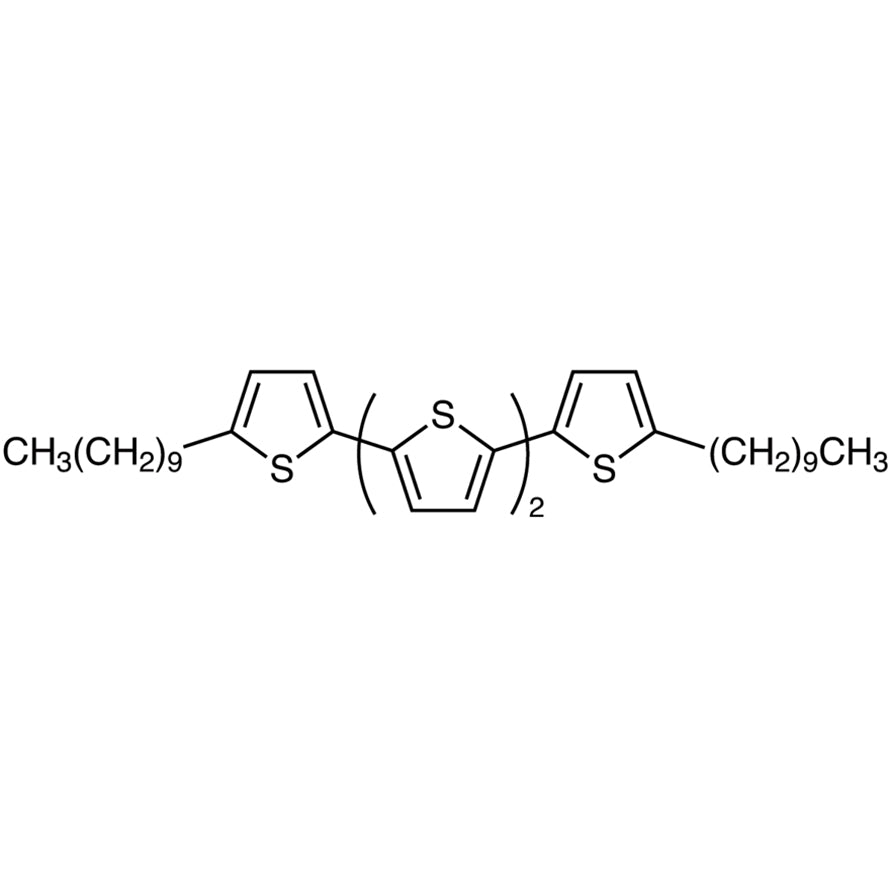
TCI D4888 514188-77-3 5,5'''-Didecyl-2,2':5',2'':5'',2'''-quaterthiophene is a specialized organic compound used in advanced materials research, particularly in the development of organic field-effect transistors (OFETs). This compound is essential for creating high-performance electronic devices due to its unique molecular structure and electronic properties. In laboratory settings, it serves as a key component in the fabrication of organic semiconductor layers, enabling the production of flexible and lightweight electronic systems. Its application spans various fields, including sensor development, display technology, and optoelectronic components, making it a versatile material for modern electronic research.
The compound’s molecular structure, composed of four thiophene units connected via covalent bonds, provides excellent charge transport properties. The presence of long hydrocarbon chains enhances its solubility and molecular alignment, which are critical for achieving high charge mobility in organic semiconductors. These properties make it a preferred choice for researchers aiming to optimize the performance of organic electronic devices. Its thermal and chemical stability further ensures consistent results under varying experimental conditions, making it reliable for repeated use in laboratory experiments.
In Indonesian laboratories, this compound is widely used in material science and information technology research. Scientists and researchers in academic institutions and research centers rely on it to develop next-generation electronic materials. Its role in advancing organic electronics is vital, supporting innovations in flexible electronics, energy-efficient devices, and advanced sensor technologies. The compound’s reliability and performance make it an essential tool for cutting-edge research in the field.
- Organic Field-Effect Transistor (OFET) Development: This compound is ideal for creating active layers in OFETs due to its high charge mobility and molecular alignment properties, which enhance device performance.
- Flexible Electronic Device Fabrication: Its solubility and structural characteristics make it suitable for producing flexible and lightweight electronic components, such as sensors and displays.
- Sensor Technology Research: The compound’s electronic properties enable the development of sensitive and efficient sensors for detecting various environmental and chemical parameters.
- Optoelectronic Component Manufacturing: Its ability to form stable and conductive layers supports the production of optoelectronic devices, including light-emitting diodes and photodetectors.
- Material Science Innovation: Researchers use it to explore new organic semiconductor materials, contributing to advancements in electronic and information technology.
| Brand | TCI |
|---|---|
| CAS number | 514188-77-3 |
| Molecular formula | — |
| Purity | — |
| Category | Materials Science > Electronic Materials > Organic Transistor (OFET) Materials |
| Pack sizes | As per supplier specifications |
| Physical form | Solid (as per standard product description) |
| Storage | Store in a cool, dry place away from light and moisture |
This compound should be stored in a cool, dry environment, away from direct light and moisture to maintain its chemical stability. It is recommended to use airtight containers made of materials such as glass or high-density polyethylene to prevent contamination and degradation. Due to its organic nature, it is important to handle it with care, using appropriate personal protective equipment such as gloves and safety goggles. In laboratory settings, it should be kept in a well-ventilated area to minimize exposure. Proper storage ensures the material remains effective for research applications and maintains its integrity over time. Always follow standard laboratory safety protocols when handling and storing organic compounds.
—
Produk Terkait
-
5-Bromobenzoxazole TCI B5515
Regular price From Rp 1.696.800,00Regular price -
BMS-599626 TCI B5520
Regular price From Rp 3.525.900,00Regular price -
6-Bromobenzo[b]thiophene TCI B5523
Regular price Rp 3.392.550,00Regular price -
3-tert-Butyl4-Methyl(4R,5S)-2,2,5-Trimethyloxazolidine-3,4-dicarboxylate TCI B5538
Regular price Rp 2.969.400,00Regular price -
Biotin-PEG4-Azide TCI B5546
Regular price Rp 7.897.050,00Regular price -
Benzo[b]benzo[4,5]thieno[2,3-d]thiophene TCI B5551
Regular price From Rp 903.000,00Regular price -
2-Bromo-5-(4-hexylphenyl)thiophene TCI B5553
Regular price Rp 3.207.750,00Regular price -
Biotin-PEG4-Amine TCI B5560
Regular price From Rp 1.510.950,00Regular price


![6-Bromobenzo[b]thiophene (CAS 17347-32-9) - TCI B5523 - AMI Scientific](http://amiscientific.com/cdn/shop/files/TCI2510B5523.jpg?v=1767092466&width=533)


![Benzo[b]benzo[4,5]thieno[2,3-d]thiophene (CAS 248-70-4) - TCI B5551 - AMI Scientific](http://amiscientific.com/cdn/shop/files/TCI2510B5551.jpg?v=1768815817&width=533)

