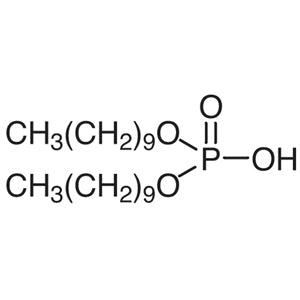
Didecyl Phosphate from TCI (product code P1011) is a phosphoric acid ester with two long decyl alkyl chains and one acidic P–OH group. The molecule has a polar phosphate head and two strongly hydrophobic hydrocarbon tails, which makes it amphiphilic. In the laboratory it is used as a non-heterocyclic building block. It is also used as a surfactant, as an extraction agent for metal ions, and as a material for building molecular layers on surfaces. This range of uses makes it relevant to researchers who work across organic chemistry, analytical chemistry, and materials science.
Researchers choose this compound because it combines an acidic phosphate group with long alkyl chains. The P–OH group can release its proton and bind metal cations. The decyl chains then make the resulting complex soluble in nonpolar organic solvents. Other dialkyl phosphates work the same way and are widely used in solvent extraction to separate metals, including rare earth elements and battery metals. Because the molecule is amphiphilic, it can also form micelles, vesicles, or ordered layers on metal oxide surfaces. These layers can change surface properties and help keep nanoparticles stable in organic solvents.
In Indonesia, Didecyl Phosphate suits university chemistry and materials science departments, research institutes, and industrial R&D laboratories. Typical work includes metal separation and recovery, studies of interfaces and amphiphilic systems, and surface modification for new materials. It is relevant to research on extracting critical metals and preparing materials for energy storage. For these groups, a reagent from an established brand like TCI provides a dependable starting point for synthesis, extraction trials, and surface chemistry experiments.
Related TCI products
- Solvent extraction of metal ions: the acidic P–OH group binds metal cations, and the two decyl chains carry the complex into nonpolar organic solvents for separation work.
- Rare earth and battery metal separation studies: it follows the same principle as other dialkyl phosphates used to separate rare earth elements and battery metals in solvent extraction.
- Surfactant and self-assembly research: its polar phosphate head and two hydrophobic tails let it form micelles, vesicles, and other organized structures for studies of amphiphilic behavior.
- Surface modification of metal oxides: it can form ordered molecular layers on metal oxide surfaces, so researchers can change how those surfaces interact with their surroundings.
- Nanoparticle stabilization and organic synthesis: it helps disperse nanoparticles in organic solvents and serves as a non-heterocyclic building block for preparing other phosphorus-containing compounds.
| Brand | TCI (product code P1011) |
|---|---|
| CAS number | 7795-87-1 |
| Molecular formula | — |
| Purity | — |
| Category | Chemistry > Building Blocks > Non-Heterocyclic Building Blocks |
| Pack sizes | see the pack sizes listed on the product page |
| Physical form | check the label and the manufacturer's documentation |
| Storage | follow the conditions on the manufacturer's label and Safety Data Sheet |
Keep Didecyl Phosphate in its original, tightly closed container in a cool, dry, well-ventilated place, away from direct sunlight and heat. Store it apart from strong bases, strong oxidizing agents, and reactive metals, because the acidic P–OH group can react with them. Always follow the storage conditions on the TCI label and Safety Data Sheet. When handling it, wear standard laboratory protective equipment: chemical-resistant gloves, safety glasses, and a lab coat. Work in a fume hood or a well-ventilated area, and avoid contact with skin, eyes, and clothing. Close the container promptly after each use, label any portions you transfer, and dispose of waste according to local regulations and your institution's procedures.
—
Produk Terkait
-
TripropylPhosphate TCI T4247
Regular price From Rp 1.644.300,00Regular price -
Bis(4-nitrophenyl)Phosphate[forPhosphodiesteraseSubstrate] TCI B1098
Regular price From Rp 5.327.700,00Regular price -
PhenylPhosphate TCI B0026
Regular price From Rp 4.240.950,00Regular price -
Tris(4-nitrophenyl)Phosphate TCI T1002
Regular price Rp 3.763.200,00Regular price -
PotassiumDi-tert-butylPhosphate TCI P2797
Regular price Rp 1.724.100,00Regular price -
DibenzylPhosphate TCI P1120
Regular price From Rp 1.749.300,00Regular price -
DidodecylHydrogenPhosphate TCI P1068
Regular price From Rp 2.386.650,00Regular price -
Tris(2-ethylhexyl)Phosphate TCI P1022
Regular price From Rp 477.750,00Regular price

![645-15-8 Bis(4-nitrophenyl) Phosphate [for Phosphodiesterase Substrate] - AMI Scientific](http://amiscientific.com/cdn/shop/files/TCI2510B1098.jpg?v=1768193282&width=533)