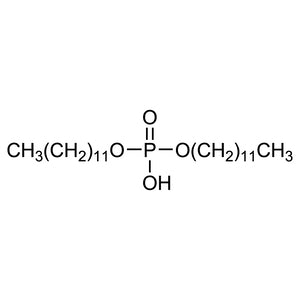
Didodecyl Hydrogen Phosphate from TCI, also known as dilauryl phosphate, is a dialkyl ester of phosphoric acid. It carries two dodecyl (C12) chains and one acidic P–OH group. In the laboratory it acts as an amphiphilic molecule: the phosphate head group is polar, while the two long alkyl chains are strongly hydrophobic. This structure makes it useful as an anionic surfactant, as a building block for vesicles and thin films, and as an extraction agent for metal ions. It is also used as a membrane component in electrochemical sensors.
Researchers choose this material because the acidic phosphate group and the two long chains together let it bind metal ions and still dissolve in organic solvents. The phosphate group can give up its proton and form complexes with cations, so the compound moves metal ions efficiently from an aqueous phase into an organic phase. With its two alkyl chains, the molecule has a shape similar to a phospholipid, which allows it to form artificial bilayers and vesicles. For this reason it is often used as a simple model for studying biological membranes.
In Indonesia, this compound is relevant to laboratories working in analytical chemistry, hydrometallurgy and colloid chemistry. University research groups can use it to study liquid–liquid extraction of metal ions and to prepare model membrane systems. Analytical and sensor laboratories may include it in ion-selective or electrochemical sensor membranes. Its listing under non-heterocyclic building blocks also makes it a convenient amphiphilic phosphate ester for synthesis and materials research projects.
Related TCI products
- TCI P0811 298-07-7 Bis(2-ethylhexyl) Hydrogen Phosphate [for Rare Metals Extraction]
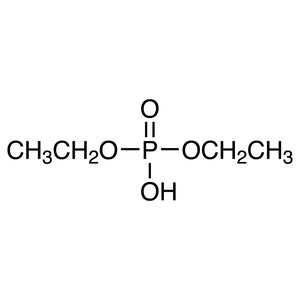
- TCI D6132 598-02-7 Diethyl Hydrogen Phosphate
- TCI D6108 813-78-5 Dimethyl Hydrogen Phosphate
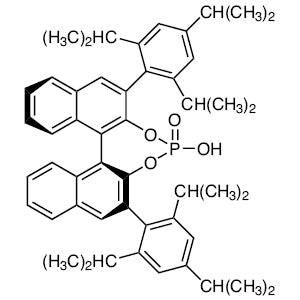
- TCI B6259 874948-63-7 (S)-3,3'-Bis(2,4,6-triisopropylphenyl)-1,1'-binaphthyl-2,2'-diyl Hydrogen Phosphate
- TCI T4247 513-08-6 Tripropyl Phosphate
- TCI B1098 645-15-8 Bis(4-nitrophenyl) Phosphate [for Phosphodiesterase Substrate]
- Metal ion solvent extraction: the acidic phosphate group releases a proton and complexes cations, which transfers metal ions from the aqueous phase into an organic phase efficiently.
- Hydrometallurgy research: because it binds metal ions and is soluble in organic solvents, it suits laboratory studies of metal separation and recovery from aqueous solutions.
- Anionic surfactant studies: its polar phosphate head and two hydrophobic dodecyl chains give it typical amphiphilic behaviour, so it works well for interfacial and colloid chemistry experiments.
- Artificial vesicle and bilayer preparation: the phospholipid-like shape with two long alkyl chains lets it self-assemble into bilayers, vesicles and thin films as simple membrane models.
- Electrochemical sensor membranes: it serves as a membrane component in electrochemical sensors, where its ion-interacting phosphate group and hydrophobic chains help with selective ion response.
| Brand | TCI (product code P1068) |
|---|---|
| CAS number | 7057-92-3 |
| Molecular formula | — |
| Purity | — |
| Category | Chemistry > Building Blocks > Non-Heterocyclic Building Blocks |
| Pack sizes | available in TCI standard pack sizes; please confirm current options with AMI Scientific |
| Physical form | — |
| Storage | follow the TCI label and Safety Data Sheet; keep the container tightly closed in a cool, dry place |
- Synonym: Dilauryl phosphate
Store Didodecyl Hydrogen Phosphate in its original, tightly closed TCI container in a cool, dry, well-ventilated area away from direct sunlight and sources of heat. Keep it away from strong bases and oxidizing agents, because the compound contains an acidic phosphate group. Before use, check the TCI label and Safety Data Sheet for the recommended storage conditions. When handling the material, wear standard laboratory protective equipment such as safety glasses, gloves and a lab coat, and avoid contact with skin and eyes. Avoid breathing in any dust or vapour. Handle it in a well-ventilated area or a fume hood, especially when preparing solutions in organic solvents. Reseal the container promptly after use, and dispose of residues according to local laboratory waste regulations.
—
Produk Terkait
-
Bis(2-ethylhexyl)HydrogenPhosphate[forRareMetalsExtraction] TCI P0811
Regular price From Rp 769.650,00Regular price -
DiethylHydrogenPhosphate TCI D6132
Regular price Rp 2.121.000,00Regular price -
DimethylHydrogenPhosphate TCI D6108
Regular price Rp 4.957.050,00Regular price -
(S)-3,3'-Bis(2,4,6-triisopropylphenyl)-1,1'-binaphthyl-2,2'-diylHydrogenPhosphate TCI B6259
Regular price Rp 7.234.500,00Regular price -
TripropylPhosphate TCI T4247
Regular price From Rp 1.644.300,00Regular price -
Bis(4-nitrophenyl)Phosphate[forPhosphodiesteraseSubstrate] TCI B1098
Regular price From Rp 5.327.700,00Regular price -
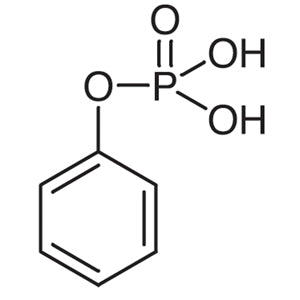
PhenylPhosphate TCI B0026
Regular price From Rp 4.240.950,00Regular price -
Tris(4-nitrophenyl)Phosphate TCI T1002
Regular price Rp 3.763.200,00Regular price
![298-07-7 Bis(2-ethylhexyl) Hydrogen Phosphate [for Rare Metals Extraction] - AMI Scientific](http://amiscientific.com/cdn/shop/files/TCI2510P0811.jpg?v=1767133767&width=533)


![645-15-8 Bis(4-nitrophenyl) Phosphate [for Phosphodiesterase Substrate] - AMI Scientific](http://amiscientific.com/cdn/shop/files/TCI2510B1098.jpg?v=1768193282&width=533)