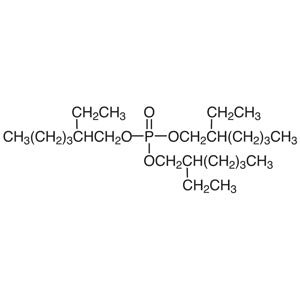
Tris(2-ethylhexyl) Phosphate from TCI (product code P1022), often abbreviated as TEHP, is a phosphoric acid triester with three branched 2-ethylhexyl chains. It is a highly lipophilic liquid with low volatility. In industry, TEHP is known as a plasticizer, a flame retardant and a process solvent. In the laboratory, TEHP is used as a building block and working material for research in solvent extraction, polymer formulation and organophosphorus chemistry, which makes it a practical reagent for both synthetic and applied research groups.
TEHP is widely chosen because its branched alkyl chains keep the compound liquid across a wide temperature range. The same chains also make it hard to evaporate and only very slightly soluble in water. Its P=O group acts as a Lewis base and can coordinate metal ions and polar molecules. This makes TEHP useful as an extractant or diluent in liquid-liquid extraction systems. It is also known as a component of the working solvent in the anthraquinone process for hydrogen peroxide production, and as a plasticizer that keeps materials flexible at low temperatures.
For laboratories in Indonesia, TEHP is relevant to hydrometallurgy and metal separation research. This field is becoming more important as domestic mineral processing and battery recycling continue to grow. University research groups, industrial R&D teams and process development laboratories can use TEHP to study extraction behaviour, evaluate polymer additives and explore organophosphorus chemistry. Its low volatility and liquid form also make it easy to handle in routine bench-scale experiments where predictable physical behaviour matters.
- Liquid-liquid extraction research: the Lewis-basic P=O group coordinates metal ions, so TEHP works as an extractant or diluent when studying the separation of metals between organic and aqueous phases.
- Hydrometallurgy and battery recycling studies: TEHP suits bench-scale research on metal recovery and separation, which is increasingly relevant to Indonesia's growing mineral processing and battery recycling sectors.
- Polymer formulation and plasticizer evaluation: TEHP is a known plasticizer that gives flexibility at low temperatures, so it is useful for testing additive performance in polymer and material research.
- Organophosphorus chemistry: as a phosphoric acid triester with branched alkyl chains, TEHP is a convenient building block and model compound for research into phosphate ester chemistry and reactivity.
- Process solvent research: TEHP is known as a working solvent component in the anthraquinone process for hydrogen peroxide, which makes it relevant for laboratory studies of solvent systems and process chemistry.
| Brand | TCI (product code P1022) |
|---|---|
| CAS number | 78-42-2 |
| Molecular formula | — |
| Purity | — |
| Category | Chemistry > Building Blocks > Non-Heterocyclic Building Blocks |
| Pack sizes | please check the available options on the product page or ask our sales team |
| Physical form | liquid, highly lipophilic, low volatility, very slightly soluble in water |
| Storage | keep in a tightly closed original container in a cool, dry, well-ventilated place |
Keep Tris(2-ethylhexyl) Phosphate in its original, tightly closed container, or in a compatible chemical-resistant container that is clearly labelled. Store it in a cool, dry and well-ventilated area, away from direct sunlight, heat sources and incompatible materials such as strong oxidizing agents. Handle it in a well-ventilated area or a fume hood, and wear suitable personal protective equipment, including chemical-resistant gloves, safety glasses and a lab coat. Avoid contact with skin and eyes, and do not inhale vapours or mists. Clean up spills with an inert absorbent material. Dispose of waste according to local regulations and institutional procedures. Always read the Safety Data Sheet (SDS) supplied by the manufacturer before use.
—
Produk Terkait
-
TCI B5774 5,10-Bis(4,4,5,5-tetramethyl-1,3,2-dioxaborolan-2-yl)naphtho[1,2-c:5,6-c']bis([1,2,5]oxadiazole)
Regular price Rp 10.255.350,00Regular price -
Dihydroiodide TCI B6569
Regular price From Rp 1.936.200,00Regular price -
Trifluoromethanesulfonate TCI B7003
Regular price From Rp 1.936.200,00Regular price
![5,10-Bis(4,4,5,5-tetramethyl-1,3,2-dioxaborolan-2-yl)naphtho[1,2-c:5,6-c']bis([1,2,5]oxadiazole) - TCI B5774 - AMI Scientific](http://amiscientific.com/cdn/shop/files/TCI2510B5774.jpg?v=1769180228&width=533)