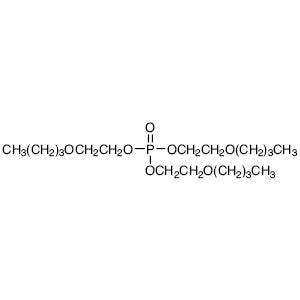
Tris(2-butoxyethyl) Phosphate from TCI, product code P0683, is an organophosphate ester. Its structure has three 2-butoxyethyl groups bonded to a central phosphate core. The compound is better known by its abbreviation, TBEP. In the laboratory, TBEP serves as a reference material for research on plasticizers, flame retardants, and coating additives. Environmental analysis laboratories also use it as a reference compound when detecting organophosphate esters in dust, water, and sediment samples. This makes TBEP useful both for material formulation research and for developing chemical analysis methods.
Researchers choose TBEP for its distinctive physical properties. At room temperature it is usually a viscous liquid that dissolves readily in many organic solvents. The ether groups on its butoxyethyl chains give it moderate polarity, so it blends well with a wide range of polymers and resins. The phosphate group lets it act as a flame-retardant additive and as a levelling agent in floor coatings. TBEP also has antifoaming properties, which is why it often appears in studies of emulsion formulations. Together, these properties make TBEP interesting for materials chemistry. They also make it an important contaminant for environmental chemists to monitor.
In Indonesian laboratories, TBEP is most often used in two settings. University and industrial research groups working on polymers, coatings, and flame-retardant materials use it as a reference additive when they study how formulations behave. Environmental testing laboratories, including those that monitor indoor dust, surface water, and river or coastal sediments, use it as a reference standard when building and validating methods for organophosphate esters. Researchers studying emerging contaminants in academic and government institutions also rely on it to compare results across sample sets.
- Plasticizer research: TBEP mixes well with many polymers and resins, so researchers can use it as a reference plasticizer when they study flexibility, compatibility, and how formulations behave.
- Flame-retardant studies: Its phosphate core gives TBEP flame-retardant activity, which makes it a relevant comparison compound when researchers evaluate organophosphate additives in polymer and coating materials.
- Coating and floor-finish formulation: Because TBEP works as a levelling agent in floor coatings, researchers use it to study surface smoothness, film formation, and additive performance in coating systems.
- Emulsion and antifoam studies: TBEP's antifoaming ability makes it a useful model additive when researchers examine foam control and stability in emulsion-based formulations.
- Environmental analysis method development: Laboratories use TBEP as a reference compound when they develop and validate methods that detect organophosphate esters in dust, water, and sediment samples.
| Brand | TCI (product code P0683) |
|---|---|
| CAS number | 78-51-3 |
| Molecular formula | — |
| Purity | — |
| Category | Chemistry > Building Blocks > Non-Heterocyclic Building Blocks |
| Pack sizes | please check the available pack options on the product page |
| Physical form | usually a viscous liquid at room temperature |
| Storage | keep tightly closed in a cool, dry, well-ventilated place; follow the TCI label and Safety Data Sheet |
Store Tris(2-butoxyethyl) Phosphate in its original, tightly sealed container, or in a compatible, clearly labelled glass container, in a cool, dry, and well-ventilated area. Keep it away from direct sunlight, heat sources, and strong oxidizing agents. When handling it, wear standard laboratory protective equipment such as safety glasses, chemical-resistant gloves, and a lab coat, and work in a fume hood or well-ventilated area. Avoid skin and eye contact and do not inhale vapours. Clean up spills with an inert absorbent material. Dispose of waste according to institutional and local regulations, and always check the TCI Safety Data Sheet before use.
—
Produk Terkait
-
TCI B5774 5,10-Bis(4,4,5,5-tetramethyl-1,3,2-dioxaborolan-2-yl)naphtho[1,2-c:5,6-c']bis([1,2,5]oxadiazole)
Regular price Rp 10.255.350,00Regular price -
Dihydroiodide TCI B6569
Regular price From Rp 1.936.200,00Regular price -
Trifluoromethanesulfonate TCI B7003
Regular price From Rp 1.936.200,00Regular price
![5,10-Bis(4,4,5,5-tetramethyl-1,3,2-dioxaborolan-2-yl)naphtho[1,2-c:5,6-c']bis([1,2,5]oxadiazole) - TCI B5774 - AMI Scientific](http://amiscientific.com/cdn/shop/files/TCI2510B5774.jpg?v=1769180228&width=533)