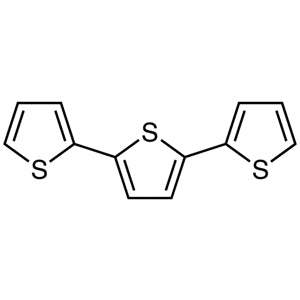
Alpha-Quaterthiophene (α-QT) is an organic compound composed of four thiophene units connected in a linear fashion through sulfur bonds. This material plays a crucial role in laboratory research, particularly in the field of electronic materials. It is widely used in the development of organic photovoltaic (OPV) cells, where it functions as an active component in the photoactive layer. Its ability to absorb light and generate electric current makes it essential for advancing solar energy technologies. In the laboratory, α-QT is a key ingredient in the synthesis of various optoelectronic devices and materials.
The unique properties of α-QT make it a preferred choice for researchers. It exhibits excellent conductivity and efficient charge carrier generation, which are vital for high-performance organic solar cells. Its stable molecular structure ensures consistent performance under various experimental conditions. Additionally, α-QT has favorable optical properties, including absorption wavelengths that align with the solar spectrum, enhancing its effectiveness in light harvesting. These characteristics contribute to its widespread use in functional material research.
In Indonesian laboratories, α-QT is commonly used in academic and industrial research settings focused on renewable energy and optoelectronics. It is an essential material for scientists working on organic photovoltaic technologies, as well as for those developing new materials with high efficiency and stability. Its versatility and reliability make it a valuable resource for advancing scientific innovation in the region.
TCI brochures (PDF)
- Organic Transistor (OFET) Materials 2026-05-07 · p. 10
- Solar Cell Materials 2026-04-21 · p. 11
- Thiophenes 2026-06-29 · p. 15
Related TCI products
- TCI S0505 86100-63-2 alpha-Septithiophene
- TCI S0504 88493-55-4 alpha-Sexithiophene (purified by sublimation)
- TCI Q0079 5660-45-7 alpha-Quinquethiophene
- TCI O0313 113728-71-5 alpha-Octithiophene
- TCI D4889 153561-79-6 5,5'''-Didodecyl-2,2':5',2'':5'',2'''-quaterthiophene
- TCI D4888 514188-77-3 5,5'''-Didecyl-2,2':5',2'':5'',2'''-quaterthiophene
- Organic Photovoltaic (OPV) Cell Development: α-QT is used to create the active layer in OPV cells, where it absorbs light and generates charge carriers, contributing to the overall efficiency of the device.
- Optoelectronic Device Fabrication: Its stable molecular structure and optical properties make it suitable for use in the production of various optoelectronic components, including sensors and light-emitting devices.
- Material Science Research: α-QT is a key material for studying the behavior of organic semiconductors, enabling researchers to explore new applications in electronic and energy technologies.
- Thin Film Deposition Studies: Its molecular stability allows it to be used in thin film deposition processes, where it is essential for creating uniform and high-quality layers for photovoltaic and electronic applications.
- Environmental Stability Testing: The compound’s thermal and chemical stability make it ideal for testing the long-term performance of materials under different environmental conditions.
| Brand | TCI |
|---|---|
| CAS number | 5632-29-1 |
| Molecular formula | — |
| Purity | — |
| Category | Materials Science > Electronic Materials > Organic Solar Cell (OPV) Materials |
| Pack sizes | Available in various quantities as per supplier specifications |
| Physical form | Solid |
| Storage | Store in a cool, dry place away from light and moisture |
Alpha-Quaterthiophene should be stored in a cool, dry environment, away from direct light and moisture to maintain its chemical stability. It is recommended to use airtight containers made of materials that do not react with the compound, such as glass or high-density polyethylene. In laboratory settings, proper ventilation should be ensured when handling the material to minimize exposure. It is important to follow standard safety protocols, including the use of personal protective equipment like gloves and safety goggles. The material should be kept in a secure location to prevent accidental spills or contamination. Regular monitoring of storage conditions is advised to ensure the integrity of the compound remains unaffected over time.
—
Produk Terkait
-
alpha-Septithiophene TCI S0505
Regular price Rp 3.975.300,00Regular priceRp 2.795.100,00Sale price Rp 3.975.300,00 -
alpha-Sexithiophene(purifiedbysublimation) TCI S0504
Regular price Rp 1.298.850,00Regular priceRp 924.000,00Sale price Rp 1.298.850,00 -
alpha-Quinquethiophene TCI Q0079
Regular price From Rp 4.425.750,00Regular priceRp 3.110.100,00Sale price From Rp 4.425.750,00 -
alpha-Octithiophene TCI O0313
Regular price Rp 13.540.800,00Regular priceRp 9.484.650,00Sale price Rp 13.540.800,00 -
5,5'''-Didodecyl-2,2':5',2'':5'',2'''-quaterthiophene TCI D4889
Regular price Rp 4.876.200,00Regular priceRp 3.425.100,00Sale price Rp 4.876.200,00 -
5,5'''-Didecyl-2,2':5',2'':5'',2'''-quaterthiophene TCI D4888
Regular price Rp 5.087.250,00Regular priceRp 3.573.150,00Sale price Rp 5.087.250,00 -
5,5'''-Di-n-octyl-2,2':5',2'':5'',2'''-quaterthiophene TCI D4877
Regular price Rp 4.902.450,00Regular priceRp 3.444.000,00Sale price Rp 4.902.450,00 -
2,2':5',2''-Terthiophene(purifiedbysublimation) TCI T1196
Regular price From Rp 2.252.250,00Regular priceRp 1.590.750,00Sale price From Rp 2.252.250,00