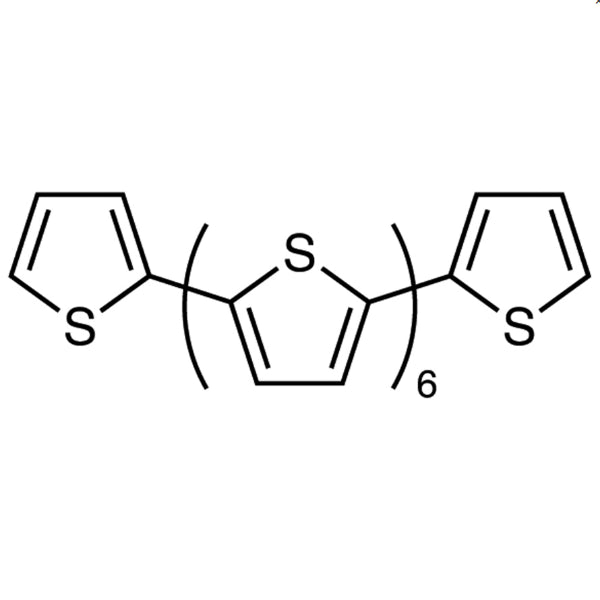
Alpha-Octithiophene (TCI O0313), with CAS number 113728-71-5, is an organic compound widely used in electronic materials research, particularly in the development of organic photovoltaic (OPV) cells. This compound plays a crucial role in laboratory settings where researchers are working on next-generation solar cell technologies. Its unique molecular structure, composed of carbon and sulfur chains, enables efficient electronic conductivity, making it a key component in the active layers of OPV devices. As a donor material, it facilitates the transfer of electrons within the photovoltaic structure, contributing to the overall efficiency of the solar cell.
The stability of Alpha-Octithiophene in both thermal and electronic properties makes it a preferred choice for researchers. It exhibits high chemical stability, which minimizes degradation during storage and use, ensuring consistent performance over time. Additionally, its ability to form stable interactions with various organic materials enhances its versatility in material synthesis. These characteristics make it an ideal candidate for applications requiring reliable and reproducible electronic behavior, especially in the context of renewable energy research.
In Indonesian laboratories, Alpha-Octithiophene is highly relevant for the development of sustainable energy technologies. Many research institutions and universities in Indonesia are actively engaged in OPV research as part of their efforts to promote environmentally friendly and renewable energy solutions. This compound supports these initiatives by providing a reliable and effective material for the fabrication of organic solar cells.
TCI brochures (PDF)
- Organic Transistor (OFET) Materials 2026-05-07 · p. 16
- Solar Cell Materials 2026-04-21 · p. 11
- Thiophenes 2026-06-29 · p. 15
Related TCI products
- Organic Photovoltaic (OPV) Cell Fabrication: Alpha-Octithiophene serves as a donor material in the active layer of OPV devices, enhancing electron transport and improving overall cell efficiency.
- Electronic Materials Research: Its unique molecular structure and electronic properties make it a valuable tool for studying charge transport mechanisms in organic semiconductors.
- Thin-Film Deposition Studies: The compound is commonly used in thin-film deposition techniques to create uniform and stable layers for solar cell applications.
- Material Compatibility Testing: Its ability to interact with various organic materials makes it ideal for testing compatibility in hybrid or multi-layered photovoltaic systems.
- Renewable Energy Innovation Projects: It supports the development of sustainable energy technologies by providing a reliable and efficient electronic material for solar cell research.
| Brand | TCI |
|---|---|
| CAS number | 113728-71-5 |
| Molecular formula | — |
| Purity | — |
| Category | Materials Science > Electronic Materials > Organic Solar Cell (OPV) Materials |
| Pack sizes | Available in various quantities as per supplier specifications |
| Physical form | Solid (exact form may vary based on supplier packaging) |
| Storage | Store in a cool, dry place away from direct light and moisture |
Alpha-Octithiophene should be stored in a cool, dry environment to maintain its chemical and thermal stability. It is recommended to use airtight containers to prevent exposure to moisture and air, which could affect its performance. As an organic compound, it should be handled with care, using appropriate personal protective equipment such as gloves and safety goggles. Proper ventilation is essential when working with this material to minimize inhalation risks. Due to its electronic properties, it is important to ensure that it is stored separately from incompatible substances. Regular monitoring of storage conditions is advised to maintain the integrity of the material during long-term use.
—
Produk Terkait
-
alpha-Septithiophene TCI S0505
Regular price Rp 3.975.300,00Regular priceRp 2.795.100,00Sale price Rp 3.975.300,00 -
alpha-Sexithiophene(purifiedbysublimation) TCI S0504
Regular price Rp 1.298.850,00Regular priceRp 924.000,00Sale price Rp 1.298.850,00 -
alpha-Quinquethiophene TCI Q0079
Regular price From Rp 4.425.750,00Regular priceRp 3.110.100,00Sale price From Rp 4.425.750,00 -
alpha-Quaterthiophene TCI Q0078
Regular price Rp 2.173.500,00Regular priceRp 1.535.100,00Sale price Rp 2.173.500,00 -
ZincPhthalocyanine(purifiedbysublimation) TCI Z0037
Regular price Rp 4.954.950,00Regular priceRp 3.480.750,00Sale price Rp 4.954.950,00 -
PBTTPD TCI P2710
Regular price Rp 11.448.150,00Regular priceRp 8.005.200,00Sale price Rp 11.448.150,00 -
Poly(3-hexylthiophene-2,5-diyl)(regioregular)[fororganicelectronics] TCI P2513
Regular price From Rp 4.056.150,00Regular priceRp 2.836.050,00Sale price From Rp 4.056.150,00 -
Pentacene(purifiedbysublimation) TCI P0030
Regular price From Rp 1.087.800,00Regular priceRp 760.200,00Sale price From Rp 1.087.800,00


![TCI P2513 110134-47-9 Poly(3-hexylthiophene-2,5-diyl) (regioregular) [for organic electronics]](http://amiscientific.com/cdn/shop/files/TCI2510P2513_9990739a-3ba9-40ea-beeb-1371f3d4b52d.jpg?v=1792653597&width=533)
![110134-47-9 Poly(3-hexylthiophene-2,5-diyl) (regioregular) [for organic electronics] - AMI Scientific](http://amiscientific.com/cdn/shop/files/TCI2510P2513.jpg?v=1767136282&width=533)