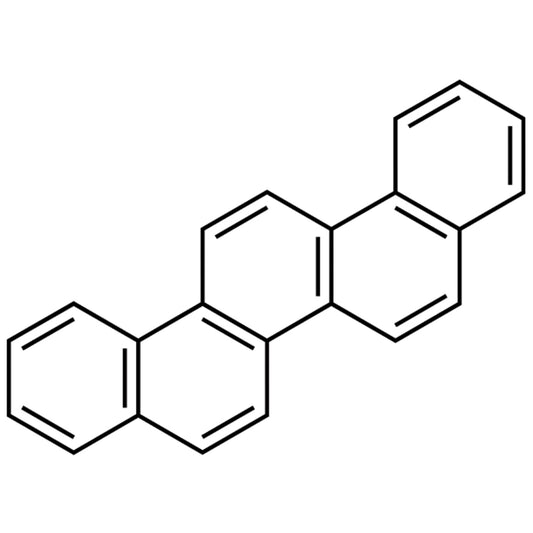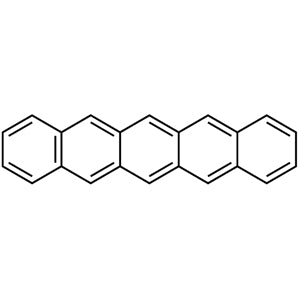
Pentacene is a polycyclic aromatic hydrocarbon made of five benzene rings fused in a straight line, and it belongs to the acene family. It is one of the most widely studied organic semiconductors and is often used as a reference material in organic electronics research. This TCI product has been purified by sublimation. That step matters for semiconductor materials, because even very small amounts of impurity can sharply reduce device performance. In the laboratory, pentacene is used as the active layer in transistors, as a material for photophysics studies, and as a building block for acene derivatives.
Researchers choose pentacene because its large conjugated pi-electron system gives it a fairly narrow energy gap and good charge transport in the solid state. In well-ordered thin films, pentacene molecules stack closely, so holes can move between them efficiently. This is why pentacene is known as the benchmark p-type organic semiconductor. It is also well known in research on singlet fission, a process that could improve solar cell efficiency. Because the material is purified by sublimation, results are more consistent and easier to reproduce. This is especially important when electrical or optical measurements depend on how pure the material is.
In Indonesian laboratories, pentacene is mainly used by university research groups and research institutes working in materials science, applied physics, and organic chemistry. Typical work includes making and testing organic thin-film transistors, studying how molecules pack in vacuum-deposited films, and running spectroscopy experiments on excited-state behaviour. Synthetic chemists also use it as a starting point for new acene derivatives. Its long history in the literature makes it a dependable reference when a group is setting up new organic electronics methods.
Advantages (TCI brochure)
- Sublimation-purified pentacene, shown as comparison grade to P2524
TCI brochures (PDF)
- Stable p-Type Organic Semiconductor Dimethylanthradithiophene (DMADT) 2025-01-20 · p. 1
- Super Performance Organic Semiconductor Ph-BTBT-10 2025-03-04 · p. 2
- Organic Transistor (OFET) Materials 2026-05-07 · p. 3
- Chemical Compounds Purified by Sublimation 2025-05-07 · p. 2
- Nanocarbon Materials 2026-09-30 · p. 8
- Solar Cell Materials 2026-04-21 · p. 11
Related TCI products
- TCI N0951 92-24-0 Naphthacene (purified by sublimation)
- TCI Z0037 14320-04-8 Zinc Phthalocyanine (purified by sublimation)
- TCI S0504 88493-55-4 alpha-Sexithiophene (purified by sublimation)
- TCI P2524 135-48-8 Pentacene (99999%, trace metals basis) (purified by sublimation) [for organic electronics]
- TCI T3267 217-59-4 Triphenylene (purified by sublimation)
- TCI T3263 92-94-4 p-Terphenyl (purified by sublimation)
- Organic thin-film transistors: pentacene is the standard p-type semiconductor for active channel layers, because its ordered molecular stacking lets holes move efficiently through the film.
- Reference material for organic electronics: as one of the most studied organic semiconductors, it gives a well-documented baseline for comparing new materials and checking fabrication processes.
- Photophysics and spectroscopy studies: its large conjugated pi-electron system and fairly narrow energy gap make it a good model compound for studying light absorption and excited-state behaviour.
- Singlet fission research: pentacene is one of the best-known materials for studying singlet fission, a process that could raise solar cell efficiency, so it is a key compound in this field.
- Synthesis of acene derivatives: as a non-heterocyclic building block, it is a useful starting structure for making modified acenes with adjusted electronic or solubility properties for further research.
| Brand | TCI (product code P0030) |
|---|---|
| CAS number | 135-48-8 |
| Molecular formula | — |
| Purity | — |
| Category | Chemistry > Building Blocks > Non-Heterocyclic Building Blocks |
| Pack sizes | See the product listing for available pack sizes |
| Physical form | — |
| Storage | Sensitive material; protect from light and air (see Handling and Storage) |
- Grade: Purified by sublimation
Data from the TCI brochure
| Hole mobility | 0.29 cm2/Vs (bare Si/SiO2, top-contact device) |
|---|---|
| Vth | -22 V (bare Si/SiO2, top-contact device) |
Source: TCI brochure F2039 (2026-05-07)
Keep pentacene in a tightly closed original container, in a cool, dry and dark place. Like many acenes, pentacene is sensitive to environmental conditions, especially light and air, and long exposure can degrade the material and lower its semiconductor performance. Where possible, store and handle it under an inert atmosphere, for example in a glovebox or a sealed container flushed with nitrogen or argon. Amber glass or opaque containers help protect it from light. Follow standard laboratory safety practice: wear gloves, safety glasses and a lab coat, avoid breathing in dust, and work in a fume hood or ventilated area. Always check the supplier's Safety Data Sheet for full hazard and disposal information before use.
—
Product Categories
- Electronic MaterialsOrganic Solar Cell (OPV) MaterialsDonor Materials [Organic Solar Cell (OPV) Materials]
- Electronic MaterialsOrganic Transistor (OFET) Materialsp-Type Organic Semiconductors [Organic Transistor (OFET) Materials]
- High Purity CompoundsCompounds Purified by SublimationOrganic Semiconductors [Compounds Purified by Sublimation]
- Nanocarbon MaterialsNanocarbon Unit Structures
Produk Terkait
-
Naphthacene(purifiedbysublimation) TCI N0951
Regular price From Rp 2.439.150,00Regular priceRp 1.705.200,00Sale price From Rp 2.439.150,00 -
ZincPhthalocyanine(purifiedbysublimation) TCI Z0037
Regular price Rp 4.954.950,00Regular priceRp 3.480.750,00Sale price Rp 4.954.950,00 -
alpha-Sexithiophene(purifiedbysublimation) TCI S0504
Regular price Rp 1.298.850,00Regular priceRp 924.000,00Sale price Rp 1.298.850,00 -
Pentacene(99999%,tracemetalsbasis)(purifiedbysublimation)[fororganicelectronics] TCI P2524
Regular price From Rp 1.405.950,00Regular priceRp 982.800,00Sale price From Rp 1.405.950,00 -
Triphenylene(purifiedbysublimation) TCI T3267
Regular price From Rp 3.367.350,00Regular priceRp 2.354.100,00Sale price From Rp 3.367.350,00 -
p-Terphenyl(purifiedbysublimation) TCI T3263
Regular price From Rp 1.510.950,00Regular priceRp 1.056.300,00Sale price From Rp 1.510.950,00 -
5,6,11,12-Tetraphenylnaphthacene(purifiedbysublimation) TCI T2233
Regular price From Rp 2.279.550,00Regular priceRp 1.593.900,00Sale price From Rp 2.279.550,00 -
Picene(purifiedbysublimation)(>99.9%) TCI P2207
Regular price From Rp 4.347.000,00Regular priceRp 3.039.750,00Sale price From Rp 4.347.000,00


![135-48-8 Pentacene (99.999%, trace metals basis) (purified by sublimation) [for organic electronics] - AMI Scientific](http://amiscientific.com/cdn/shop/files/TCI2510P2524.jpg?v=1768819391&width=533)