

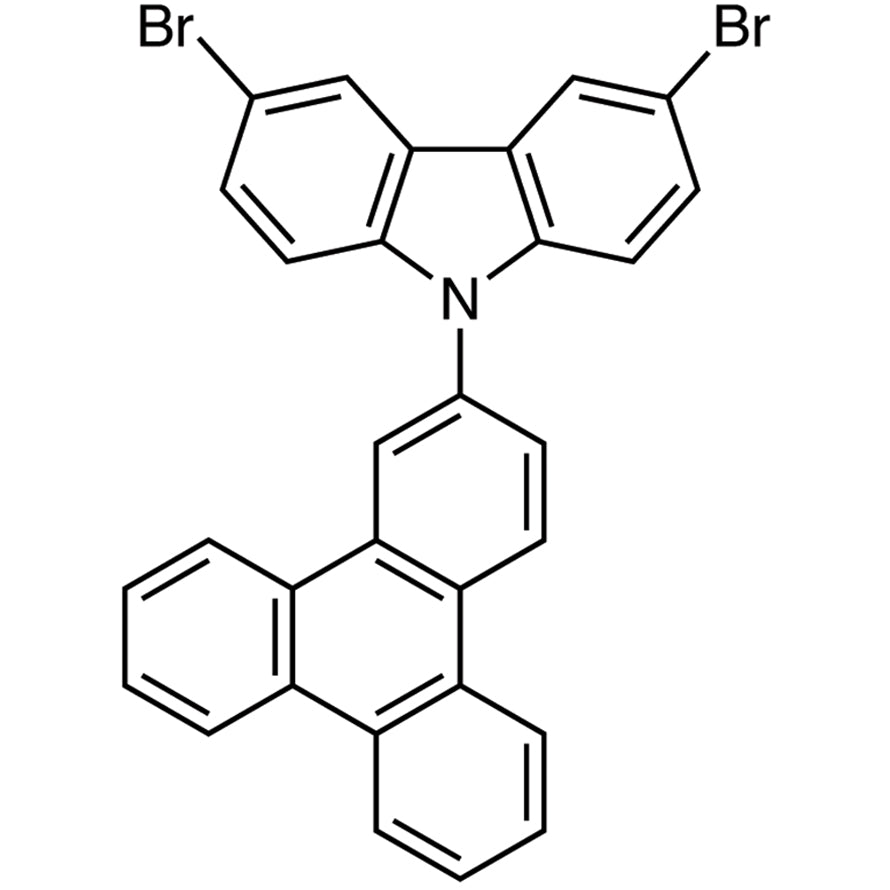
3,6-Dibromo-9-(triphenylen-2-yl)carbazole is a specialized organic compound used in semiconductor material research. It plays a crucial role in the development of advanced materials with unique optical and electronic properties. This compound is widely utilized in laboratories for its ability to serve as a building block in the synthesis of complex molecular structures. Its presence in organic conductor research highlights its importance in creating materials for next-generation electronic devices.
The compound’s high chemical stability and compatibility with various functional groups make it a preferred choice for researchers. These properties enable it to participate in a wide range of chemical reactions, particularly those requiring high precision in semiconductor synthesis. Its ability to form stable covalent bonds with other molecules enhances its versatility in material science applications. Additionally, its optical properties make it suitable for use in photovoltaic and optoelectronic devices.
In Indonesian laboratories, 3,6-Dibromo-9-(triphenylen-2-yl)carbazole is commonly used by researchers working on organic semiconductor materials. It is a key component in the development of organic solar cells and optoelectronic devices. Its availability through AMI Scientific ensures that Indonesian researchers have access to this essential compound for their advanced material research projects.
TCI brochures (PDF)
- Carbazoles 2025-06-27 · p. 6
- Building Blocks for Organic Semiconductor 2026-03-24 · p. 11
Related TCI products
- TCI B5472 912850-81-8 9-Benzoyl-3,6-dibromo-9H-carbazole
- TCI B5462 1384281-49-5 9-Benzyl-2,7-dibromo-9H-carbazole
- TCI D6528 1796549-32-0 3,11-Dibromo-7H-dibenzo[c,g]carbazole
- TCI D5546 1221237-83-7 3,6-Dibromo-9-(2-naphthalenyl)-9H-carbazole
- TCI D5426 1214-16-0 3,6-Dibromo-9-vinyl-9H-carbazole
- TCI D5425 1438252-33-5 2,7-Dibromo-9-vinyl-9H-carbazole
- Organic Semiconductor Synthesis: This compound is ideal for creating complex molecular structures used in organic semiconductors due to its stable chemical properties and ability to form covalent bonds.
- Organic Solar Cell Development: Its optical properties make it suitable for use in organic photovoltaic materials, contributing to efficient light absorption and charge transport.
- Optoelectronic Device Fabrication: The compound’s unique electronic and optical characteristics are beneficial in the development of optoelectronic components such as sensors and light-emitting diodes.
- Advanced Material Research: It is frequently used in laboratories for the synthesis of novel materials with tailored electronic and optical properties.
- Chemical Reaction Precursor: Its reactivity and compatibility with various functional groups make it a valuable precursor in a wide range of chemical synthesis processes.
| Brand | TCI |
|---|---|
| CAS number | 1351870-16-0 |
| Molecular formula | — |
| Purity | — |
| Category | Materials Science > Material Building Blocks > Small Molecule Semiconductor Building Blocks |
| Pack sizes | Available in various sizes as per supplier specifications |
| Physical form | Solid (as per standard chemical properties) |
| Storage | Store in a cool, dry place away from direct sunlight and moisture |
This compound should be stored in a cool, dry environment to maintain its chemical stability. It is recommended to keep it in a tightly sealed container to prevent exposure to moisture and air. Due to its organic nature, it should be stored away from strong oxidizing agents and incompatible substances. Proper ventilation is essential when handling the material to minimize inhalation risks. Laboratory personnel should wear appropriate personal protective equipment, including gloves and safety goggles, when working with this compound. Regular monitoring of storage conditions ensures the compound remains in optimal condition for use in research applications.
—
Produk Terkait
-
9-Benzoyl-3,6-dibromo-9H-carbazole TCI B5472
Regular price Rp 1.908.900,00Regular priceRp 1.350.300,00Sale price Rp 1.908.900,00 -
9-Benzyl-2,7-dibromo-9H-carbazole TCI B5462
Regular price Rp 2.914.800,00Regular priceRp 2.053.800,00Sale price Rp 2.914.800,00 -
3,11-Dibromo-7H-dibenzo[c,g]carbazole TCI D6528
Regular price Rp 2.411.850,00Regular priceRp 1.702.050,00Sale price Rp 2.411.850,00 -
3,6-Dibromo-9-(2-naphthalenyl)-9H-carbazole TCI D5546
Regular price Rp 848.400,00Regular priceRp 609.000,00Sale price Rp 848.400,00 -
3,6-Dibromo-9-vinyl-9H-carbazole TCI D5426
Regular price Rp 4.081.350,00Regular priceRp 2.869.650,00Sale price Rp 4.081.350,00 -
2,7-Dibromo-9-vinyl-9H-carbazole TCI D5425
Regular price Rp 3.870.300,00Regular priceRp 2.721.600,00Sale price Rp 3.870.300,00 -
3,6-Dibromo-9-(m-tolyl)-9H-carbazole TCI D5424
Regular price Rp 2.518.950,00Regular priceRp 1.776.600,00Sale price Rp 2.518.950,00 -
3,6-Dibromo-9-(3,5-dimethylphenyl)-9H-carbazole TCI D5421
Regular price Rp 1.113.000,00Regular priceRp 793.800,00Sale price Rp 1.113.000,00


![3,11-Dibromo-7H-dibenzo[c,g]carbazole (CAS 1796549-32-0) - TCI D6528 - AMI Scientific](http://amiscientific.com/cdn/shop/files/TCI2510D6528.jpg?v=1767110368&width=533)


