
![3,11-Dibromo-7H-dibenzo[c,g]carbazole (CAS 1796549-32-0) - TCI D6528 - AMI Scientific](http://amiscientific.com/cdn/shop/files/TCI2510D6528.jpg?v=1767110368&width=1946)
![3,11-Dibromo-7H-dibenzo[c,g]carbazole (CAS 1796549-32-0) - TCI D6528 - AMI Scientific](http://amiscientific.com/cdn/shop/files/TCI2510D6528.jpg?v=1767110368&width=1445)
TCI D6528 with CAS number 1796549-32-0 is 3,11-Dibromo-7H-dibenzo[c,g]carbazole, an aromatic heterocyclic compound belonging to the fused carbazole family and carrying two bromo groups at positions 3 and 11. In the laboratory, this material serves as a building block for the synthesis of larger organic molecules, particularly materials that require an electron-rich aromatic framework. The presence of two bromine atoms makes it a practical starting point for researchers who wish to construct either symmetrical or asymmetrical structures through transition-metal-catalysed coupling reactions.
The characteristic that makes this compound a frequent choice is the combination of a rigid, extensively conjugated dibenzocarbazole framework with two bromo positions that are highly reactive towards cross-coupling reactions. The carbazole framework is well known as an electron-donor unit that confers thermal stability and attractive photophysical properties, while the bromo substituents act as leaving groups that are readily replaced by aryl, alkenyl, alkynyl, or amine groups. The nitrogen at position 7 can also still be functionalised, giving researchers three distinct points of modification within a single molecule.
In Indonesian laboratories, this building block is typically used in university and institutional research settings working on organic synthesis and functional materials. It suits groups preparing conjugated molecules on a research scale, where a defined heterocyclic core with predictable reactive positions saves several synthetic steps. Because the material is supplied as a catalogue reagent, it fits scheduled experimental work in synthesis laboratories rather than routine high-volume production.
TCI brochures (PDF)
- Carbazoles 2025-06-27 · p. 3
- Building Blocks for Organic Semiconductor 2026-03-24 · p. 22
Related TCI products
- TCI D5546 1221237-83-7 3,6-Dibromo-9-(2-naphthalenyl)-9H-carbazole
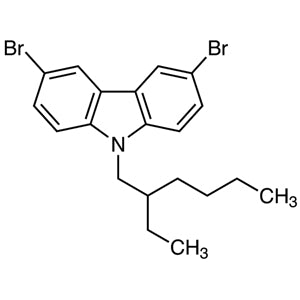
- TCI D4830 173063-52-0 3,6-Dibromo-9-(2-ethylhexyl)carbazole
- TCI D4563 73087-83-9 3,6-Dibromo-9-(4-bromophenyl)carbazole
- TCI B5461 339576-55-5 9-Benzyl-3-bromo-9H-carbazole
- TCI B5437 1616607-88-5 2-(2-Bromophenyl)-9-phenyl-9H-carbazole
- TCI B5183 84359-61-5 9-(3-Bromopropyl)carbazole
- Transition-metal-catalysed cross-coupling: the two bromo positions serve as reliable leaving groups for building aryl, alkenyl, or alkynyl extensions onto the carbazole core.
- Synthesis of symmetrical conjugated molecules: both bromine atoms can be coupled with the same partner in one operation, giving clean twofold extension of the framework.
- Synthesis of asymmetrical architectures: stepwise reaction at the two bromo positions lets researchers introduce different substituents and construct molecules with deliberately unbalanced structures.
- Preparation of functional organic materials: the rigid, extensively conjugated dibenzocarbazole core provides the electron-rich aromatic backbone required by materials-oriented synthesis programmes.
- Amination chemistry at the halogenated positions: the bromo substituents are readily displaced by amine groups, supporting the preparation of nitrogen-substituted derivatives of the core.
| Brand | TCI |
|---|---|
| CAS number | 1796549-32-0 |
| Molecular formula | — |
| Purity | — |
| Category | Chemistry > Building Blocks > Heterocyclic Building Blocks |
| Pack sizes | — |
| Physical form | — |
| Storage | store according to the conditions stated on the manufacturer's label and safety data sheet |
- Chemical name: 3,11-Dibromo-7H-dibenzo[c,g]carbazole
- Product code: D6528
Store the container tightly closed in a cool, dry, well-ventilated place away from direct sunlight, ignition sources, and incompatible materials, following the storage conditions stated on the manufacturer's label and safety data sheet. Keep the compound in its original container or in a suitable tightly sealed glass or amber container that protects it from moisture and light. Handle the material in a fume hood using appropriate personal protective equipment, including gloves, safety goggles, and a laboratory coat. Avoid generating dust, avoid contact with skin and eyes, and wash hands thoroughly after handling. Consult the safety data sheet before use and dispose of residues in accordance with applicable laboratory waste procedures.
—
Produk Terkait
-
3,6-Dibromo-9-(2-naphthalenyl)-9H-carbazole TCI D5546
Regular price From Rp 795.900,00Regular price -
3,6-Dibromo-9-(2-ethylhexyl)carbazole TCI D4830
Regular price From Rp 2.147.250,00Regular price -
3,6-Dibromo-9-(4-bromophenyl)carbazole TCI D4563
Regular price From Rp 664.650,00Regular price -
9-Benzyl-3-bromo-9H-carbazole TCI B5461
Regular price From Rp 1.510.950,00Regular price -
2-(2-Bromophenyl)-9-phenyl-9H-carbazole TCI B5437
Regular price From Rp 1.193.850,00Regular price -
9-(3-Bromopropyl)carbazole TCI B5183
Regular price From Rp 1.988.700,00Regular price -
3-Bromo-9-(4-bromophenyl)-9H-carbazole TCI B5107
Regular price From Rp 2.571.450,00Regular price -
10-Bromo-7H-benzo[c]carbazole TCI B4883
Regular price From Rp 769.650,00Regular price



![1698-16-4 10-Bromo-7H-benzo[c]carbazole - AMI Scientific](http://amiscientific.com/cdn/shop/files/TCI2510B4883_a6301f58-a063-4c77-86ec-5cb7f70da5fe.jpg?v=1767854168&width=533)