


3,6-Dibromo-9-(2-ethylhexyl)carbazole is a chemical compound widely used in organic synthesis applications. It belongs to the category of heterocyclic building blocks and serves as a key component in the development of more complex molecular structures. In laboratory settings, this compound functions as a versatile building block, enabling researchers to create novel compounds with tailored properties. Its unique molecular structure makes it a valuable tool for various scientific disciplines, including materials science, pharmaceutical research, and electronic materials development.
The compound’s chemical stability and controlled reactivity make it a preferred choice for synthetic chemists. The presence of two bromo groups at positions 3 and 6 provides multiple substitution opportunities, enhancing its adaptability in different synthetic pathways. Additionally, its solubility in organic solvents simplifies purification and isolation processes, making it efficient for laboratory workflows. These properties contribute to its popularity among researchers seeking reliable and flexible synthetic intermediates.
In Indonesian laboratories, 3,6-Dibromo-9-(2-ethylhexyl)carbazole is commonly used in organic chemistry research, particularly in the development of compounds with applications in material science and pharmaceuticals. Its availability and performance make it a standard reagent in academic and industrial research settings. The compound’s role in advancing chemical innovation is well recognized in the scientific community.
TCI brochures (PDF)
- Carbazoles 2025-06-27 · p. 4
- Building Blocks for Organic Semiconductor 2026-03-24 · p. 20
Related TCI products
- TCI D4563 73087-83-9 3,6-Dibromo-9-(4-bromophenyl)carbazole
- TCI E1325 448955-87-1 9-(2-Ethylhexyl)-3,6-bis(4,4,5,5-tetramethyl-1,3,2-dioxaborolan-2-yl)-9H-carbazole
- TCI E1324 476360-83-5 9-(2-Ethylhexyl)-2,7-bis(4,4,5,5-tetramethyl-1,3,2-dioxaborolan-2-yl)-9H-carbazole
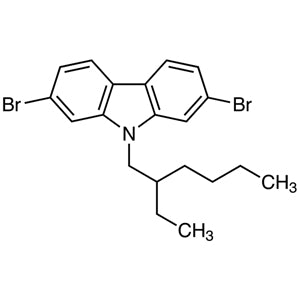
- TCI D4735 544436-46-6 2,7-Dibromo-9-(2-ethylhexyl)carbazole
- TCI B5462 1384281-49-5 9-Benzyl-2,7-dibromo-9H-carbazole
- TCI D6528 1796549-32-0 3,11-Dibromo-7H-dibenzo[c,g]carbazole
- Organic synthesis applications benefit from its role as a versatile building block, enabling the creation of complex molecular structures with high precision.
- Pharmaceutical research utilizes this compound for the development of new drug candidates, leveraging its reactivity and substitution potential.
- Material science applications take advantage of its chemical stability and solubility, making it suitable for the synthesis of advanced organic materials.
- Electronic materials development benefits from its unique molecular structure, which can be tailored for use in optoelectronic devices and conductive polymers.
- Academic research in Indonesian laboratories frequently incorporates this compound due to its reliability and effectiveness in synthetic processes.
| Brand | TCI |
|---|---|
| CAS number | 173063-52-0 |
| Molecular formula | — |
| Purity | — |
| Category | Chemistry > Building Blocks > Heterocyclic Building Blocks |
| Pack sizes | As per supplier specifications |
| Physical form | Solid (as per standard product description) |
| Storage | Store in a cool, dry place away from light and moisture |
This compound should be stored in a cool, dry environment, away from direct sunlight and moisture to maintain its chemical integrity. It is recommended to use airtight containers made of glass or high-density polyethylene to prevent contamination and degradation. Due to its brominated structure, it is important to handle the compound with care, using appropriate personal protective equipment such as gloves and safety goggles. In laboratory settings, it should be kept in a well-ventilated area to minimize exposure. Proper labeling and storage conditions ensure the compound remains safe and effective for use in research applications.
—
Product Categories
Produk Terkait
-
3,6-Dibromo-9-(4-bromophenyl)carbazole TCI D4563
Regular price From Rp 664.650,00Regular price -
9-(2-Ethylhexyl)-3,6-bis(4,4,5,5-tetramethyl-1,3,2-dioxaborolan-2-yl)-9H-carbazole TCI E1325
Regular price From Rp 2.545.200,00Regular price -
9-(2-Ethylhexyl)-2,7-bis(4,4,5,5-tetramethyl-1,3,2-dioxaborolan-2-yl)-9H-carbazole TCI E1324
Regular price From Rp 3.100.650,00Regular price -
2,7-Dibromo-9-(2-ethylhexyl)carbazole TCI D4735
Regular price Rp 2.386.650,00Regular price -
9-Benzyl-2,7-dibromo-9H-carbazole TCI B5462
Regular price From Rp 2.862.300,00Regular price -
3,11-Dibromo-7H-dibenzo[c,g]carbazole TCI D6528
Regular price From Rp 2.359.350,00Regular price -
3,6-Dibromo-9-(2-naphthalenyl)-9H-carbazole TCI D5546
Regular price From Rp 795.900,00Regular price -
3,6-Dibromo-9-(m-tolyl)-9H-carbazole TCI D5424
Regular price Rp 2.466.450,00Regular price



![3,11-Dibromo-7H-dibenzo[c,g]carbazole (CAS 1796549-32-0) - TCI D6528 - AMI Scientific](http://amiscientific.com/cdn/shop/files/TCI2510D6528.jpg?v=1767110368&width=533)

