


3,6-Dibromo-9-(2-naphthalenyl)-9H-carbazole, bearing CAS number 1221237-83-7, is a heterocyclic building block based on a carbazole skeleton that has been modified at three positions simultaneously. The carbazole nitrogen atom carries a 2-naphthyl substituent, while positions 3 and 6 on the two benzene rings each bear a bromine atom. This arrangement makes the compound a highly useful starting material for constructing large conjugated molecules, particularly organic electronic materials. In the laboratory, it serves as an electron-donor core ready to be elaborated through cross-coupling reactions into light emitters, host materials, or conjugated polymers for a wide range of materials studies.
The property that makes this compound a frequent choice is the combination of an electron-rich carbazole framework with two symmetrically positioned bromine handles. Carbazole is well known as an electron-donating unit with good thermal and photochemical stability, while the naphthyl group on the nitrogen broadens the conjugated system and increases molecular rigidity, which typically influences the thermal behaviour of the resulting films. The two bromine atoms at positions 3 and 6 give a very clear reaction direction, so that coupling products can be obtained with predictable regiochemistry rather than as a mixture of isomers. This symmetry also simplifies purification and structural confirmation of the products.
In Indonesian laboratories, this building block is generally used in university and institutional research groups working on organic electronics, photophysics, and synthetic materials chemistry. It is typically handled at the milligram-to-gram scale on a Schlenk line or in a standard synthesis fume hood, then carried through palladium-catalysed coupling steps followed by column chromatography and spectroscopic characterisation. Because the compound is imported as a research chemical, groups usually plan their experiments around a single purchased lot and record its use carefully within the laboratory's chemical inventory.
TCI brochures (PDF)
- Building Blocks for Organic Semiconductor 2026-03-24 · p. 21
Related TCI products
- TCI D6528 1796549-32-0 3,11-Dibromo-7H-dibenzo[c,g]carbazole
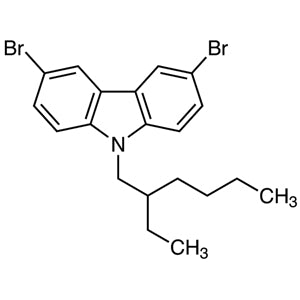
- TCI D4830 173063-52-0 3,6-Dibromo-9-(2-ethylhexyl)carbazole
- TCI D4563 73087-83-9 3,6-Dibromo-9-(4-bromophenyl)carbazole
- TCI B5461 339576-55-5 9-Benzyl-3-bromo-9H-carbazole
- TCI B5437 1616607-88-5 2-(2-Bromophenyl)-9-phenyl-9H-carbazole
- TCI B5183 84359-61-5 9-(3-Bromopropyl)carbazole
- Suzuki-Miyaura cross-coupling: the two aryl bromide positions react cleanly with boronic acids or esters, allowing researchers to install aryl groups symmetrically on both sides of the carbazole core.
- Buchwald-Hartwig amination: the carbon-bromine bonds serve as reliable electrophilic partners for palladium-catalysed C-N bond formation, giving access to diarylamino-substituted carbazoles used as hole-transporting units.
- Synthesis of host materials for organic light-emitting devices: the electron-rich, thermally stable carbazole core with an extended naphthyl substituent is a common structural motif in host material design.
- Preparation of conjugated polymers: the symmetric dibromo substitution pattern makes the molecule a suitable difunctional monomer for step-growth polymerisation with complementary bifunctional comonomers.
- Photophysical and structure-property studies: the rigid, extended conjugated framework provides a well-defined reference scaffold for investigating how donor strength and substitution pattern affect emission behaviour.
| Brand | TCI (Tokyo Chemical Industry) |
|---|---|
| CAS number | 1221237-83-7 |
| Molecular formula | — |
| Purity | — |
| Category | Chemistry > Building Blocks > Heterocyclic Building Blocks |
| Pack sizes | available in the research-scale pack sizes listed in the TCI catalogue for this item |
| Physical form | — |
| Storage | store in a cool, dark place in a tightly sealed container, following the manufacturer's stated conditions on the product label |
- Catalogue number: D5546
Store the container tightly closed in a cool, dark, and well-ventilated place, away from heat sources, direct sunlight, and incompatible chemicals such as strong oxidising agents. Keep the material in its original amber or opaque glass container, or transfer it to a clean, dry, chemically resistant vial with a well-fitting cap; for longer-term use, storing under an inert atmosphere in a desiccator helps limit exposure to moisture and air. Weigh and transfer the solid in a fume hood using dedicated clean spatulas to avoid cross-contamination between lots. Wear safety goggles, nitrile gloves, and a laboratory coat at all times, and avoid generating or inhaling dust. Always consult the manufacturer's Safety Data Sheet before use, and dispose of residues and contaminated consumables as halogenated organic chemical waste in accordance with institutional procedures.
—
Produk Terkait
-
3,11-Dibromo-7H-dibenzo[c,g]carbazole TCI D6528
Regular price From Rp 2.359.350,00Regular price -
3,6-Dibromo-9-(2-ethylhexyl)carbazole TCI D4830
Regular price From Rp 2.147.250,00Regular price -
3,6-Dibromo-9-(4-bromophenyl)carbazole TCI D4563
Regular price From Rp 664.650,00Regular price -
9-Benzyl-3-bromo-9H-carbazole TCI B5461
Regular price From Rp 1.510.950,00Regular price -
2-(2-Bromophenyl)-9-phenyl-9H-carbazole TCI B5437
Regular price From Rp 1.193.850,00Regular price -
9-(3-Bromopropyl)carbazole TCI B5183
Regular price From Rp 1.988.700,00Regular price -
3-Bromo-9-(4-bromophenyl)-9H-carbazole TCI B5107
Regular price From Rp 2.571.450,00Regular price -
10-Bromo-7H-benzo[c]carbazole TCI B4883
Regular price From Rp 769.650,00Regular price
![3,11-Dibromo-7H-dibenzo[c,g]carbazole (CAS 1796549-32-0) - TCI D6528 - AMI Scientific](http://amiscientific.com/cdn/shop/files/TCI2510D6528.jpg?v=1767110368&width=533)


![1698-16-4 10-Bromo-7H-benzo[c]carbazole - AMI Scientific](http://amiscientific.com/cdn/shop/files/TCI2510B4883_a6301f58-a063-4c77-86ec-5cb7f70da5fe.jpg?v=1767854168&width=533)