9-(3-Bromopropyl)carbazole is a chemical compound widely used in organic reactions, particularly in the synthesis of complex heterocyclic compounds. This material serves as a key building block in laboratory settings, offering a versatile platform for the creation of structurally intricate molecules with specific functional properties. Its unique structure, featuring a carbazole core modified with a bromopropyl group at the ninth position, makes it highly valuable for synthetic chemists. The presence of the bromopropyl group enhances its reactivity, allowing it to participate in various chemical transformations.
The compound’s reactivity is primarily due to its bromopropyl substituent, which enables it to engage in nucleophilic substitution and cross-coupling reactions. These properties make it a preferred choice for chemists aiming to develop new compounds with tailored functionalities. Its ability to undergo multiple reaction pathways increases its utility in the synthesis of pharmaceuticals, organic materials, and other advanced chemical products. This versatility supports its application in a wide range of research areas.
In Indonesian laboratories, 9-(3-Bromopropyl)carbazole is commonly used in organic chemistry research, especially in the synthesis of heterocyclic compounds and the development of new chemical entities. It is a valuable resource for researchers in pharmaceutical, material science, and analytical chemistry fields. Its role in creating complex molecular structures makes it an essential component in modern synthetic strategies.
TCI brochures (PDF)
- Building Blocks for Organic Semiconductor 2026-03-24 · p. 19
Related TCI products
- TCI T3882 6558-85-6 1,3,6,8-Tetramethyl-9H-carbazole
- TCI T3642 1630723-98-6 N,N,N',N'-Tetrakis(4-methoxyphenyl)-9H-carbazole-3,6-diamine
- TCI B5461 339576-55-5 9-Benzyl-3-bromo-9H-carbazole
- TCI B5437 1616607-88-5 2-(2-Bromophenyl)-9-phenyl-9H-carbazole
- TCI B5107 1226860-66-7 3-Bromo-9-(4-bromophenyl)-9H-carbazole
- TCI B4883 1698-16-4 10-Bromo-7H-benzo[c]carbazole
- Synthesis of complex heterocyclic compounds for the development of new pharmaceuticals due to its reactivity and structural versatility.
- Cross-coupling reactions in organic synthesis to create diverse molecular architectures with specific functional groups.
- Research in material science for the creation of advanced organic materials with tailored chemical properties.
- Development of new chemical entities in pharmaceutical research through its ability to participate in multiple reaction pathways.
- Analytical chemistry applications for the study of reaction mechanisms and structural transformations in synthetic processes.
| Brand | TCI |
|---|---|
| CAS number | 84359-61-5 |
| Molecular formula | — |
| Purity | — |
| Category | Chemistry > Building Blocks > Heterocyclic Building Blocks |
| Pack sizes | As available from supplier |
| Physical form | Solid (as per standard chemical specifications) |
| Storage | Store in a cool, dry place away from light and moisture |
This compound should be stored in a cool, dry environment, away from direct light and moisture to maintain its chemical integrity. It is recommended to use airtight containers made of materials such as glass or polyethylene to prevent contamination and degradation. As a brominated compound, it may react with strong oxidizing agents or incompatible substances, so it should be handled with care in a well-ventilated laboratory setting. Proper personal protective equipment, including gloves and safety goggles, should always be worn when handling this material. It is important to follow standard laboratory safety protocols to ensure safe usage and storage.
—
Product Categories
Produk Terkait
-
1,3,6,8-Tetramethyl-9H-carbazole TCI T3882
Regular price From Rp 4.108.650,00Regular priceRp 2.888.550,00Sale price From Rp 4.108.650,00 -
N,N,N',N'-Tetrakis(4-methoxyphenyl)-9H-carbazole-3,6-diamine TCI T3642
Regular price From Rp 9.778.650,00Regular priceRp 6.853.350,00Sale price From Rp 9.778.650,00 -
9-Benzyl-3-bromo-9H-carbazole TCI B5461
Regular price From Rp 1.563.450,00Regular priceRp 1.108.800,00Sale price From Rp 1.563.450,00 -
2-(2-Bromophenyl)-9-phenyl-9H-carbazole TCI B5437
Regular price From Rp 1.246.350,00Regular priceRp 887.250,00Sale price From Rp 1.246.350,00 -
3-Bromo-9-(4-bromophenyl)-9H-carbazole TCI B5107
Regular price From Rp 2.623.950,00Regular priceRp 1.850.100,00Sale price From Rp 2.623.950,00 -
10-Bromo-7H-benzo[c]carbazole TCI B4883
Regular price From Rp 822.150,00Regular priceRp 590.100,00Sale price From Rp 822.150,00 -
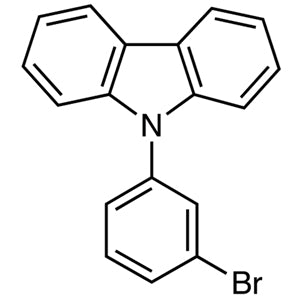
9-(3-Bromophenyl)carbazole TCI B4427
Regular price From Rp 1.351.350,00Regular priceRp 960.750,00Sale price From Rp 1.351.350,00 -
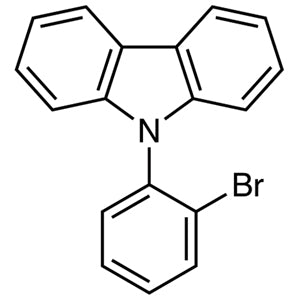
9-(2-Bromophenyl)-9H-carbazole TCI B4109
Regular price From Rp 875.700,00Regular priceRp 627.900,00Sale price From Rp 875.700,00