

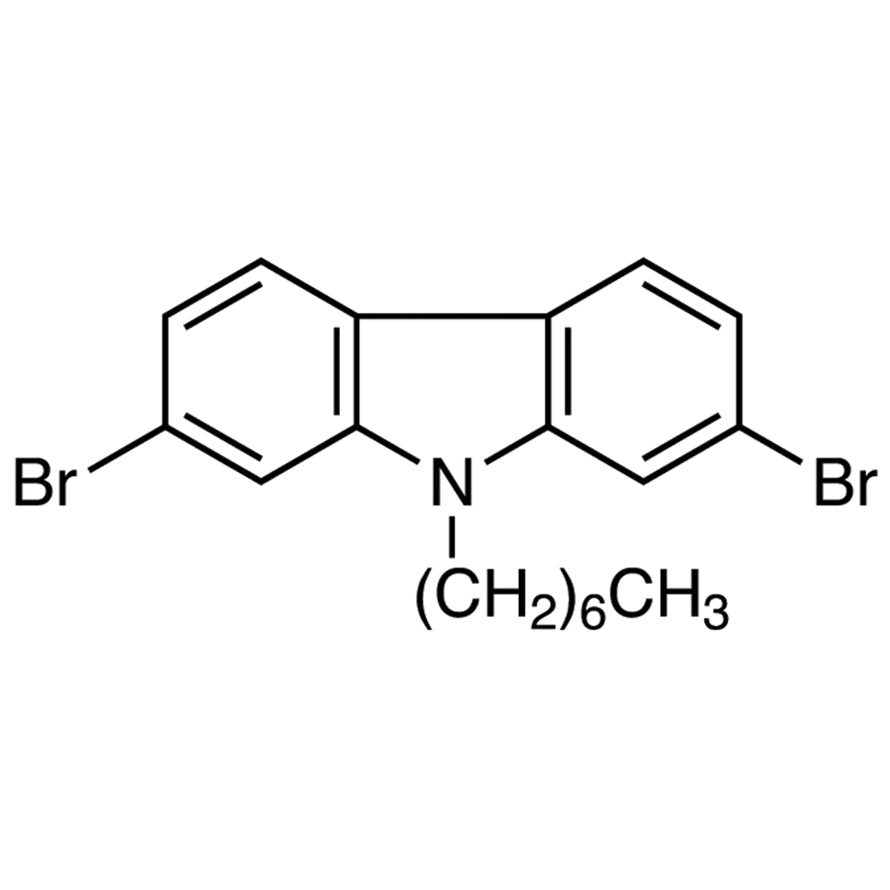
2,7-Dibromo-9-heptyl-9H-carbazole is a chemical compound widely used in material science research, particularly in the development of semiconductor and polymer materials. This compound plays a crucial role in the synthesis of organic materials with unique electronic properties, making it an essential component in advanced laboratory settings. Its molecular structure allows for chemical modifications that can be tailored to specific technological applications, enhancing its versatility in research and development. As a building block for organic semiconductors, it supports innovation in fields such as optoelectronics and energy conversion technologies.
The compound's stability and controlled reactivity make it a preferred choice for researchers aiming to create new materials with precise functional properties. Its aromatic structure provides excellent chemical stability, while the presence of bromine and heptyl substituents allows for flexible chemical reactions. These characteristics contribute to its effectiveness in applications requiring high performance and durability. Additionally, its thermal properties make it suitable for use in high-temperature environments, which is critical in many advanced material synthesis processes.
In Indonesian laboratories, 2,7-Dibromo-9-heptyl-9H-carbazole is commonly used in material science and technology research, particularly in universities and research institutions focused on developing new materials. It is integral to projects involving organic semiconductors, LED technology, and solar cell research. Its role in these applications underscores its importance in advancing scientific innovation within the Indonesian scientific community.
TCI brochures (PDF)
- Building Blocks for Organic Semiconductor 2026-03-24 · p. 35
Related TCI products
- TCI D5404 1103535-99-4 3,6-Dibromo-9-heptyl-9H-carbazole
- TCI B5462 1384281-49-5 9-Benzyl-2,7-dibromo-9H-carbazole
- TCI D5424 890653-54-0 3,6-Dibromo-9-(m-tolyl)-9H-carbazole
- TCI D5421 1873364-08-9 3,6-Dibromo-9-(3,5-dimethylphenyl)-9H-carbazole
- TCI D5420 1786404-06-5 3,6-Dibromo-9-(3,4-dimethylphenyl)-9H-carbazole
- TCI D5419 1873362-96-9 3,6-Dibromo-9-(2,4-dimethylphenyl)-9H-carbazole
- Organic semiconductor synthesis due to its aromatic structure and substituent flexibility, enabling tailored electronic properties for advanced materials.
- LED development as a key building block for organic light-emitting diodes, supporting efficient light emission and conductivity.
- Solar cell research because of its potential to enhance charge transport and light absorption in photovoltaic materials.
- Polymer chemistry applications where its chemical reactivity allows for the creation of novel macromolecules with specific functional groups.
- High-temperature material testing due to its thermal stability, making it suitable for experiments requiring resistance to elevated temperatures.
| Brand | TCI |
|---|---|
| CAS number | 1173071-58-3 |
| Molecular formula | — |
| Purity | — |
| Category | Materials Science > Material Building Blocks > Polymer/Macromolecule Semiconductor Building Blocks |
| Pack sizes | As listed on product packaging |
| Physical form | Solid (as per standard chemical compound form) |
| Storage | Store in a cool, dry place away from light and moisture |
This compound should be stored in a cool, dry environment, away from direct sunlight and moisture to maintain its chemical integrity. It is recommended to use airtight containers made of glass or high-density polyethylene to prevent contamination and degradation. Due to its bromine substituents, proper ventilation is essential when handling to avoid inhalation of vapors. Laboratory personnel should wear appropriate personal protective equipment, including gloves and safety goggles, to ensure safe handling. The compound should not be exposed to incompatible materials such as strong oxidizers or flammable substances. Regular inspection of storage conditions is advised to ensure long-term stability and safety in the laboratory setting.
—
Produk Terkait
-
3,6-Dibromo-9-heptyl-9H-carbazole TCI D5404
Regular price From Rp 1.113.000,00Regular priceRp 793.800,00Sale price From Rp 1.113.000,00 -
9-Benzyl-2,7-dibromo-9H-carbazole TCI B5462
Regular price From Rp 2.914.800,00Regular priceRp 2.053.800,00Sale price From Rp 2.914.800,00 -
3,6-Dibromo-9-(m-tolyl)-9H-carbazole TCI D5424
Regular price Rp 2.518.950,00Regular priceRp 1.776.600,00Sale price Rp 2.518.950,00 -
3,6-Dibromo-9-(3,5-dimethylphenyl)-9H-carbazole TCI D5421
Regular price From Rp 1.113.000,00Regular priceRp 793.800,00Sale price From Rp 1.113.000,00 -
3,6-Dibromo-9-(3,4-dimethylphenyl)-9H-carbazole TCI D5420
Regular price Rp 3.578.400,00Regular priceRp 2.517.900,00Sale price Rp 3.578.400,00 -
3,6-Dibromo-9-(2,4-dimethylphenyl)-9H-carbazole TCI D5419
Regular price Rp 4.108.650,00Regular priceRp 2.888.550,00Sale price Rp 4.108.650,00 -
3,6-Dibromo-9-hexyl-9H-carbazole TCI D5410
Regular price From Rp 1.087.800,00Regular priceRp 775.950,00Sale price From Rp 1.087.800,00 -
3,6-Dibromo-9-(4-dodecyloxyphenyl)-9H-carbazole TCI D5343
Regular price Rp 822.150,00Regular priceRp 590.100,00Sale price Rp 822.150,00


