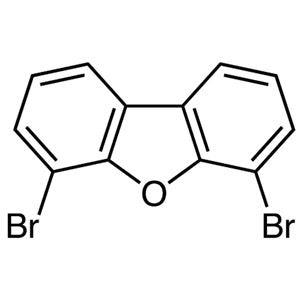
![2,7-Dibromodibenzo[b,e][1,4]dioxin (CAS 39073-07-9) - TCI D5528 - AMI Scientific](http://amiscientific.com/cdn/shop/files/TCI2510D5528.jpg?v=1768818458&width=1946)
![2,7-Dibromodibenzo[b,e][1,4]dioxin (CAS 39073-07-9) - TCI D5528 - AMI Scientific](http://amiscientific.com/cdn/shop/files/TCI2510D5528.jpg?v=1768818458&width=1445)
2,7-Dibromodibenzo[b,e][1,4]dioxin is an organic compound widely used in scientific research, particularly in the fields of materials chemistry and semiconductor technology. This compound plays a crucial role in laboratory settings as a foundational material for the synthesis of complex molecules. Its unique molecular structure and chemical properties make it a valuable tool for researchers aiming to develop advanced electronic materials and functional substances. Due to its stability and controlled reactivity, it is often selected for applications requiring high precision and reproducibility in chemical reactions.
The compound is characterized by its stable chemical properties and controlled reactivity, which are essential for maintaining consistency in experimental outcomes. Its molecular structure, featuring two bromine atoms at specific positions, enhances its reactivity and ability to form bonds with various other molecules. These characteristics make it highly suitable for targeted chemical reactions and molecular modifications. Additionally, its chemical stability under controlled laboratory conditions ensures minimal degradation during storage and use, making it a reliable choice for long-term research projects.
In Indonesian laboratories, 2,7-Dibromodibenzo[b,e][1,4]dioxin is utilized by researchers in educational institutions and research organizations. It supports studies in organic electronics, material science, and semiconductor technology, contributing to the development of innovative materials with specific electronic and structural properties. Its application is particularly relevant in the context of advancing scientific research in Indonesia, where the compound is used to meet the needs of both academic and industrial research initiatives.
TCI brochures (PDF)
- Building Blocks for Organic Semiconductor 2026-03-24 · p. 34
Related TCI products
- TCI D5525 250726-93-3 2-(2,3-Dihydrothieno[3,4-b][1,4]dioxin-5-yl)-4,4,5,5-tetramethyl-1,3,2-dioxaborolane
- TCI D4274 83834-10-0 3,7-Dibromodibenzo[b,d]thiophene
- TCI D5052 83834-12-2 3,7-Dibromodibenzothiophene 5,5-Dioxide
- TCI D4858 201138-91-2 4,6-Dibromodibenzofuran
- TCI D4821 10016-52-1 2,8-Dibromodibenzofuran
- TCI D2245 31574-87-5 2,8-Dibromodibenzothiophene
- Organic Electronics Research – This compound is ideal for synthesizing organic semiconductors due to its molecular structure and reactivity, enabling the development of advanced electronic materials.
- Semiconductor Material Development – Its controlled reactivity and stability make it suitable for creating semiconductor building blocks with precise electronic properties.
- Molecular Synthesis Studies – The compound's ability to form bonds with various molecules makes it a key component in the synthesis of complex organic structures.
- Functional Material Innovation – Its chemical stability and reactivity support the creation of functional materials with tailored properties for specific applications.
- Structural Chemistry Investigations – The compound's unique molecular configuration is valuable for studying molecular interactions and electronic behavior in materials science.
| Brand | TCI |
|---|---|
| CAS number | 39073-07-9 |
| Molecular formula | — |
| Purity | — |
| Category | Materials Science > Material Building Blocks > Small Molecule Semiconductor Building Blocks |
| Pack sizes | As per standard supplier offerings |
| Physical form | Solid (as per typical chemical compound form) |
| Storage | Store in a cool, dry place away from light and incompatible substances |
This compound should be stored in a cool, dry environment, away from direct sunlight and sources of heat. It is recommended to use airtight containers made of materials compatible with organic chemicals to prevent contamination and degradation. Due to its chemical stability, it does not require refrigeration but should be kept in a secure location to avoid accidental exposure. Laboratory personnel should handle the compound with appropriate personal protective equipment, such as gloves and safety goggles, to ensure safe handling. Proper ventilation should be maintained in the workspace to minimize inhalation risks. Regular inspection of storage conditions is advised to maintain the integrity of the compound throughout its shelf life.
—
Produk Terkait
-
2-(2,3-Dihydrothieno[3,4-b][1,4]dioxin-5-yl)-4,4,5,5-tetramethyl-1,3,2-dioxaborolane TCI D5525
Regular price Rp 2.942.100,00Regular price -
3,7-Dibromodibenzo[b,d]thiophene TCI D4274
Regular price Rp 7.023.450,00Regular price -
3,7-Dibromodibenzothiophene5,5-Dioxide TCI D5052
Regular price Rp 1.961.400,00Regular price -
4,6-Dibromodibenzofuran TCI D4858
Regular price From Rp 848.400,00Regular price -
2,8-Dibromodibenzofuran TCI D4821
Regular price From Rp 2.041.200,00Regular price -
2,8-Dibromodibenzothiophene TCI D2245
Regular price From Rp 823.200,00Regular price -
2,2,5,6-Tetramethyl-4H-1,3-dioxin-4-one TCI T1222
Regular price From Rp 4.373.250,00Regular price -
2,2,6-Trimethyl-1,3-dioxin-4-one TCI T1099
Regular price From Rp 903.000,00Regular price
![2-(2,3-Dihydrothieno[3,4-b][1,4]dioxin-5-yl)-4,4,5,5-tetramethyl-1,3,2-dioxaborolane (CAS 250726-93-3) - TCI D5525 - AMI Scientific](http://amiscientific.com/cdn/shop/files/TCI2510D5525.jpg?v=1768818457&width=533)
![3,7-Dibromodibenzo[b,d]thiophene (CAS 83834-10-0) - TCI D4274 - AMI Scientific](http://amiscientific.com/cdn/shop/files/TCI2510D4274.jpg?v=1768818058&width=533)