N,9-Diphenyl-9H-carbazol-3-amine with CAS number 894791-43-6 is a carbazole-based heterocyclic building block that carries an aromatic secondary amine group at the 3-position and a phenyl group on the ring nitrogen atom. This structure makes it an important intermediate in the synthesis of organic electronic materials, particularly hole-transport and light-emitting materials. In the laboratory, the compound serves as a source of a half-formed diarylamine group, so that researchers need only add one further aryl group to obtain a triarylamine, the structural motif very commonly used in the positive-charge-transport layers of organic electronic devices.
Its principal characteristic lies in the N-H amine group that remains available for further reaction. This group is a nucleophile well suited to Buchwald-Hartwig amination with aryl halides, allowing researchers to assemble target molecules modularly without having to build the carbazole framework from scratch. The combination of carbazole and arylamine produces strong electron-donor character together with an ionisation potential appropriate for hole injection. The carbazole framework is also known to be rigid and thermally stable, a property that supports the durability of the materials derived from it.
In Indonesian laboratories, this building block is typically used by university and institutional research groups working on organic semiconductors, OLED materials and related materials chemistry. It is handled in synthetic chemistry laboratories equipped for palladium-catalysed cross-coupling under inert atmosphere, and is usually purchased in research-scale quantities for method development, derivative preparation and structure-property studies rather than for production use.
TCI brochures (PDF)
- Building Blocks for Organic Semiconductor 2026-03-24 · p. 21
Related TCI products
- TCI B4960 226958-06-1 2,7-Bis(9H-carbazol-9-yl)-9,9-dimethylfluorene
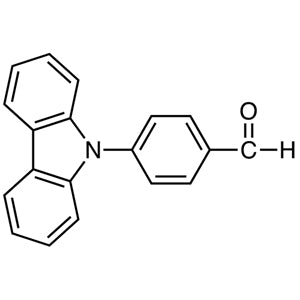
- TCI C3481 110677-45-7 4-(9H-Carbazol-9-yl)benzaldehyde
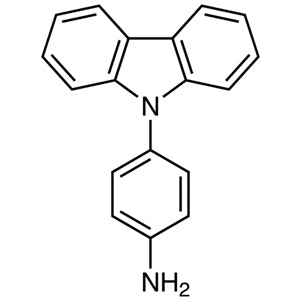
- TCI C3082 52708-37-9 4-(9H-Carbazol-9-yl)aniline
- TCI C2967 864377-33-3 3-(9H-Carbazol-9-yl)phenylboronic Acid (contains varying amounts of Anhydride)
- TCI C2926 419536-33-7 4-(9H-Carbazol-9-yl)phenylboronic Acid (contains varying amounts of Anhydride)
- TCI N1098 1133057-98-3 [9-(Naphthalen-2-yl)-9H-carbazol-3-yl]boronic Acid (contains varying amounts of Anhydride)
- Buchwald-Hartwig amination — the free N-H amine group reacts with aryl halides under palladium catalysis, letting researchers install the final aryl group and complete a triarylamine in a single modular step.
- Hole-transport material synthesis — the carbazole-arylamine combination gives strong electron-donating character and an ionisation potential suited to hole injection, making it a direct precursor for positive-charge-transport layers.
- Organic light-emitting material preparation — as a carbazole-based intermediate it feeds into the synthesis of emitter and host materials used in organic light-emitting device research programmes.
- Modular construction of triarylamine motifs — because the diarylamine is already half formed, researchers avoid building the carbazole skeleton from the beginning and shorten multi-step synthetic routes considerably.
- Thermally stable functional material development — the rigid carbazole framework contributes thermal stability to the derived products, supporting structure-property studies on durable organic electronic materials.
| Brand | TCI |
|---|---|
| CAS number | 894791-43-6 |
| Molecular formula | — |
| Purity | — |
| Category | Chemistry > Building Blocks > Heterocyclic Building Blocks |
| Pack sizes | available in standard TCI research-scale catalogue pack sizes; storage according to the manufacturer's label instructions |
| Physical form | — |
| Storage | — |
- Product code: D5567
- Chemical name: N,9-Diphenyl-9H-carbazol-3-amine
Store the container tightly closed in a cool, dry place away from direct sunlight, moisture and sources of ignition, following the storage conditions stated on the manufacturer's label and safety data sheet. Amber glass or the original supplier container is suitable, and transfers are best performed under an inert atmosphere where the subsequent chemistry requires dry conditions. Handle the compound in a fume hood using gloves, safety glasses and a laboratory coat, avoid generating dust during weighing, and keep the material separated from strong oxidising agents. Consult the current safety data sheet before first use and dispose of residues through the laboratory's chemical waste stream.
—
Product Categories
Produk Terkait
-
2,7-Bis(9H-carbazol-9-yl)-9,9-dimethylfluorene TCI B4960
Regular price From Rp 1.538.250,00Regular price -
4-(9H-Carbazol-9-yl)benzaldehyde TCI C3481
Regular price From Rp 3.155.250,00Regular price -
4-(9H-Carbazol-9-yl)aniline TCI C3082
Regular price Rp 10.812.900,00Regular price -
3-(9H-Carbazol-9-yl)phenylboronicAcid(containsvaryingamountsofAnhydride) TCI C2967
Regular price From Rp 1.246.350,00Regular price -
4-(9H-Carbazol-9-yl)phenylboronicAcid(containsvaryingamountsofAnhydride) TCI C2926
Regular price From Rp 1.485.750,00Regular price -
[9-(Naphthalen-2-yl)-9H-carbazol-3-yl]boronicAcid(containsvaryingamountsofAnhydride) TCI N1098
Regular price Rp 4.028.850,00Regular price -
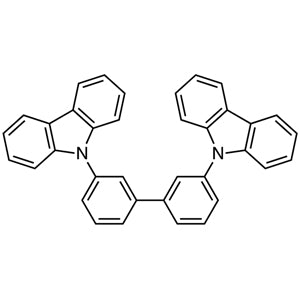
3,3'-Di(9H-carbazol-9-yl)-1,1'-biphenyl(purifiedbysublimation) TCI D5594
Regular price From Rp 2.650.200,00Regular price -
4-(3,6-Di-tert-butyl-9H-carbazol-9-yl)aniline TCI D5592
Regular price Rp 3.021.900,00Regular price



![1133057-98-3 [9-(Naphthalen-2-yl)-9H-carbazol-3-yl]boronic Acid (contains varying amounts of Anhydride) - AMI Scientific](http://amiscientific.com/cdn/shop/files/TCI2510N1098.jpg?v=1769143156&width=533)