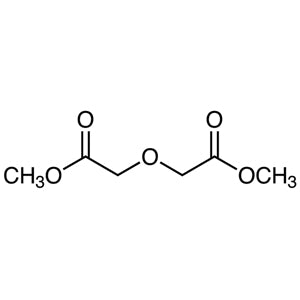
TCI D5721 Dimethyl 2,2'-Oxydiacetate is the dimethyl diester of diglycolic acid, a symmetrical molecule in which two ester groups are joined through a central ether bridge. The compound belongs to the family of non-heterocyclic building blocks and is widely used as a versatile starting material in organic synthesis laboratories. Its simple yet bifunctional skeleton gives researchers two equivalent reaction points together with a single ether oxygen atom that can act as a donor in the construction of macrocyclic compounds and cation-binding ligands.
The properties that make this compound valuable are the equivalence of its two ester groups and the flexibility of its chain. The ester groups can be hydrolysed, transesterified, converted to amides, reduced to alcohols, or condensed under Claisen conditions, so that a single starting material can be directed towards many different classes of product. Because both ends are identical, double reactions give clean symmetrical products without regioselectivity problems, while controlled reaction at one side opens a route to unsymmetrical derivatives. The ether bridge at the centre of the chain adds polarity, improves solubility in polar solvents, and provides a coordination site that is characteristic of macrocyclic chemistry.
In Indonesia, non-heterocyclic building blocks of this type are ordered mainly by university research laboratories, institutional synthesis groups, and industrial R&D units that prepare intermediates and reference materials in-house. The compound is typically handled at bench scale in fume hoods during multi-step synthesis work, and it is generally purchased in the packaged unit sizes offered by the manufacturer so that laboratories can match the quantity to a specific project rather than holding large volumes of a reactive intermediate.
Related TCI products
- TCI H1546 172611-72-2 2-(1-Hydroxy-3-methylbutylidene)-5,5-dimethyl-1,3-cyclohexanedione
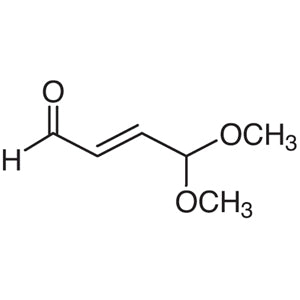
- TCI F0350 4093-49-6 Fumaraldehyde Mono(dimethyl Acetal) (stabilized with HQ)
- TCI E1417 6290-17-1 Ethyl 2-(2,4-Dimethyl-1,3-dioxolan-2-yl)acetate (mixture of diastereoisomers)
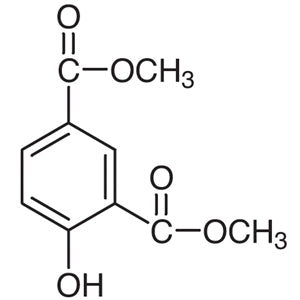
- TCI D3562 5985-24-0 Dimethyl 4-Hydroxyisophthalate
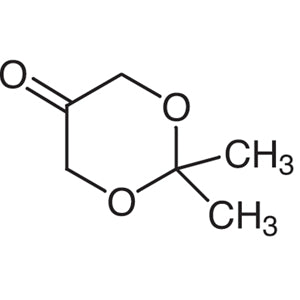
- TCI D2397 74181-34-3 2,2-Dimethyl-1,3-dioxan-5-one
- TCI M1168 128459-09-6 N-Methoxydiacetamide [Selective Acetylating Reagent]
- Macrocycle and crown-type ligand synthesis: the central ether oxygen acts as a donor atom while the two equivalent ester ends allow ring closure without regioselectivity complications during cyclisation work.
- Symmetrical diamide preparation: reaction of both ester groups with the same amine gives clean, symmetrical bis-amide products, making it a direct route to chelating amide ligands.
- Diol building block synthesis: reduction of both ester functions yields the corresponding diol, providing a flexible ether-containing linker for further derivatisation in multi-step routes.
- Unsymmetrical derivative synthesis: controlled reaction at only one ester end leaves the second group intact, allowing researchers to install two different functionalities on one flexible ether backbone.
- Claisen condensation substrate: the activated methyl ester groups participate in Claisen-type carbon–carbon bond formation, giving access to extended keto-ester frameworks from a simple, inexpensive starting skeleton.
| Brand | TCI |
|---|---|
| CAS number | 7040-23-5 |
| Molecular formula | — |
| Purity | — |
| Category | Chemistry > Building Blocks > Non-Heterocyclic Building Blocks |
| Pack sizes | supplied in the standard laboratory unit sizes listed by the manufacturer for this catalogue item |
| Physical form | — |
| Storage | store in a cool, dry place in a tightly closed container, in accordance with the manufacturer's label and safety data sheet |
- Product code: D5721
- Chemical name: Dimethyl 2,2'-Oxydiacetate (dimethyl diglycolate)
Store the container tightly closed in a cool, dry, well-ventilated area away from direct sunlight, heat sources, and incompatible materials such as strong oxidising agents, strong acids, and strong bases. Esters are moisture-sensitive over time, so keep the container sealed between uses and consider handling under dry conditions when the material is intended for anhydrous reactions. Use the original manufacturer container or a chemically compatible, clearly labelled glass vessel with a well-fitting closure; avoid transferring to unlabelled containers. Handle in a fume hood with standard personal protective equipment, including safety goggles, chemical-resistant gloves, and a laboratory coat, and avoid contact with skin and eyes as well as inhalation of vapours. Consult the manufacturer's safety data sheet before use, and dispose of residues and contaminated materials through the laboratory's chemical waste procedures rather than through the drain.
—
Produk Terkait
-
2-(1-Hydroxy-3-methylbutylidene)-5,5-dimethyl-1,3-cyclohexanedione TCI H1546
Regular price From Rp 2.121.000,00Regular price -
FumaraldehydeMono(dimethylAcetal)(stabilizedwithHQ) TCI F0350
Regular price From Rp 6.281.100,00Regular price -
Ethyl2-(2,4-Dimethyl-1,3-dioxolan-2-yl)acetate(mixtureofdiastereoisomers) TCI E1417
Regular price From Rp 610.050,00Regular price -
Dimethyl4-Hydroxyisophthalate TCI D3562
Regular price From Rp 1.458.450,00Regular price -
2,2-Dimethyl-1,3-dioxan-5-one TCI D2397
Regular price From Rp 2.650.200,00Regular price -
N-Methoxydiacetamide[SelectiveAcetylatingReagent] TCI M1168
Regular price Rp 2.837.100,00Regular price -
DimethylAcetylenedicarboxylate TCI A0090
Regular price From Rp 2.041.200,00Regular price -
Dimethyl1,3-Acetonedicarboxylate TCI A0056
Regular price From Rp 1.298.850,00Regular price


![128459-09-6 N-Methoxydiacetamide [Selective Acetylating Reagent] - AMI Scientific](http://amiscientific.com/cdn/shop/files/TCI2510M1168.jpg?v=1767124448&width=533)