

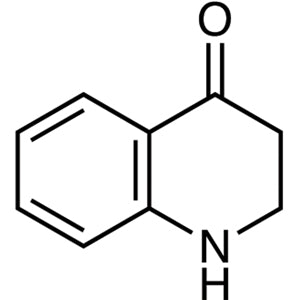
2,3-Dihydro-4(1H)-quinolinone (TCI D5773) is a heterocyclic building block built on a bicyclic framework in which a benzene ring is fused to a saturated nitrogen-containing ring bearing a ketone group. This arrangement, commonly referred to as the dihydroquinolinone scaffold, holds an important place in organic synthesis because it presents two reactive functional handles at once: a carbonyl group and an aromatic secondary amine. In the laboratory, the compound serves as a starting point for constructing quinoline and quinolone derivatives, as well as a range of synthetic alkaloid frameworks of interest in medicinal chemistry research.
The property that most often drives its selection is the flexibility of its reactivity. The ketone group can undergo reduction, condensation, and nucleophilic addition, or be converted into an enolate for substitution at the alpha position, while the ring nitrogen can be acylated, alkylated, or sulfonylated to install a variety of substituents. Combining both sites allows considerable structural diversity to be generated from a single starting material, which makes the compound an efficient choice for assembling compound libraries. This semi-saturated framework can also be oxidised further towards a fully aromatic quinoline system when required, adding to its versatility.
In Indonesian laboratories, this type of building block is typically used in university research groups, medicinal chemistry programmes, and synthetic method development work where a small, well-defined heterocyclic core is needed as a scaffold. It is usually handled at bench scale in synthetic organic chemistry laboratories equipped with a fume hood and standard glassware, and it is a practical choice for research groups that need to prepare a series of related derivatives from one common intermediate rather than sourcing many separate precursors.
Related TCI products
- TCI D3599 22246-18-0 3,4-Dihydro-7-hydroxy-2(1H)-quinolinone
- TCI D3448 54197-66-9 3,4-Dihydro-6-hydroxy-2(1H)-quinolinone
- TCI B3345 4876-10-2 4-(Bromomethyl)-2-quinolinone
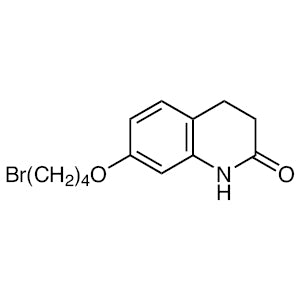
- TCI B3333 129722-34-5 7-(4-Bromobutoxy)-3,4-dihydro-2(1H)-quinolinone
- TCI B1512 7426-75-7 1,4-Bis(4,5-dihydro-2-oxazolyl)benzene
- TCI B1511 34052-90-9 1,3-Bis(4,5-dihydro-2-oxazolyl)benzene
- Quinoline derivative synthesis — the semi-saturated ring can be oxidised further towards a fully aromatic quinoline system, giving direct access to this widely studied heterocyclic class.
- Quinolone scaffold construction — the fused benzene ring and nitrogen-containing ring with its ketone group provide the core framework required to build quinolone-type structures.
- Synthetic alkaloid framework preparation — the bicyclic dihydroquinolinone core serves as a starting skeleton for alkaloid-like structures that attract attention in medicinal chemistry research.
- Compound library assembly — the presence of both a carbonyl group and a secondary aromatic amine allows many structural variants to be generated efficiently from a single starting material.
- N-functionalisation chemistry — the ring nitrogen can be acylated, alkylated, or sulfonylated, making the compound suitable for systematic substituent variation studies at that position.
| Brand | TCI |
|---|---|
| CAS number | 4295-36-7 |
| Molecular formula | — |
| Purity | — |
| Category | Chemistry > Building Blocks > Heterocyclic Building Blocks |
| Pack sizes | available in standard TCI research-scale packaging; please confirm the pack size required when ordering |
| Physical form | — |
| Storage | store in a closed original container under the conditions stated on the manufacturer's label and safety data sheet |
- Catalogue number: D5773
- Chemical name: 2,3-Dihydro-4(1H)-quinolinone
Store the material in its original tightly closed container, kept in a cool, dry, and well-ventilated area away from direct sunlight, heat sources, and incompatible reagents such as strong oxidising agents. Follow the storage temperature and any special conditions stated on the manufacturer's label and safety data sheet. Handle in a fume hood using appropriate personal protective equipment, including safety glasses, chemical-resistant gloves, and a laboratory coat, and avoid inhalation of dust and contact with skin or eyes. Because the carbonyl and amine groups are reactive, minimise unnecessary exposure to air and moisture by closing the container promptly after weighing. Dispose of residues and contaminated materials in accordance with institutional chemical waste procedures.
—
Produk Terkait
-
3,4-Dihydro-7-hydroxy-2(1H)-quinolinone TCI D3599
Regular price From Rp 769.650,00Regular price -
3,4-Dihydro-6-hydroxy-2(1H)-quinolinone TCI D3448
Regular price From Rp 1.326.150,00Regular price -
4-(Bromomethyl)-2-quinolinone TCI B3345
Regular price From Rp 1.405.950,00Regular price -
7-(4-Bromobutoxy)-3,4-dihydro-2(1H)-quinolinone TCI B3333
Regular price From Rp 689.850,00Regular price -
1,4-Bis(4,5-dihydro-2-oxazolyl)benzene TCI B1512
Regular price Rp 2.518.950,00Regular price -
1,3-Bis(4,5-dihydro-2-oxazolyl)benzene TCI B1511
Regular price From Rp 903.000,00Regular price -
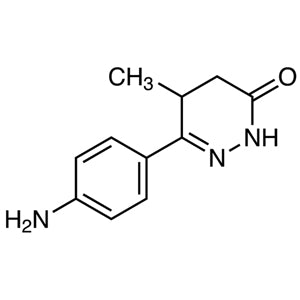
6-(4-Aminophenyl)-4,5-dihydro-5-methyl-3(2H)-pyridazinone TCI A2919
Regular price Rp 1.670.550,00Regular price -
4-[2-(2-Amino-4,7-dihydro-4-oxo-3H-pyrrolo[2,3-d]pyrimidin-5-yl)ethyl]benzoicAcid TCI A2618
Regular price From Rp 928.200,00Regular price




![137281-39-1 4-[2-(2-Amino-4,7-dihydro-4-oxo-3H-pyrrolo[2,3-d]pyrimidin-5-yl)ethyl]benzoic Acid - AMI Scientific](http://amiscientific.com/cdn/shop/files/TCI2510A2618.jpg?v=1767083121&width=533)