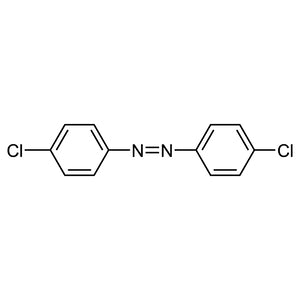
TCI D6361 is 5,5'-(Diazene-1,2-diyl)diisophthalic Acid, an azobenzene compound carrying four carboxylic acid groups, two on each aromatic ring. This arrangement makes it a tetratopic linker — a bridging molecule with four binding points that is highly sought after in the assembly of metal–organic frameworks (MOFs) and other porous materials. In materials chemistry laboratories, compounds of this type are combined with metal salts under solvothermal conditions so that the carboxylate groups coordinate to metal centres and build an ordered, porous crystalline network.
What makes this material distinctive is the azo bridge (–N=N–) at the centre of the molecule. Azo groups are known to switch configuration between trans and cis forms when illuminated at particular wavelengths, so materials constructed from this linker have the potential to display light-responsive behaviour. The relatively long molecular span also produces more spacious cavities than short linkers give, while the four carboxylic acid groups impart rigidity and stability to the resulting network. It is this combination of rigidity, length, and photoresponsive character that makes the compound a preferred building block.
In Indonesian laboratories, this reagent is typically used by materials chemistry and inorganic synthesis groups at universities and research institutes working on porous frameworks. It is normally handled in small quantities as a research-scale building block rather than as a bulk commodity, weighed out for solvothermal framework syntheses and structural studies. Researchers exploring stimulus-responsive and gas-related porous materials are the usual users of this type of linker.
TCI brochures (PDF)
- Organic Linker Molecules for Metal Organic Frameworks (MOFs) 2026-05-11 · p. 4
- Metal–organic framework synthesis — the four carboxylic acid groups coordinate to metal centres under solvothermal conditions, producing ordered crystalline porous networks from a single well-defined tetratopic building block.
- Photoresponsive material research — the central azo bridge can switch between trans and cis configurations under light of suitable wavelength, giving frameworks built from it potential light-triggered behaviour.
- Porous material development — the relatively long molecular span of this linker generates larger cavities within the assembled framework than shorter linkers of the same coordination chemistry can provide.
- Coordination polymer and network chemistry — the tetratopic connectivity offers four binding points per molecule, allowing researchers to construct extended networks with defined topology and predictable connection geometry.
- Structural and framework stability studies — the four carboxylate groups confer rigidity and stability on the assembled network, making this compound useful for investigating how linker design governs framework robustness.
| Brand | TCI |
|---|---|
| CAS number | 365549-33-3 |
| Molecular formula | — |
| Purity | — |
| Category | Chemistry > Building Blocks > Non-Heterocyclic Building Blocks |
| Pack sizes | available in research-scale laboratory pack sizes; please refer to the current catalogue listing |
| Physical form | — |
| Storage | store according to the manufacturer's instructions stated on the product label |
- Chemical name: 5,5'-(Diazene-1,2-diyl)diisophthalic Acid
- Product code: D6361
Store this compound in its original tightly closed container, kept in a cool, dry, well-ventilated place away from direct sunlight, since the azo functionality is light-sensitive by design. Amber glass or opaque containers help limit unintended photoisomerisation during storage. Handle the material in a fume hood using standard laboratory personal protective equipment — safety glasses, gloves, and a laboratory coat — and avoid generating dust when weighing the solid. Keep containers closed when not in use to prevent moisture uptake, and always consult the manufacturer's safety data sheet before handling, disposal, or transfer.
—
Product Categories
- Organic-Inorganic Hybrid MaterialsMetal Organic Frameworks (MOF) and Their Raw MaterialsOrganic Linker Molecules [Metal Organic Frameworks (MOFs) Precursors]
- Polymer/Macromolecule ReagentsMetal Organic Frameworks (MOF) and Their Raw MaterialsOrganic Linker Molecules [Metal Organic Frameworks (MOFs) Precursors]
Produk Terkait
-
1,2-Bis(4-chlorophenyl)diazene TCI B6866
Regular price Rp 6.970.950,00Regular priceRp 4.874.100,00Sale price Rp 6.970.950,00 -
IsophthalicAcid TCI I0155
Regular price Rp 477.750,00Regular priceRp 333.900,00Sale price Rp 477.750,00 -
5-BromoisophthalicAcid TCI B4232
Regular price Rp 1.193.850,00Regular priceRp 834.750,00Sale price Rp 1.193.850,00 -
5-NitroisophthalicAcid TCI N0520
Regular price Rp 903.000,00Regular priceRp 631.050,00Sale price Rp 903.000,00 -
5-MethoxyisophthalicAcid TCI M1835
Regular price Rp 4.001.550,00Regular priceRp 2.814.000,00Sale price Rp 4.001.550,00 -
5-HydroxyisophthalicAcid TCI H0794
Regular price Rp 1.298.850,00Regular priceRp 924.000,00Sale price Rp 1.298.850,00 -
TetrafluoroisophthalicAcid TCI T1374
Regular price Rp 2.625.000,00Regular priceRp 1.835.400,00Sale price Rp 2.625.000,00 -
2-NitroisophthalicAcid TCI N1086
Regular price Rp 1.590.750,00Regular priceRp 1.111.950,00Sale price Rp 1.590.750,00