

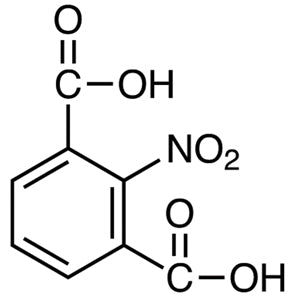
2-Nitroisophthalic Acid is a chemical compound widely used in laboratory settings for the synthesis of complex molecules. As a building block in organic chemistry, it plays a crucial role in the development of heterocyclic and organic compounds. Its aromatic structure provides a stable yet reactive framework, making it ideal for various chemical reactions. This compound is essential for researchers aiming to create new substances with specific functional groups and molecular architectures.
The compound is preferred due to its high chemical stability and reactivity under different reaction conditions. Its high melting point ensures it remains solid during synthesis processes, reducing the risk of decomposition. The complex molecular structure allows for substitution reactions and other critical transformations in synthetic pathways. These properties make it a reliable and versatile material for advanced chemical research.
In Indonesian laboratories, 2-Nitroisophthalic Acid is commonly used in organic synthesis and chemical analysis. It is a key component in studies involving the development of new compounds and the exploration of chemical reactivity. Its reliability and effectiveness have made it a popular choice among researchers in both academic and industrial settings.
Related TCI products
- Organic synthesis applications benefit from 2-Nitroisophthalic Acid due to its aromatic structure and reactivity, enabling the creation of complex organic molecules with high precision.
- Chemical analysis requires this compound for its stability and ability to participate in various reaction mechanisms, aiding in the identification and characterization of unknown substances.
- Heterocyclic compound development relies on this material as a starting point for constructing rings with specific functional groups, enhancing the diversity of synthesized compounds.
- Research in catalytic processes utilizes this acid for its ability to undergo substitution reactions, making it a valuable tool in the study of reaction mechanisms and catalyst performance.
- Industrial chemical production incorporates this compound as a building block for the synthesis of specialty chemicals, supporting the development of new products with tailored properties.
| Brand | TCI |
|---|---|
| CAS number | 21161-11-5 |
| Molecular formula | — |
| Purity | — |
| Category | Chemistry > Building Blocks > Non-Heterocyclic Building Blocks |
| Pack sizes | Available in standard laboratory quantities |
| Physical form | Solid |
| Storage | Store in a cool, dry place away from direct sunlight |
This compound should be stored in a cool, dry environment to maintain its chemical stability. It is recommended to keep it in a sealed container to prevent moisture absorption and contamination. Due to its reactivity, it should be handled with care, using appropriate personal protective equipment such as gloves and safety goggles. Avoid exposure to heat or direct sunlight, as these conditions may affect its physical properties. Proper ventilation is essential when working with this material to ensure a safe laboratory environment. Always follow standard laboratory safety protocols when handling and storing chemical substances.
—
Produk Terkait
-
Monoethyl5-Nitroisophthalate TCI N0676
Regular price From Rp 1.193.850,00Regular price -
5-NitroisophthalicAcid TCI N0520
Regular price From Rp 903.000,00Regular price -
IsophthalicAcid TCI I0155
Regular price From Rp 477.750,00Regular price -
Monomethyl5-Nitroisophthalate TCI N0641
Regular price From Rp 1.008.000,00Regular price -
Dimethyl5-Nitroisophthalate TCI N0567
Regular price Rp 928.200,00Regular price -
5,5'-(Diazene-1,2-diyl)diisophthalicAcid TCI D6361
Regular price From Rp 1.670.550,00Regular price -
5-IodoisophthalicAcid TCI I1308
Regular price Rp 3.843.000,00Regular price -
2-IodoisophthalicAcid TCI I0883
Regular price Rp 5.857.950,00Regular price


