

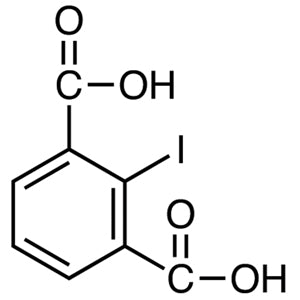
2-Iodoisophthalic Acid is a chemical compound widely used in laboratory settings as a building block for various chemical reactions, particularly in the synthesis of complex organic compounds. Its structure consists of an isophthalic acid backbone with an iodine atom attached at the 2-position, which significantly enhances its reactivity. This compound plays a crucial role in organic chemistry by enabling the formation of diverse molecular structures through functional group modifications. Due to its versatility, it is a valuable tool for researchers aiming to develop new chemical entities.
The unique properties of 2-Iodoisophthalic Acid make it a preferred choice in chemical synthesis. The presence of iodine increases its nucleophilic substitution potential, making it ideal for reactions such as Friedel-Crafts, coupling, and substitution reactions. Its ability to participate in multiple reaction pathways allows chemists to tailor the final product according to their needs. Additionally, its chemical stability under controlled conditions ensures reliable results in experimental setups. These characteristics make it a go-to reagent for advanced organic synthesis.
In Indonesian laboratories, 2-Iodoisophthalic Acid is commonly used in organic chemistry research conducted by universities and research institutions. It is particularly favored for its reactivity and adaptability in synthetic routes. Its application spans across various research fields, including pharmaceutical development and material science. Researchers in Indonesia rely on this compound for its consistent performance and reliability in complex chemical processes.
TCI brochures (PDF)
- Iodinated Phenol/Benzoic Acid/Benzaldehyde Building Blocks 2024-11-15 · p. 2
Related TCI products
- TCI I1308 51839-16-8 5-Iodoisophthalic Acid
- TCI I0155 121-91-5 Isophthalic Acid
- TCI A2169 31127-80-7 5-Acetamido-N,N'-bis(2,3-dihydroxypropyl)-2,4,6-triiodoisophthalamide
- TCI D6483 51839-15-7 Dimethyl 5-Iodoisophthalate
- TCI B4232 23351-91-9 5-Bromoisophthalic Acid
- TCI B1260 6939-93-1 4-Bromoisophthalic Acid
- Organic synthesis applications benefit from 2-Iodoisophthalic Acid due to its high reactivity and ability to form diverse chemical structures.
- It is widely used in pharmaceutical research for the development of new drug compounds through functional group modifications.
- The compound supports the creation of heterocyclic and non-heterocyclic molecules, making it essential for synthetic chemistry projects.
- In material science, it is employed to synthesize polymers and other advanced materials with specific functional properties.
- Its versatility in participating in nucleophilic substitution and coupling reactions makes it suitable for a broad range of chemical transformations.
| Brand | TCI |
|---|---|
| CAS number | 2902-65-0 |
| Molecular formula | — |
| Purity | — |
| Category | Chemistry > Building Blocks > Non-Heterocyclic Building Blocks |
| Pack sizes | Available in various quantities as per supplier specifications |
| Physical form | Solid |
| Storage | Store in a cool, dry place away from light and moisture |
2-Iodoisophthalic Acid should be stored in a cool, dry environment, away from direct sunlight and moisture to maintain its chemical stability. It is recommended to use airtight containers made of materials such as glass or polyethylene to prevent contamination and degradation. Due to its reactivity, it should be handled with care, using appropriate personal protective equipment like gloves and safety goggles. In laboratory settings, it should be stored separately from incompatible substances to avoid any potential chemical interactions. Proper labeling and storage conditions ensure the safety and effectiveness of the compound during its use.
—
Produk Terkait
-
5-IodoisophthalicAcid TCI I1308
Regular price Rp 3.843.000,00Regular price -
IsophthalicAcid TCI I0155
Regular price From Rp 477.750,00Regular price -
5-Acetamido-N,N'-bis(2,3-dihydroxypropyl)-2,4,6-triiodoisophthalamide TCI A2169
Regular price Rp 7.473.900,00Regular price -
Dimethyl5-Iodoisophthalate TCI D6483
Regular price From Rp 980.700,00Regular price -
5-BromoisophthalicAcid TCI B4232
Regular price From Rp 1.193.850,00Regular price -
4-BromoisophthalicAcid TCI B1260
Regular price From Rp 3.710.700,00Regular price -
2-NitroisophthalicAcid TCI N1086
Regular price Rp 1.590.750,00Regular price -
5-NitroisophthalicAcid TCI N0520
Regular price From Rp 903.000,00Regular price


