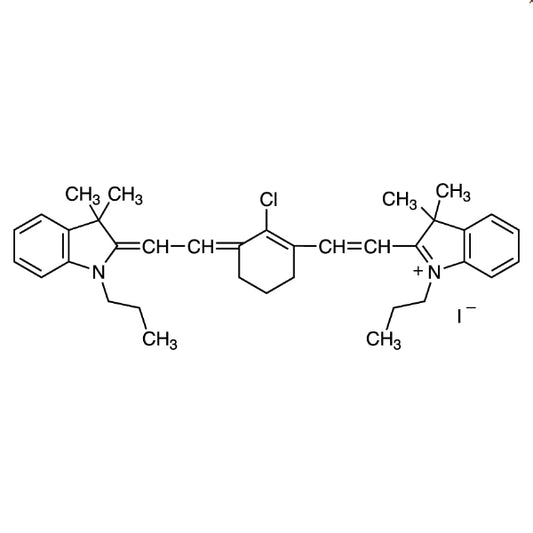
TCI D6451 is DiD, a lipophilic cyanine dye widely recognised as a cell membrane marker. Its molecule consists of an indodicarbocyanine core that fluoresces in the far-red region, together with two long alkyl chains that act as anchors. When the dye is added to a cell suspension, these alkyl chains insert themselves into the lipid bilayer of the membrane, so that the dye is retained and spreads evenly across the cell surface. In cell biology laboratories, its main role is to label cells, vesicles, or lipid-based particles so that they can be observed and traced by fluorescence microscopy as well as flow cytometry.
The property that makes DiD a frequent choice is the position of its excitation and emission wavelengths in the far-red region. In this range, background fluorescence from the natural components of tissue is far lower, and light penetrates tissue more deeply than green or blue light does, so the resulting images are cleaner and higher in contrast. The dye also fluoresces very weakly before it inserts into a membrane, after which its emission rises sharply once it sits in a lipid environment — a behaviour that suppresses background signal. Because it does not readily transfer between cells that are not in contact, the label stays where it was applied.
In Indonesian laboratories, TCI D6451 is typically handled in cell biology and biomedical research groups at universities, research institutes, and hospital laboratories equipped with fluorescence microscopes or flow cytometers. It is normally used at the bench level in small working quantities, prepared as a stock solution and diluted into cell suspensions before imaging. Laboratories with far-red capable filter sets and detectors benefit most, since the emission range of this dye requires appropriate optical configuration to be read correctly.
Related TCI products
- TCI T4274 36536-22-8 Hexacyanine 2
- TCI T4273 25470-94-4 1,3,3-Trimethyl-2-[3-(1,3,3-trimethylindolin-2-ylidene)prop-1-en-1-yl]-3H-indol-1-ium Iodide
- TCI T4272 19764-96-6 1,3,3-Trimethyl-2-[7-(1,3,3-trimethylindolin-2-ylidene)hepta-1,3,5-trien-1-yl]-3H-indol-1-ium Iodide
- TCI P3233 154214-55-8 PKH 26
- TCI O0574 ICG Carboxylic Acid
- TCI I1281 207399-07-3 IR 780
- Cell membrane labelling for fluorescence microscopy, where the long alkyl chains anchor the dye into the lipid bilayer so the marked cell surface stays uniformly and stably stained during observation.
- Flow cytometry of labelled cell populations, taking advantage of far-red emission that sits away from the wavelengths where natural tissue and media components contribute most of the background fluorescence.
- Tracking of lipid-based particles and vesicles, since the dye incorporates directly into lipid structures and reports their position without requiring any covalent chemical modification of the particle.
- Cell tracing studies over time, supported by the low tendency of the dye to transfer between cells that are not in physical contact, keeping the original labelling assignment intact.
- Deep-signal imaging work in tissue contexts, where far-red excitation and emission penetrate further than green or blue light and therefore yield cleaner, higher-contrast images.
| Brand | TCI |
|---|---|
| CAS number | 127274-91-3 |
| Molecular formula | — |
| Purity | — |
| Category | Materials Science > Photonic Materials and Optical Materials > Cyanine Dyes, Squarylium Dyes |
| Pack sizes | available in standard research-scale catalogue pack sizes; please confirm the packaging option when ordering. |
| Physical form | — |
| Storage | store according to the manufacturer's instructions stated on the product label and its safety data sheet. |
- Product Code: D6451
Store the container tightly closed in a cool, dark, and dry place, protected from light, since cyanine dyes are sensitive to prolonged light exposure. Amber glass vials or containers wrapped in foil are suitable for both the supplied material and any prepared stock solutions. Handle the dye in a well-ventilated area or a fume hood, wearing gloves, safety glasses, and a laboratory coat, and avoid contact with skin and eyes. Use clean, dry spatulas and pipettes to prevent contamination or moisture uptake, label all prepared solutions clearly, and consult the manufacturer's safety data sheet before first use and before disposing of any residues.
—
Produk Terkait
-
Hexacyanine2 TCI T4274
Regular price Rp 1.033.200,00Regular priceRp 738.150,00Sale price Rp 1.033.200,00 -
1,3,3-Trimethyl-2-[3-(1,3,3-trimethylindolin-2-ylidene)prop-1-en-1-yl]-3H-indol-1-iumIodide TCI T4273
Regular price Rp 1.033.200,00Regular priceRp 738.150,00Sale price Rp 1.033.200,00 -
1,3,3-Trimethyl-2-[7-(1,3,3-trimethylindolin-2-ylidene)hepta-1,3,5-trien-1-yl]-3H-indol-1-iumIodide TCI T4272
Regular price Rp 1.033.200,00Regular priceRp 738.150,00Sale price Rp 1.033.200,00 -
PKH26 TCI P3233
Regular price Rp 4.399.500,00Regular priceRp 3.092.250,00Sale price Rp 4.399.500,00 -
ICGCarboxylicAcid TCI O0574
Regular price Rp 4.240.950,00Regular priceRp 2.965.200,00Sale price Rp 4.240.950,00 -
IR780 TCI I1281
Regular price Rp 900.900,00Regular priceRp 645.750,00Sale price Rp 900.900,00 -
IR783 TCI I1031
Regular price Rp 2.702.700,00Regular priceRp 1.905.750,00Sale price Rp 2.702.700,00 -
IR775Chloride TCI I1026
Regular price Rp 2.411.850,00Regular priceRp 1.702.050,00Sale price Rp 2.411.850,00

![25470-94-4 1,3,3-Trimethyl-2-[3-(1,3,3-trimethylindolin-2-ylidene)prop-1-en-1-yl]-3H-indol-1-ium Iodide - AMI Scientific](http://amiscientific.com/cdn/shop/files/TCI2510T4273.jpg?v=1771058870&width=533)
![19764-96-6 1,3,3-Trimethyl-2-[7-(1,3,3-trimethylindolin-2-ylidene)hepta-1,3,5-trien-1-yl]-3H-indol-1-ium Iodide - AMI Scientific](http://amiscientific.com/cdn/shop/files/TCI2510T4272.jpg?v=1769143805&width=533)