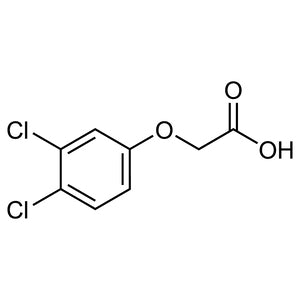
2-(3,4-Dichlorophenoxy)acetic Acid is a chemical compound widely used as a foundational building block in organic synthesis. It serves as a versatile intermediate in the creation of various organic compounds, playing a crucial role in laboratory settings where chemical reactions involving phenolic and carboxylic acid groups are required. Its molecular structure allows for a range of chemical modifications, making it an essential tool for chemists working on complex molecule synthesis. This compound is particularly valuable in research and educational environments due to its adaptability and chemical stability under controlled conditions.
The compound is known for its chemical stability and ability to form stable bonds with a variety of functional groups, which makes it a preferred choice for synthetic chemists. Its predictable reactivity and compatibility with different reagents allow for the efficient synthesis of target molecules. Additionally, its relatively simple molecular structure enables researchers to easily incorporate it into more complex chemical frameworks. These properties contribute to its popularity in both academic and industrial chemical research.
In Indonesian laboratories, 2-(3,4-Dichlorophenoxy)acetic Acid is commonly used by researchers and students in organic chemistry experiments. It is an essential component in the study of chemical reactions and the development of new compounds for pharmaceutical and industrial applications. Its availability in the local market supports ongoing research and teaching activities, ensuring that it remains a key material in the chemical sciences.
Related TCI products
- Organic synthesis is a primary application where this compound is used to create complex molecules by reacting with various functional groups.
- Pharmaceutical research benefits from its role in developing new drug compounds through structural modifications.
- Educational institutions use it in teaching organic chemistry to demonstrate reaction mechanisms and synthesis techniques.
- Industrial chemical processes incorporate it as a building block for producing specialty chemicals and intermediates.
- Environmental studies may utilize it to analyze the behavior of chlorinated compounds in different chemical environments.
| Brand | TCI |
|---|---|
| CAS number | 588-22-7 |
| Molecular formula | — |
| Purity | — |
| Category | Chemistry > Building Blocks > Non-Heterocyclic Building Blocks |
| Pack sizes | Available in various quantities as per supplier specifications |
| Physical form | Solid, typically in crystalline or powder form |
| Storage | Store in a cool, dry place away from light and moisture |
This compound should be stored in a cool, dry environment, away from direct sunlight and moisture to maintain its chemical integrity. It is recommended to use airtight containers made of materials such as glass or polyethylene to prevent contamination and degradation. Due to its chemical nature, it should be handled with appropriate personal protective equipment, including gloves and safety goggles, to ensure laboratory safety. It is important to keep it away from incompatible substances such as strong oxidizers to avoid potential chemical reactions. Proper labeling and storage conditions are essential to maintain its effectiveness and ensure safe handling in laboratory settings.
—
Produk Terkait
-
Methyl(2,4-Dichlorophenoxy)acetate TCI D6084
Regular price From Rp 2.306.850,00Regular price -
2,4,6-TrichlorophenoxyaceticAcid TCI T1063
Regular price From Rp 3.232.950,00Regular price -
4-NitrophenoxyaceticAcid TCI N0226
Regular price From Rp 1.115.100,00Regular price -
2-NitrophenoxyaceticAcid TCI N0225
Regular price From Rp 1.035.300,00Regular price -
3-NitrophenoxyaceticAcid TCI N0224
Regular price From Rp 1.565.550,00Regular price -
2,4-DichlorophenoxyaceticAcid TCI D0396
Regular price From Rp 664.650,00Regular price -
2-(4-Chlorophenoxy)propanoicAcid TCI C3880
Regular price Rp 2.359.350,00Regular price -
2-(4-Chlorophenoxy)benzaldehyde TCI C3351
Regular price From Rp 2.650.200,00Regular price