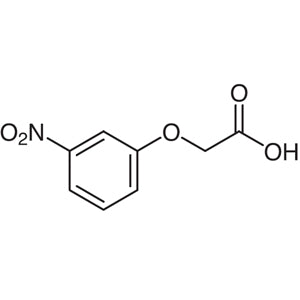
3-Nitrophenoxyacetic Acid is a chemical compound widely used in organic synthesis reactions within laboratory settings. It serves as a key building block in the development of both heterocyclic and non-heterocyclic compounds. Its chemical structure allows it to participate in various synthetic pathways, making it a versatile reagent for researchers. This compound is particularly valuable in the creation of bioactive molecules, including pharmaceuticals and industrial chemicals. Its role in laboratory research is essential for advancing chemical innovation and understanding molecular behavior.
The compound is valued for its stable chemical structure and controlled reactivity, which make it suitable for substitution and coupling reactions. It is soluble in organic solvents such as ethyl acetate and acetone, facilitating easy processing and separation in laboratory procedures. These properties contribute to its popularity among chemists and researchers who require reliable and efficient reagents for their experiments. Its solubility and reactivity ensure that it can be effectively integrated into a wide range of chemical processes.
In Indonesian laboratories, 3-Nitrophenoxyacetic Acid is commonly used in organic chemistry research, chemical material development, and studies of complex compound properties. Its reliability and effectiveness in various reactions make it a preferred choice for both academic and industrial research. Researchers and students rely on this compound for its consistent performance and applicability in diverse experimental contexts.
- Organic synthesis reactions where substitution and coupling are required due to its controlled reactivity and stable structure.
- Development of pharmaceutical compounds as a building block for bioactive molecule synthesis.
- Industrial chemical production processes that require reliable and efficient reagents for large-scale applications.
- Research on complex compound properties, especially in studies involving molecular behavior and reactivity.
- Academic experiments in chemistry education where high-quality building blocks are essential for teaching and learning.
| Brand | TCI |
|---|---|
| CAS number | 1878-88-2 |
| Molecular formula | — |
| Purity | — |
| Category | Chemistry > Building Blocks > Non-Heterocyclic Building Blocks |
| Pack sizes | Available in standard laboratory quantities |
| Physical form | Solid or liquid, depending on the specific product variant |
| Storage | Store in a cool, dry place away from direct sunlight |
This compound should be stored in a cool, dry environment, away from direct sunlight and sources of heat. It is recommended to use airtight containers to prevent moisture absorption and contamination. Due to its chemical nature, it should be handled with appropriate personal protective equipment, such as gloves and safety goggles, to ensure laboratory safety. Proper ventilation is essential when working with this material to minimize exposure. It is important to keep the compound in a secure location to prevent accidental spills or contamination. Regular inspection of storage conditions is advised to maintain the integrity of the material.
—
Produk Terkait
-
4-NitrophenoxyaceticAcid TCI N0226
Regular price From Rp 1.115.100,00Regular price -
2-NitrophenoxyaceticAcid TCI N0225
Regular price From Rp 1.035.300,00Regular price -
2,4,6-TrichlorophenoxyaceticAcid TCI T1063
Regular price From Rp 3.232.950,00Regular price -
2-Phenoxyacetophenone TCI P2121
Regular price Rp 1.298.850,00Regular price -
4'-Phenoxyacetophenone TCI P1355
Regular price Rp 1.298.850,00Regular price -
PhenoxyaceticAnhydride TCI P0111
Regular price From Rp 4.399.500,00Regular price -
PhenoxyaceticAcid TCI P0107
Regular price From Rp 637.350,00Regular price -
2-(3,4-Dichlorophenoxy)aceticAcid TCI D6455
Regular price From Rp 1.696.800,00Regular price