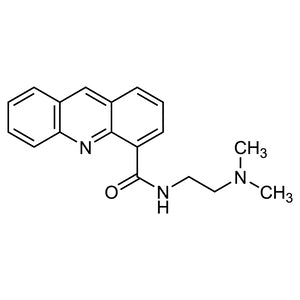
TCI D6653, bearing CAS number 89459-25-6 and commonly abbreviated as DACA, is an acridine-carboxamide derivative belonging to the class of fused aromatic heterocyclic compounds. It is supplied in a 10 mg micro-pack and is intended exclusively for research and laboratory testing purposes. On the researcher's bench, DACA serves both as a reference compound and as a heterocyclic building block in studies of how small molecules interact with biological macromolecules, largely because its acridine framework is a highly distinctive planar aromatic system.
The principal characteristics that make this compound a preferred choice are its flat, extensively conjugated acridine core combined with a carboxamide group bearing a basic amine side chain. This combination delivers two capabilities at once: the ability to intercalate into stacked structures, and the ability to engage in electrostatic interactions through the protonated amine group. The acridine system is also fluorescent, so its behaviour can be monitored with a spectrofluorometer without the need for any additional labelling. These built-in properties reduce the number of preparatory steps required before meaningful data can be collected.
In Indonesian laboratories, the 10 mg pack size reflects the fact that this compound is used at very low concentrations in experiments, so a small quantity is already sufficient for many runs. This format suits university research groups, institutional laboratories, and analytical testing facilities that need a well-defined heterocyclic reference material without committing to bulk quantities. It is handled as a research-grade material within a controlled laboratory workflow rather than in routine production settings.
- Molecular interaction studies — the planar acridine core allows the compound to intercalate into stacked structures, making it suitable for investigating how small molecules associate with biological macromolecules.
- Fluorescence-based measurement — because the acridine system is intrinsically fluorescent, binding behaviour can be tracked directly on a spectrofluorometer without attaching an external label or reporter dye.
- Heterocyclic building block work — the acridine-carboxamide scaffold provides a defined fused aromatic framework that synthetic chemists can use as a starting structure in heterocyclic chemistry programmes.
- Reference compound use — supplied as a characterised material with a specific CAS identity, it serves as a comparison standard when validating methods or confirming the behaviour of related acridine derivatives.
- Electrostatic interaction studies — the basic amine side chain on the carboxamide group can become protonated, enabling experiments that examine charge-driven association alongside the planar stacking contribution.
| Brand | TCI |
|---|---|
| CAS number | 89459-25-6 |
| Molecular formula | — |
| Purity | — |
| Category | Chemistry > Building Blocks > Heterocyclic Building Blocks |
| Pack sizes | 10 mg micro-pack |
| Physical form | — |
| Storage | — |
- Common abbreviation: DACA
- Chemical class: acridine-carboxamide derivative, fused aromatic heterocyclic compound
- Intended use: research and laboratory testing only
Store the compound in its original tightly closed container, kept in a cool, dry place away from direct sunlight and sources of heat or ignition. Because the material is supplied in a 10 mg micro-pack, weighing should be carried out carefully on an analytical balance to avoid unnecessary loss, and the container should be reclosed promptly after use. Amber glass vials are appropriate for prepared solutions, since acridine systems are light-sensitive by nature. Handle the compound inside a fume hood while wearing a laboratory coat, chemical-resistant gloves, and safety glasses. Avoid inhalation of dust and any contact with skin or eyes. Label all working solutions clearly with the compound identity and preparation date, keep the material separate from incompatible substances, and dispose of residues and contaminated consumables through the laboratory's designated chemical waste route. Always consult the manufacturer's safety data sheet before first use.
—
Produk Terkait
-
O~6~-Benzylguanine TCI B4208
Regular price From Rp 1.220.100,00Regular priceRp 868.350,00Sale price From Rp 1.220.100,00 -
alpha-Naphthoflavone TCI B0056
Regular price Rp 795.900,00Regular priceRp 572.250,00Sale price Rp 795.900,00 -
1-Aminobenzotriazole TCI A1464
Regular price Rp 6.067.950,00Regular priceRp 4.258.800,00Sale price Rp 6.067.950,00 -
1,10-Phenanthroline-5,6-dione TCI P1973
Regular price Rp 3.472.350,00Regular priceRp 2.443.350,00Sale price Rp 3.472.350,00 -
2-Methyl-4(1H)-quinazolinone TCI M2709
Regular price Rp 2.677.500,00Regular priceRp 1.887.900,00Sale price Rp 2.677.500,00 -
3,3'-Methylenediindole TCI M1399
Regular price Rp 822.150,00Regular priceRp 590.100,00Sale price Rp 822.150,00 -
Melatonin TCI M1105
Regular price Rp 1.988.700,00Regular priceRp 1.405.950,00Sale price Rp 1.988.700,00 -
6-MercaptopurineMonohydrate TCI M0063
Regular price Rp 530.250,00Regular priceRp 386.400,00Sale price Rp 530.250,00