

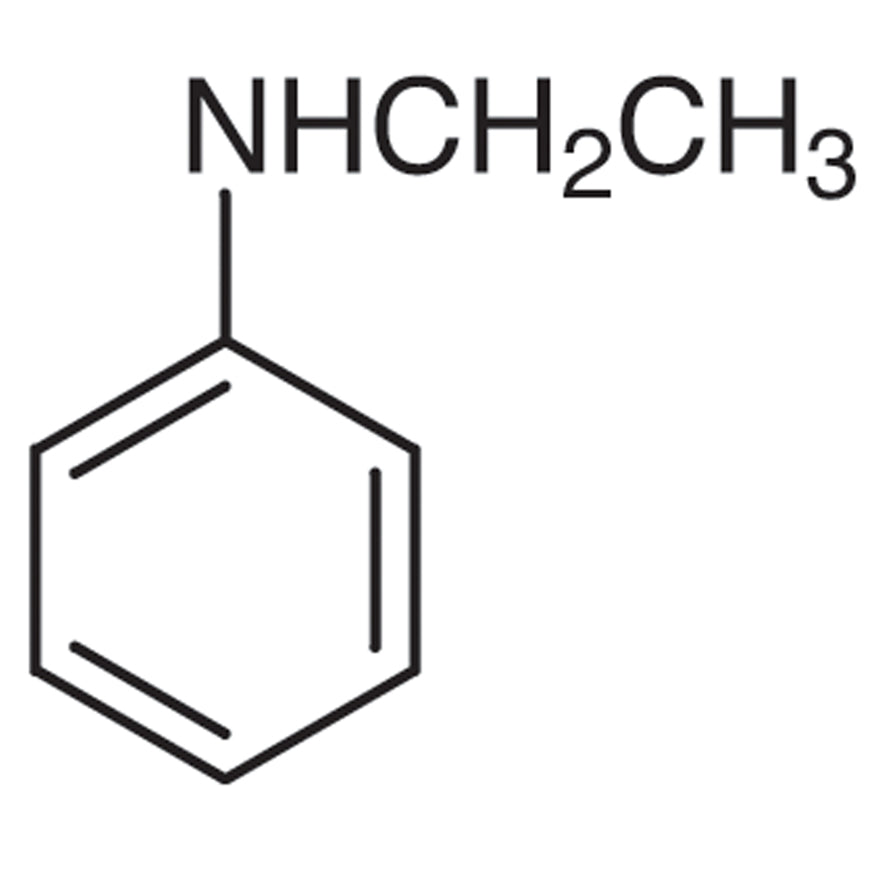
TCI E0059 N-Ethylaniline is a secondary aromatic amine formed from aniline with a single ethyl group bound to the nitrogen atom. This simple structure makes it one of the classic starting materials in organic chemistry, particularly in the preparation of dyes, intermediate compounds, and active substances. In the laboratory, the compound serves as a supplier of an activated aromatic nitrogen group, as a weak base in certain reactions, and as a starting material for alkylation, acylation, and condensation reactions that build up larger molecular frameworks.
The properties that make it a preferred choice are the combination of a nitrogen atom whose nucleophilicity remains high and a strongly activated aromatic ring. As a secondary amine, its nitrogen is ready to react with acyl halides, anhydrides, and other electrophiles, while the nitrogen lone pair makes the para position of the benzene ring highly reactive toward substitution. That combination explains why this compound has become a backbone of triphenylmethane and azo dye synthesis. Synthesis-grade quality from TCI also matters because aromatic amines darken easily through air oxidation, and a product that has already darkened can interfere with colour observation.
In Indonesian laboratories, N-Ethylaniline is typically used in university organic synthesis teaching and research work, in dye and pigment development, and in the preparation of intermediates for further reaction steps. It is generally ordered in modest bottle quantities because a single synthesis campaign consumes only small volumes, and because a freshly opened bottle gives more reliable results than one that has been stored for a long time under variable ambient conditions.
- Triphenylmethane dye synthesis: the activated aromatic ring and reactive secondary nitrogen let this amine condense readily with carbonyl partners to build the characteristic dye chromophore.
- Azo dye and pigment preparation: the strongly activated para position couples efficiently with diazonium electrophiles, making this compound a dependable coupling component for azo colourant work.
- N-Acylation studies: as a secondary amine, its nitrogen reacts cleanly with acyl halides and anhydrides, giving predictable amide products for mechanism teaching and derivative preparation.
- N-Alkylation and quaternisation reactions: the remaining N–H bond provides a single well-defined site for further alkylation, allowing controlled conversion to tertiary amine intermediates.
- Synthesis of larger intermediates and active substances: the compound acts as an aromatic nitrogen building block in condensation sequences that assemble more elaborate molecular frameworks.
| Brand | TCI (Tokyo Chemical Industry) |
|---|---|
| CAS number | 103-69-5 |
| Molecular formula | — |
| Purity | — |
| Category | Chemistry > Building Blocks > Non-Heterocyclic Building Blocks |
| Pack sizes | — |
| Physical form | — |
| Storage | keep tightly closed and protected from air and light, as aromatic amines darken on oxidation |
- Chemical name: N-Ethylaniline
- Grade: synthesis grade, supplied in standard TCI laboratory bottle pack sizes
Store N-Ethylaniline in a tightly closed original container, kept in a cool, dry, well-ventilated chemical cabinet away from direct sunlight and heat sources. Because aromatic amines darken through contact with air, minimise headspace and reseal the bottle immediately after each withdrawal; a bottle that has already darkened may interfere with colour observation in dye work. Handle in a fume hood using gloves, safety glasses, and a laboratory coat, since aromatic amines can be absorbed through the skin. Keep the material separated from strong oxidising agents and strong acids, and follow the institution's chemical waste procedures for residues and rinsings.
—
Produk Terkait
-
4,4'-Methylenebis(2-ethylaniline) TCI M3167
Regular price From Rp 1.326.150,00Regular price -
2-Ethylaniline TCI E0060
Regular price From Rp 769.650,00Regular price -
N-(2-Cyanoethyl)-N-ethylaniline TCI C0451
Regular price From Rp 452.550,00Regular price


