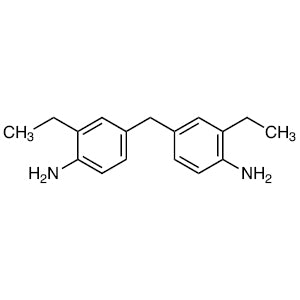
4,4'-Methylenebis(2-ethylaniline), CAS 19900-65-3, is an aromatic diamine composed of two ethyl-substituted aniline rings joined by a methylene bridge. It belongs to the class of non-heterocyclic building blocks widely used in materials science research and polymer chemistry. Because each molecule carries two primary amine groups, it functions as a difunctional monomer — a material able to react at two sites simultaneously, allowing it to build long chains or three-dimensional networks together with its reaction partners inside a polymer system. This structural arrangement places the compound among the standard reagents stocked by laboratories working on thermosetting and engineered polymer formulations.
The property that makes this diamine a preferred choice lies in the ethyl groups attached at the ortho position relative to each amine. These groups introduce controlled steric hindrance that slows the reaction rate of the amines compared with unsubstituted aromatic diamines, so researchers gain a longer working time when mixing and pouring resin systems before curing begins. The ethyl substituents also improve solubility in organic media and influence the packing density of the resulting polymer chains, which in turn affects the glass transition temperature, flexibility, and thermal resistance of the finished material.
In Indonesian laboratories, this building block is typically handled in university research groups, polymer and materials science institutes, and industrial R&D units developing coatings, adhesives, and composite matrices. It is generally used at bench scale for formulation trials, where the extended pot life is valuable during manual mixing and casting. Analytical and synthetic chemistry laboratories also keep it as a reference difunctional amine when comparing cure behaviour across different diamine structures.
Related TCI products
- TCI E0060 578-54-1 2-Ethylaniline
- TCI E0059 103-69-5 N-Ethylaniline
- TCI C0451 148-87-8 N-(2-Cyanoethyl)-N-ethylaniline
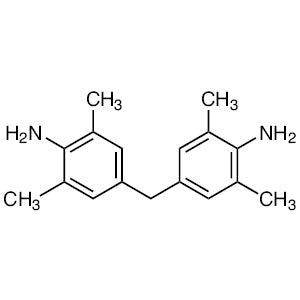
- TCI M3403 4073-98-7 4,4'-Methylenebis(2,6-dimethylaniline)
- TCI M3183 106246-33-7 4,4'-Methylenebis(3-chloro-2,6-diethylaniline)
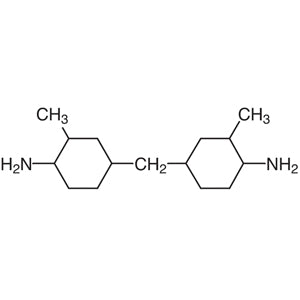
- TCI M1422 6864-37-5 4,4'-Methylenebis(2-methylcyclohexylamine) (mixture of isomers)
- Epoxy resin curing studies — the two primary amine groups react with epoxide rings to build crosslinked networks, while the ortho-ethyl hindrance extends pot life during mixing and casting trials.
- Polymer network and thermoset development — as a difunctional monomer it forms three-dimensional networks, letting researchers correlate diamine structure with glass transition temperature, flexibility, and thermal resistance.
- Polyamide and polyimide synthesis research — the aromatic diamine backbone serves as the amine component when preparing high-performance polymer chains for structural and thermal characterisation work.
- Composite matrix formulation — controlled amine reactivity gives longer working time when impregnating fibres or fillers by hand before the matrix begins to harden.
- Organic synthesis as a non-heterocyclic building block — the two accessible amine sites allow symmetric derivatisation routes toward larger molecules in methodology and intermediate development studies.
| Brand | TCI |
|---|---|
| CAS number | 19900-65-3 |
| Molecular formula | — |
| Purity | — |
| Category | Chemistry > Building Blocks > Non-Heterocyclic Building Blocks |
| Pack sizes | available in standard TCI research-scale packaging; please refer to the current listing for the sizes offered |
| Physical form | — |
| Storage | keep in a cool, dry place in a tightly closed container, away from light and oxidising agents |
- Product code: M3167
Store the container tightly closed in a cool, dry, well-ventilated area, protected from direct sunlight and kept away from strong oxidising agents and acids. Use the original supplier packaging or a compatible tightly sealed glass or chemically resistant container, clearly labelled and dated on receipt. Aromatic amines should be handled inside a fume hood with appropriate personal protective equipment, including nitrile gloves, safety goggles, and a laboratory coat, avoiding skin contact, inhalation of dust, and contamination of shared workspaces. Allow sealed containers to reach room temperature before opening to limit moisture condensation, and dispose of residues and contaminated materials through the laboratory's designated chemical waste stream in line with institutional procedures and the manufacturer's safety data sheet.
—
Produk Terkait
-
2-Ethylaniline TCI E0060
Regular price From Rp 769.650,00Regular price -
N-Ethylaniline TCI E0059
Regular price From Rp 505.050,00Regular price -
N-(2-Cyanoethyl)-N-ethylaniline TCI C0451
Regular price From Rp 452.550,00Regular price -
4,4'-Methylenebis(2,6-dimethylaniline) TCI M3403
Regular price From Rp 2.359.350,00Regular price -
4,4'-Methylenebis(3-chloro-2,6-diethylaniline) TCI M3183
Regular price Rp 1.140.300,00Regular price -
4,4'-Methylenebis(2-methylcyclohexylamine)(mixtureofisomers) TCI M1422
Regular price From Rp 505.050,00Regular price -
4,4'-Methylenebis[N-(sec-butyl)aniline] TCI B6650
Regular price From Rp 1.008.000,00Regular price -
2,2'-Methylenebis(6-bromo-4-chlorophenol) TCI M1940
Regular price Rp 2.279.550,00Regular price



![4,4'-Methylenebis[N-(sec-butyl)aniline] (CAS 5285-60-9) - TCI B6650 - AMI Scientific](http://amiscientific.com/cdn/shop/files/TCI2510B6650.jpg?v=1768816090&width=533)