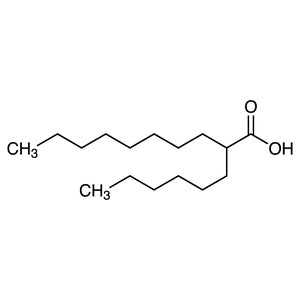
TCI E0120 2-Ethylhexanoic Acid is a branched eight-carbon carboxylic acid carrying an ethyl group on the alpha carbon. This branching adjacent to the carboxyl group is what distinguishes it from linear fatty acids and has made it one of the most widely used organic acids in the materials laboratory. Its principal role is as a precursor to metal salts and metal soaps — metal carboxylates that serve as catalysts, coating driers, polymer stabilisers, and solution precursors for the preparation of metal oxides.
The property that leads researchers to select this acid is the ability of its carboxyl group to form stable complexes with a wide range of metal ions while simultaneously contributing a branched hydrocarbon tail that renders the resulting metal salt soluble in organic solvents. This is the reason 2-ethylhexanoate-based metal carboxylates can be used in non-aqueous systems, unlike acetate or nitrate salts, which are generally only water-soluble. The alpha branching also imposes steric hindrance that suppresses the tendency of these salts to crystallise, so the product takes the form of a solution or viscous liquid that is easy to measure out and blend.
Laboratories in Indonesia draw on this material in catalysis research, in nanoparticle and thin-film synthesis, and in coatings and polymer work where an organic-soluble metal source is required. It is a routine bench reagent for groups preparing metal carboxylate precursors in-house rather than purchasing each individual salt, and it supports both academic materials research and industrial formulation and quality-control laboratories.
TCI brochures (PDF)
- Colloidal Quantum Dot (QD) Research Reagents 2026-05-21 · p. 5
- Building Blocks for Organic Semiconductor 2026-03-24 · p. 43
- Metal carboxylate synthesis — reaction with metal oxides, hydroxides, or salts gives 2-ethylhexanoates whose branched tail makes them soluble and stable in organic reaction media.
- Catalyst preparation — metal 2-ethylhexanoates prepared from this acid function as soluble catalysts, allowing the active metal to be introduced homogeneously into non-aqueous systems.
- Solution-route metal oxide processing — the acid supplies organic-soluble precursors for sol-gel and related routes to metal oxides, giving control over precursor concentration and mixing.
- Nanoparticle and thin-film synthesis — its carboxyl group complexes metal ions in organic solvents, so it serves both as a metal source and as a coordinating species during growth.
- Coatings and polymer formulation studies — it underpins the driers and polymer stabilisers used in coating research, where organic solubility and resistance to crystallisation are essential.
| Brand | TCI (Tokyo Chemical Industry) |
|---|---|
| CAS number | 149-57-5 |
| Molecular formula | — |
| Purity | — |
| Category | Chemistry > Building Blocks > Non-Heterocyclic Building Blocks |
| Pack sizes | available in standard TCI research and bulk pack sizes; please refer to the listed options when ordering |
| Physical form | — |
| Storage | keep in a tightly closed container in a cool, dry, well-ventilated area away from incompatible materials |
- Catalogue number: E0120
Store the container tightly closed in a cool, dry, well-ventilated place, away from oxidising agents, strong bases, and sources of ignition or heat. Original supplier packaging is preferred; where transfer is necessary, use glass or a chemically compatible container with a sealing closure, and label it clearly. Handle in a fume hood or a well-ventilated work area, and wear safety glasses, chemical-resistant gloves, and a laboratory coat, as carboxylic acids are irritating to skin, eyes, and the respiratory tract. Avoid inhaling vapour, use dedicated clean glassware and pipettes when dispensing, keep spill absorbent nearby, and consult the manufacturer's safety data sheet before first use.
—
Product Categories
Produk Terkait
-
5-MethylhexanoicAcid TCI M1142
Regular price From Rp 1.246.350,00Regular price -
2-MethylhexanoicAcid TCI M0947
Regular price From Rp 689.850,00Regular price -
2-HexadecyloctadecanoicAcid TCI H0837
Regular price Rp 3.763.200,00Regular price -
2-HexyldecanoicAcid TCI H0507
Regular price From Rp 795.900,00Regular price -
3,5,5-TrimethylhexanoicAcid TCI T0630
Regular price From Rp 477.750,00Regular price -
2,2-DimethylhexanoicAcid TCI D2809
Regular price From Rp 3.870.300,00Regular price -
Triethylhexanoin TCI T4161
Regular price From Rp 743.400,00Regular price -
1-Bromo-2-ethylhexane TCI B0596
Regular price From Rp 769.650,00Regular price