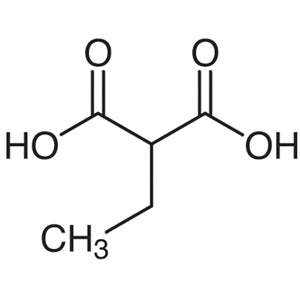
Ethylmalonic Acid with CAS number 601-75-2 is a dicarboxylic acid that carries an ethyl group on the carbon atom situated between its two carboxyl functions. This characteristic malonate structure makes it an important building block in organic synthesis, particularly because the malonate skeleton readily undergoes decarboxylation and carbon–carbon bond formation. In the laboratory, the compound serves as a practical source for introducing branched carbon units into target molecules, while also acting as a comparison material in a range of analytical studies and metabolic research involving short-chain organic acids.
The properties that make Ethylmalonic Acid a frequently chosen reagent centre on its two adjacent carboxyl groups, which give the compound a stronger acidity than comparable monocarboxylic acids and allow it to decarboxylate readily on heating. Those same two groups open the way to the selective formation of esters, amides, or salts, granting considerable freedom in synthetic design. As a crystalline solid, the material is relatively straightforward to weigh out and handle — a practical advantage for laboratories that demand accuracy in dosing. Its solubility behaviour in common solvents further supports flexible reaction planning.
In Indonesian laboratories, this TCI-branded reagent is typically encountered in academic and institutional organic synthesis work, where the malonate framework is used to build branched carbon chains, and in analytical laboratories that require a well-defined short-chain organic acid for method development and comparison purposes. Research groups working on metabolic studies of organic acids also draw on it, as do teaching laboratories illustrating the classic chemistry of malonic acid derivatives to students.
- Organic synthesis building block — the malonate skeleton supports reliable carbon–carbon bond formation, letting chemists assemble branched carbon frameworks into target molecules with a well-understood reaction pathway.
- Decarboxylation chemistry — because the malonate structure decarboxylates readily under heating, the compound is a convenient starting point for preparing substituted carboxylic acids in stepwise synthetic routes.
- Ester and amide preparation — the two carboxyl groups can be converted selectively, so laboratories use the material to prepare mono- or di-functionalised derivatives for further synthetic elaboration.
- Analytical comparison material — as a defined short-chain organic acid, it serves laboratories developing or checking analytical methods that must resolve and identify organic acid species.
- Metabolic research studies — investigations concerning short-chain organic acids employ this compound as a reference substance, supporting the interpretation of results in biochemical and metabolic research contexts.
| Brand | TCI |
|---|---|
| CAS number | 601-75-2 |
| Molecular formula | — |
| Purity | — |
| Category | Chemistry > Building Blocks > Non-Heterocyclic Building Blocks |
| Pack sizes | available in the standard TCI catalogue pack sizes; please confirm the size required when ordering |
| Physical form | crystalline solid |
| Storage | keep in a closed container in a cool, dry place |
- Product code: E0137
Store Ethylmalonic Acid in its original tightly closed container, kept in a cool, dry, and well-ventilated area away from heat sources, since the malonate structure decarboxylates on heating. Glass or chemically compatible plastic containers with secure closures are suitable, and the container should be reclosed promptly after each use to limit moisture uptake by the crystalline solid. Handle the material in a fume hood or a well-ventilated workspace, wearing safety glasses, gloves, and a laboratory coat, as the compound is an acid and may irritate skin, eyes, and the respiratory tract. Weigh the solid carefully to avoid generating dust, keep it separated from bases and strong oxidising agents, and follow institutional procedures for waste collection and disposal. Always consult the manufacturer's safety data sheet before use.
—
Produk Terkait
-
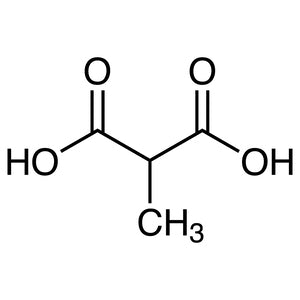
MethylmalonicAcid TCI M0568
Regular price From Rp 2.386.650,00Regular price -
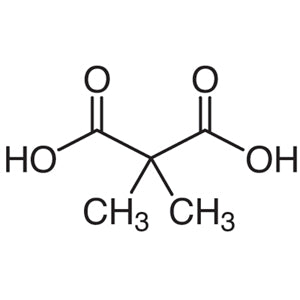
DimethylmalonicAcid TCI D2606
Regular price From Rp 1.298.850,00Regular price -
N,N,N',N'-Tetraethylmalonamide TCI T1966
Regular price Rp 3.683.400,00Regular price -
N,N,N',N'-Tetramethylmalonamide TCI T1891
Regular price Rp 6.625.500,00Regular price -
DiethylMethylmalonate TCI M0366
Regular price From Rp 637.350,00Regular price -
DiethylEthylmalonate TCI E0138
Regular price From Rp 530.250,00Regular price -
DimethylMethylmalonate TCI D6097
Regular price From Rp 1.644.300,00Regular price -
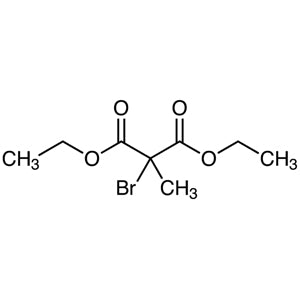
Diethyl2-Bromo-2-methylmalonate TCI D4368
Regular price Rp 2.016.000,00Regular price