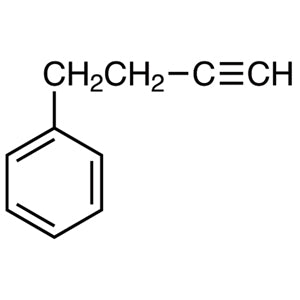
Ethynylbenzene is an organic chemical compound with an aromatic structure featuring the ethynyl (-C₂H) group. It serves as a crucial building block in the laboratory, particularly in organic chemistry and pharmaceutical research. Its unique molecular structure allows it to participate in a wide range of chemical reactions, making it an essential component for the synthesis of complex molecules. This compound is widely used in the development of new chemical compounds and in the testing of raw material suitability. Its versatility and reactivity make it a valuable tool for chemists working in both academic and industrial settings.
Ethynylbenzene is known for its high reactivity and stability under controlled conditions. It exhibits strong affinity for various functional groups, enabling it to undergo substitution, addition, and catalytic reactions. Its chemical properties allow it to be a flexible reagent in synthetic pathways. However, it is highly reactive under extreme conditions such as high temperatures or exposure to strong reagents. This reactivity makes it ideal for applications requiring precise control over reaction conditions. Additionally, its relatively high boiling point facilitates handling in various experimental procedures.
In Indonesian laboratories, Ethynylbenzene is commonly used in organic chemistry research, compound development, and material testing. Its availability through reliable suppliers like AMI Scientific ensures that researchers have access to this essential chemical for their experiments. It plays a significant role in advancing chemical innovation and scientific discovery in the region.
TCI brochures (PDF)
- Pincer-type Chiral Rhodium Complex Catalyst 2024-08-07 · p. 1
- Reagent for Incorporating a Protecting Group (Ph2P(O)) into Terminal Acetylenes 2025-06-03 · p. 2
- Click Chemistry 2026-09-08 · p. 11
- Organic synthesis applications benefit from Ethynylbenzene's ability to form stable intermediates in complex molecule construction.
- Pharmaceutical research utilizes its reactivity to develop new drug compounds through targeted chemical modifications.
- Material testing in laboratories relies on its chemical stability and reactivity for evaluating new compound properties.
- Chemical reaction optimization uses Ethynylbenzene to explore reaction pathways and improve synthetic efficiency.
- Research in functional group chemistry leverages its compatibility with various functional groups for molecular design.
From the TCI brochure
- Alkyne substrate in stereoselective cross-coupling with dimethyl acetylenedicarboxylate
| Brand | TCI |
|---|---|
| CAS number | 536-74-3 |
| Molecular formula | — |
| Purity | — |
| Category | Chemistry > Building Blocks > Non-Heterocyclic Building Blocks |
| Pack sizes | Available in standard laboratory quantities |
| Physical form | Liquid |
| Storage | Store in a cool, dry place away from light and incompatible materials |
Ethynylbenzene should be stored in a cool, dry environment, away from direct sunlight and sources of heat. It is recommended to use sealed, airtight containers made of materials compatible with organic solvents, such as glass or high-density polyethylene. Due to its reactivity, it should be kept separate from strong oxidizing agents, acids, and bases. Proper ventilation is essential when handling this compound to minimize exposure. Always use appropriate personal protective equipment, including gloves, goggles, and a lab coat, to ensure safety during handling and experimentation.
References cited in the TCI brochure
- Jun-ichi Ito. Cross-Coupling of Alkynes Catalyzed by Phebox−Rhodium Acetate Complexes Organometallics, 2007. doi:10.1021/om700742t
Product Categories
Produk Terkait
-
1-Butyl-4-ethynylbenzene TCI B2301
Regular price From Rp 980.700,00Regular priceRp 685.650,00Sale price From Rp 980.700,00 -
1-Ethyl-4-ethynylbenzene TCI E0749
Regular price From Rp 3.551.100,00Regular priceRp 2.483.250,00Sale price From Rp 3.551.100,00 -
1,3,5-Triethynylbenzene TCI T2760
Regular price From Rp 3.578.400,00Regular priceRp 2.502.150,00Sale price From Rp 3.578.400,00 -
1,4-Diethynylbenzene TCI D2151
Regular price From Rp 1.485.750,00Regular priceRp 1.038.450,00Sale price From Rp 1.485.750,00 -
1,3-Diethynylbenzene TCI D2496
Regular price From Rp 1.193.850,00Regular priceRp 834.750,00Sale price From Rp 1.193.850,00 -
1-Ethoxy-4-ethynylbenzene TCI E1029
Regular price From Rp 505.050,00Regular priceRp 352.800,00Sale price From Rp 505.050,00 -
3-Phenyl-1-propyne(stabilizedwithBHT) TCI P1956
Regular price From Rp 1.273.650,00Regular priceRp 890.400,00Sale price From Rp 1.273.650,00 -
4-Phenyl-1-butyne TCI P0358
Regular price Rp 2.359.350,00Regular priceRp 1.649.550,00Sale price Rp 2.359.350,00