

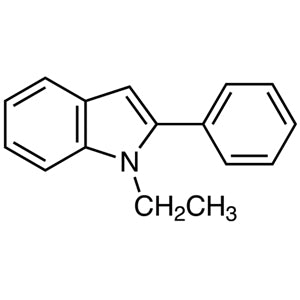
1-Ethyl-2-phenylindole is a chemical compound that serves as a fundamental building block in the synthesis of complex heterocyclic compounds. Its unique structure, featuring an indole core modified with ethyl and phenyl groups, makes it a valuable reagent for organic chemists seeking to construct molecules with specific stereochemistry and functional groups. In laboratory settings, this compound is widely used to develop compounds with tailored biological or chemical properties, supporting research in pharmaceutical and materials science. Its role extends beyond mere synthesis, as it contributes to the exploration of new chemical reactions and molecular architectures.
The compound is prized for its chemical stability and controlled reactivity, which allow it to participate effectively in nucleophilic and electrophilic reactions. These properties make it a reliable choice for researchers aiming to achieve predictable outcomes in synthetic processes. Its ability to maintain structural integrity under various reaction conditions ensures that it remains a consistent and dependable reagent in both academic and industrial laboratories. This reliability is essential for experiments requiring precision and reproducibility.
In Indonesian laboratories, 1-Ethyl-2-phenylindole is commonly utilized in organic chemistry, pharmacology, and the synthesis of complex compounds. It is a key component in research projects aimed at developing new drugs, materials, and chemical intermediates. Many research institutions and universities in Indonesia rely on this compound to advance their scientific investigations and contribute to the broader field of chemical innovation.
Related TCI products
- Organic synthesis applications benefit from 1-Ethyl-2-phenylindole due to its structural versatility and reactivity, enabling the creation of complex heterocyclic compounds with specific functional groups.
- Pharmaceutical research utilizes this compound as a building block for developing new drug molecules with targeted biological activities and improved therapeutic properties.
- Materials science applications leverage its chemical stability and reactivity to design novel compounds with unique physical and chemical characteristics.
- Academic research in Indonesian universities employs this compound to explore new synthetic pathways and expand the understanding of heterocyclic chemistry.
- Analytical chemistry studies use it as a reference standard to evaluate reaction mechanisms and optimize synthetic procedures in laboratory settings.
| Brand | TCI |
|---|---|
| CAS number | 13228-39-2 |
| Molecular formula | — |
| Purity | — |
| Category | Chemistry > Building Blocks > Heterocyclic Building Blocks |
| Pack sizes | Available in various quantities suitable for laboratory use |
| Physical form | Solid (as per standard product description) |
| Storage | Store in a cool, dry place away from direct sunlight |
1-Ethyl-2-phenylindole should be stored in a cool, dry environment to maintain its chemical stability and prevent degradation. It is recommended to keep the compound in a tightly sealed container to minimize exposure to moisture and air. Suitable storage containers include glass or high-density polyethylene vessels that are resistant to chemical interactions. In laboratory settings, it is important to handle the compound with care, using appropriate personal protective equipment such as gloves and safety goggles. Proper ventilation should be ensured when working with the compound to avoid inhalation of vapors. Regular monitoring of storage conditions ensures that the compound remains in optimal condition for use in research and development activities.
—
Produk Terkait
-
2-Phenylindole-3-carboxaldehyde TCI P2273
Regular price From Rp 637.350,00Regular price -
2-Phenylindole TCI P0188
Regular price From Rp 743.400,00Regular price -
1-Methyl-2-phenylindole TCI M0733
Regular price From Rp 477.750,00Regular price -
11,12-Dihydro-11-phenylindolo[2,3-a]carbazole TCI D4860
Regular price From Rp 557.550,00Regular price -
2,3,3,5-Tetramethylindolenine TCI T3458
Regular price From Rp 1.803.900,00Regular price -
5-Amino-2-methylindole TCI A1539
Regular price From Rp 1.353.450,00Regular price -
3-Acetylindole TCI A0849
Regular price From Rp 1.298.850,00Regular price -
2,3,3-Trimethylindolenine TCI T0766
Regular price From Rp 1.405.950,00Regular price


![11,12-Dihydro-11-phenylindolo[2,3-a]carbazole (CAS 1024598-06-8) - TCI D4860 - AMI Scientific](http://amiscientific.com/cdn/shop/files/TCI2510D4860.jpg?v=1767108091&width=533)


