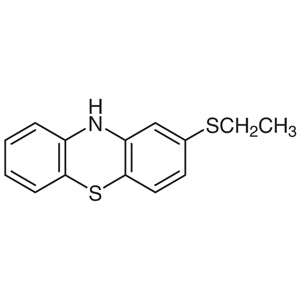
2-Ethylthiophenothiazine is a chemical compound widely used in laboratory settings for the synthesis of complex heterocyclic compounds. Its unique molecular structure, consisting of an expanded thiazine ring with an ethyl and thiophene group, makes it a valuable building block in organic chemistry. This compound plays a key role in various synthetic pathways, particularly in the development of pharmaceuticals and industrial chemicals. Due to its stability and controlled reactivity, it is frequently employed in substitution and ring-opening reactions, offering versatility in chemical synthesis.
The compound’s chemical properties make it a preferred choice for researchers. It exhibits high reactivity with various functional groups, enabling the formation of diverse molecular structures. Its solubility in organic solvents such as ethyl acetate and chloroform enhances its utility in reaction systems requiring precision and efficiency. These characteristics allow it to be used in a wide range of experimental conditions, making it a reliable reagent for both academic and industrial applications.
In Indonesian laboratories, 2-Ethylthiophenothiazine is commonly used in organic chemistry, pharmaceutical research, and industrial chemical development. Its stability and reactivity make it an essential component in the synthesis of new compounds. It is particularly favored for its compatibility with a variety of reaction conditions, supporting both small-scale experiments and larger production processes.
TCI brochures (PDF)
- Phenylphenothiazine (PTH) Derivatives 2026-09-16 · p. 1
Related TCI products
- TCI A1181 13679-74-8 2-Acetyl-5-methylthiophene
- TCI P0106 92-84-2 Phenothiazine
- TCI M3639 58736-69-9 10-(4-Methoxyphenyl)-10H-phenothiazine
- TCI M2662 81452-54-2 Methyl 3-Methylthiophene-2-carboxylate
- TCI M1772 85006-31-1 Methyl 3-Amino-4-methylthiophene-2-carboxylate
- TCI M1387 7643-08-5 2-Methylthiophenothiazine
- Organic synthesis applications benefit from its unique molecular structure, allowing the creation of complex heterocyclic compounds with high precision.
- Pharmaceutical research utilizes it for the development of new drug molecules, leveraging its reactivity with functional groups.
- Industrial chemical production relies on its stability and controlled reactivity for efficient and scalable synthesis processes.
- It is ideal for ring-opening and substitution reactions, providing reliable results in both academic and industrial settings.
- Its solubility in organic solvents makes it suitable for reactions requiring high reactivity and precise control over reaction conditions.
| Brand | TCI |
|---|---|
| CAS number | 46815-10-5 |
| Molecular formula | — |
| Purity | — |
| Category | Chemistry > Building Blocks > Heterocyclic Building Blocks |
| Pack sizes | Available in various quantities as per standard laboratory supply |
| Physical form | Solid or crystalline, depending on the batch |
| Storage | Store in a cool, dry place away from direct sunlight and moisture |
This compound should be stored in a cool, dry environment, away from direct sunlight and moisture to maintain its stability. It is recommended to use airtight containers made of glass or high-density polyethylene to prevent contamination and degradation. Due to its reactivity, it should be handled with care, using appropriate personal protective equipment such as gloves and safety goggles. It is important to ensure proper ventilation in the laboratory when working with this compound to minimize exposure. Regular inspection of storage conditions is advised to maintain the integrity of the material over time.
—
Produk Terkait
-
2-Acetyl-5-methylthiophene TCI A1181
Regular price Rp 1.696.800,00Regular priceRp 1.202.250,00Sale price Rp 1.696.800,00 -
Phenothiazine TCI P0106
Regular price From Rp 530.250,00Regular priceRp 386.400,00Sale price From Rp 530.250,00 -
10-(4-Methoxyphenyl)-10H-phenothiazine TCI M3639
Regular price From Rp 2.677.500,00Regular priceRp 1.887.900,00Sale price From Rp 2.677.500,00 -
Methyl3-Methylthiophene-2-carboxylate TCI M2662
Regular price From Rp 769.650,00Regular priceRp 553.350,00Sale price From Rp 769.650,00 -
Methyl3-Amino-4-methylthiophene-2-carboxylate TCI M1772
Regular price From Rp 505.050,00Regular priceRp 368.550,00Sale price From Rp 505.050,00 -
2-Methylthiophenothiazine TCI M1387
Regular price Rp 4.213.650,00Regular priceRp 2.962.050,00Sale price Rp 4.213.650,00 -
5-Methylthiophene-2-carboxaldehyde TCI M0911
Regular price From Rp 980.700,00Regular priceRp 701.400,00Sale price From Rp 980.700,00 -
3-Methylthiophene-2-carboxaldehyde TCI M0899
Regular price From Rp 1.590.750,00Regular priceRp 1.127.700,00Sale price From Rp 1.590.750,00