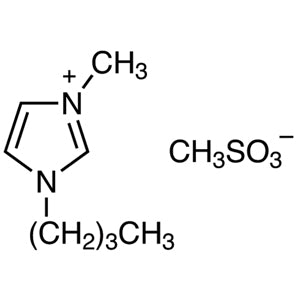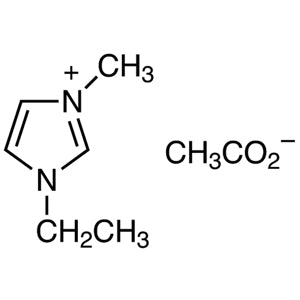
1-Ethyl-3-methylimidazolium Acetate from TCI, supplied under catalogue code E0883 and frequently abbreviated as [EMIM][OAc], is an ionic liquid built on an imidazolium cation paired with an acetate anion. Unlike conventional organic solvents, this compound is composed entirely of ions yet remains liquid at room temperature, which means it combines the characteristics of a salt and a solvent in a single material. In the laboratory it is best known for its ability to dissolve biopolymers that are otherwise difficult to handle, particularly cellulose and lignocellulose, and for its very low vapour pressure, which keeps it from evaporating appreciably while a process is running.
The property that makes this ionic liquid a preferred choice is the acetate anion, which is weakly basic and functions as an excellent hydrogen bond acceptor. That capability allows the solvent to break up the inter-chain hydrogen bonding network of cellulose, long recognised as the principal obstacle to biomass processing. In addition, the fact that it is practically non-volatile and not readily flammable makes procedures safer to run and allows the solvent to be recovered and recycled many times over. Its good ionic conductivity also makes it attractive for electrochemical research, while the basicity of the anion is exploited in capture-oriented studies.
In Indonesian laboratories the material is typically encountered in university and institutional research groups working on biomass valorisation, where local agricultural and forestry residues provide abundant cellulosic feedstock for dissolution and regeneration studies. It also appears in electrochemistry laboratories that require a non-volatile conductive medium, and in green chemistry programmes where recyclable solvents are preferred over volatile organics. Its low volatility is a practical advantage in warm laboratory environments and in facilities with limited fume hood capacity.
Related TCI products
- TCI B5582 284049-75-8 1-Butyl-3-methylimidazolium Acetate
- TCI B5487 878027-73-7 1-Butyl-3-methylimidazolium Tricyanomethanide
- TCI B5447 448245-52-1 1-Butyl-3-methylimidazolium Dicyanamide
- TCI B4091 344790-87-0 1-Butyl-3-methylimidazolium Thiocyanate
- TCI B3596 820965-08-0 1-Butyl-3-methylimidazolium Tribromide
- TCI B3542 741677-68-9 1-Butyl-3-methylimidazolium Trifluoro(trifluoromethyl)borate
- Cellulose dissolution studies — the acetate anion disrupts the hydrogen bonding network between cellulose chains, allowing the polymer to be taken into solution without derivatisation and later regenerated into films or fibres.
- Lignocellulosic biomass pretreatment — the solvent opens up the recalcitrant structure of plant residues so that cellulose, hemicellulose and lignin fractions become far more accessible for subsequent separation or enzymatic work.
- Green solvent and solvent recycling research — because the liquid is practically non-volatile and not readily flammable, it can be recovered and reused across many cycles, making it a model system for closed-loop solvent studies.
- Electrochemical investigations — the good ionic conductivity of this room temperature ionic liquid provides a conductive, non-volatile medium suitable for electrode and electrolyte studies that would suffer from solvent evaporation.
- Acid gas capture research — the weakly basic character of the acetate anion is used to bind acidic species, making this ionic liquid a common candidate medium in capture and absorption experiments.
| Brand | TCI (Tokyo Chemical Industry), catalogue code E0883 |
|---|---|
| CAS number | 143314-17-4 |
| Molecular formula | — |
| Purity | — |
| Category | Chemistry > Specialty Synthesis > Ionic Liquids [Specialty Synthesis] |
| Pack sizes | available in standard TCI research and laboratory pack sizes; please confirm the size required when ordering |
| Physical form | liquid at room temperature (room temperature ionic liquid) |
| Storage | keep in a tightly closed original container, protected from moisture |
- Common abbreviation: [EMIM][OAc]
Store the container tightly closed in a cool, dry and well ventilated area, away from incompatible materials. Imidazolium acetate ionic liquids are hygroscopic, so minimise exposure to open air and reseal the container promptly after each use; handling under a dry inert atmosphere is advisable where water content matters to the experiment. Use original supplier packaging or clean, chemically compatible glass containers with secure closures, and label all working aliquots clearly. Transfer and weighing should be carried out in a fume hood using nitrile gloves, safety glasses and a laboratory coat, since the liquid is viscous and can be difficult to remove from skin and glassware. Because the material is essentially non-volatile, spills do not evaporate and must be absorbed and cleaned up mechanically. Always consult the manufacturer's safety data sheet before first use and follow your institution's chemical waste procedures for disposal.
—
Produk Terkait
-
1-Butyl-3-methylimidazoliumAcetate TCI B5582
Regular price From Rp 875.700,00Regular price -
1-Butyl-3-methylimidazoliumTricyanomethanide TCI B5487
Regular price From Rp 1.803.900,00Regular price -
1-Butyl-3-methylimidazoliumDicyanamide TCI B5447
Regular price From Rp 1.696.800,00Regular price -
1-Butyl-3-methylimidazoliumThiocyanate TCI B4091
Regular price From Rp 1.115.100,00Regular price -
1-Butyl-3-methylimidazoliumTribromide TCI B3596
Regular price Rp 3.870.300,00Regular price -
1-Butyl-3-methylimidazoliumTrifluoro(trifluoromethyl)borate TCI B3542
Regular price Rp 3.260.250,00Regular price -
1-Butyl-3-methylimidazoliumMethanesulfonate TCI B3231
Regular price From Rp 795.900,00Regular price -
1-Butyl-3-methylimidazoliumIodide TCI B2708
Regular price From Rp 1.538.250,00Regular price