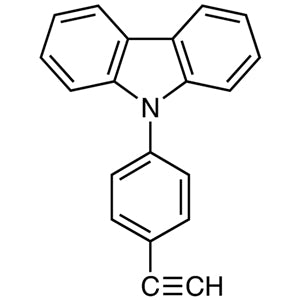
9-(4-Ethynylphenyl)carbazole is a chemical compound classified under the category of heterocyclic building blocks. It plays a crucial role in laboratory settings by serving as a foundational component for the synthesis of complex organic molecules. This compound is widely used in chemical reactions to construct intricate molecular structures, particularly in the development of pharmaceuticals, advanced materials, and cutting-edge technologies. Its versatility makes it an essential tool for researchers aiming to create compounds with specific functional properties.
The compound's high reactivity and unique molecular structure make it a preferred choice for synthetic chemists. Its heterocyclic framework, featuring a nitrogen atom, contributes to its stability and reactivity, enabling it to participate in various chemical reactions such as substitution, addition, and condensation. These properties allow it to be easily modified by attaching different functional groups, making it adaptable to a wide range of synthetic strategies. Its ability to form complex structures also enhances its utility in the development of optically active compounds and aromatic derivatives.
In Indonesian laboratories, 9-(4-Ethynylphenyl)carbazole is commonly used in research focused on organic synthesis and material science. It is frequently employed as a starting material for the creation of specialized compounds with tailored properties. Its application spans across academic and industrial research, supporting the development of new drugs, advanced polymers, and functional materials. Its reliability and effectiveness make it a valuable resource for scientists working in diverse chemical fields.
TCI brochures (PDF)
- Reagent for Incorporating a Protecting Group (Ph2P(O)) into Terminal Acetylenes 2025-06-03 · p. 2
- Carbazoles 2025-06-27 · p. 5
- Click Chemistry 2026-09-08 · p. 15
- Building Blocks for Organic Semiconductor 2026-03-24 · p. 21
Related TCI products
- TCI T3882 6558-85-6 1,3,6,8-Tetramethyl-9H-carbazole
- TCI T3642 1630723-98-6 N,N,N',N'-Tetrakis(4-methoxyphenyl)-9H-carbazole-3,6-diamine
- TCI B5183 84359-61-5 9-(3-Bromopropyl)carbazole
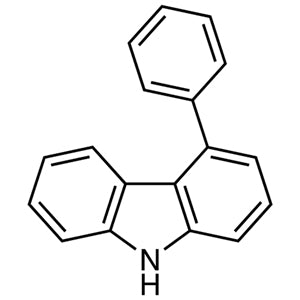
- TCI P2601 1201561-34-3 4-Phenyl-9H-carbazole
- TCI P2351 87220-68-6 9-Phenyl-9H-carbazole-3-carboxaldehyde
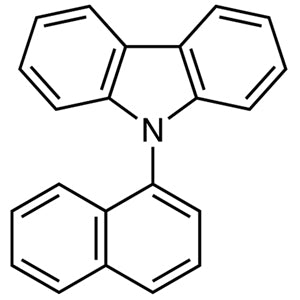
- TCI N1012 22034-43-1 9-(1-Naphthyl)carbazole
- Organic synthesis: This compound is ideal for creating complex organic molecules due to its reactivity and structural versatility.
- Pharmaceutical research: It is used to develop new drugs by serving as a building block for synthesizing bioactive compounds.
- Material science: Its aromatic structure makes it suitable for the production of advanced polymers and optoelectronic materials.
- Functional compound development: The compound's ability to form optically active structures is valuable in creating compounds with specific optical properties.
- Academic research: It is widely used in teaching and research settings to demonstrate synthetic methodologies and molecular design.
| Brand | TCI |
|---|---|
| CAS number | 262861-81-4 |
| Molecular formula | — |
| Purity | — |
| Category | Chemistry > Building Blocks > Heterocyclic Building Blocks |
| Pack sizes | Available in various quantities as per standard laboratory supply |
| Physical form | Solid |
| Storage | Store in a cool, dry place away from light and moisture |
This compound should be stored in a cool, dry environment, away from direct light and moisture to maintain its chemical integrity. It is recommended to use airtight containers made of glass or inert plastic to prevent contamination and degradation. Due to its reactivity, it should be handled with care using appropriate personal protective equipment such as gloves and safety goggles. It is important to ensure good ventilation in the workspace to minimize exposure. The compound should not be stored near incompatible materials such as strong oxidizers or acids. Regular inspection of storage conditions is advised to ensure optimal preservation and safety in the laboratory.
—
Product Categories
Produk Terkait
-
1,3,6,8-Tetramethyl-9H-carbazole TCI T3882
Regular price Rp 4.108.650,00Regular priceRp 2.888.550,00Sale price Rp 4.108.650,00 -
N,N,N',N'-Tetrakis(4-methoxyphenyl)-9H-carbazole-3,6-diamine TCI T3642
Regular price Rp 9.778.650,00Regular priceRp 6.853.350,00Sale price Rp 9.778.650,00 -
9-(3-Bromopropyl)carbazole TCI B5183
Regular price From Rp 1.988.700,00Regular price -
4-Phenyl-9H-carbazole TCI P2601
Regular price Rp 7.499.100,00Regular priceRp 5.259.450,00Sale price Rp 7.499.100,00 -
9-Phenyl-9H-carbazole-3-carboxaldehyde TCI P2351
Regular price Rp 3.419.850,00Regular priceRp 2.406.600,00Sale price Rp 3.419.850,00 -
9-(1-Naphthyl)carbazole TCI N1012
Regular price Rp 900.900,00Regular priceRp 645.750,00Sale price Rp 900.900,00 -
1-Methyl-9H-carbazole TCI M3317
Regular price Rp 4.054.050,00Regular priceRp 2.850.750,00Sale price Rp 4.054.050,00 -
3-Methyl-9H-carbazole TCI M2561
Regular price Rp 5.300.400,00Regular priceRp 3.722.250,00Sale price Rp 5.300.400,00