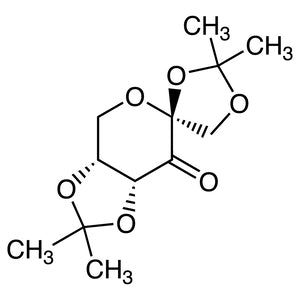
Shi Epoxidation Diketal Catalyst is a chiral ketone derived from fructose and protected as a diketal, and it is the best known organocatalyst for the asymmetric epoxidation reaction developed by Shi. The catalyst works by forming a dioxirane in situ when it is treated with an oxidant source such as Oxone; the resulting chiral dioxirane then transfers an oxygen atom to the double bond of an alkene. In the laboratory, this material is the primary choice for researchers who wish to produce optically active epoxides without using heavy metals.
The property that makes this catalyst distinctive is its origin in a natural sugar, which means it is available in enantiomerically pure form with a well defined chiral environment. Being metal free, it avoids residual metal contamination in the product, an important advantage for the synthesis of compounds that will subsequently be tested biologically. The reaction proceeds in a mixture of water and organic solvent at low temperature with pH control, conditions that are relatively mild and that do not require specialised pressurised equipment. The best selectivity is generally obtained with trans-disubstituted and trisubstituted alkenes, so the substrate scope is highly useful in natural product synthesis.
In Indonesian laboratories, this catalyst is typically used in university and institutional research groups working on asymmetric synthesis, where optically active epoxides are needed as intermediates. Because the reaction is run in aqueous and organic solvent mixtures at low temperature with pH control, it can be carried out with standard glassware, cooling baths and pH monitoring already present in most synthetic chemistry laboratories, without investment in dedicated high pressure or inert atmosphere systems.
TCI brochures (PDF)
- Asymmetric Organocatalysts 2025-06-12 · p. 11
Related TCI products
- TCI B1689 69221-14-3 N-Benzylcinchoninium Chloride [Chiral Phase-Transfer Catalyst]
- TCI B1684 77481-82-4 N-Benzylquinidinium Chloride [Chiral Phase-Transfer Catalyst]
- TCI B1683 69257-04-1 N-Benzylcinchonidinium Chloride [Chiral Phase-Transfer Catalyst]
- TCI G0665 9037-55-2 D-Galactan [for Plant-based Organic Molecular Catalyst]
- TCI T1125 429-41-4 Tetrabutylammonium Fluoride (ca. 1mol/L in Tetrahydrofuran) [for Catalyst of silylation and cleavage of silyl ether]
- TCI T1037 22206-57-1 Tetrabutylammonium Fluoride Hydrate [for Catalyst of silylation and cleavage of silyl ether]
- Asymmetric epoxidation of alkenes: the catalyst generates a chiral dioxirane in situ with Oxone, transferring oxygen to the double bond and giving optically active epoxides.
- Metal free synthesis of biologically tested compounds: because no heavy metal is involved, the product is not contaminated with residual metal that could interfere with biological evaluation.
- Natural product synthesis: the best selectivity on trans-disubstituted and trisubstituted alkenes makes the substrate scope particularly useful for building optically active fragments of natural products.
- Preparation of chiral epoxide intermediates: enantiomerically pure epoxides obtained with this catalyst serve as versatile intermediates that can be opened to give further optically active building blocks.
- Teaching and research in organocatalysis: as the best known catalyst for Shi asymmetric epoxidation, it is a clear demonstration of metal free asymmetric catalysis based on a sugar derived chiral ketone.
| Brand | TCI |
|---|---|
| CAS number | 18422-53-2 |
| Molecular formula | — |
| Purity | — |
| Category | Chemistry > Catalysis and Inorganic Chemistry > Organocatalysts [Catalysis] |
| Pack sizes | available in standard TCI research packaging; please confirm the available pack sizes when ordering |
| Physical form | — |
| Storage | store in a tightly closed container in a cool, dry place away from oxidants |
- Product code: E1579
- Chemical class: fructose derived chiral ketone protected as a diketal; metal free organocatalyst
Store the catalyst in its original tightly closed container in a cool, dry place, protected from moisture and light, and keep it clearly separated from the oxidant used in the reaction, such as Oxone, since the two are only combined under controlled conditions in the reaction vessel. Use clean, dry glass or the supplied packaging for weighing and transfer, and avoid introducing moisture into the bulk material. Handle the powder in a fume hood using a laboratory coat, safety glasses and chemically resistant gloves, following the safety data sheet supplied with the product. Because the reaction itself is run at low temperature with pH control in an aqueous and organic solvent mixture, prepare cooling baths and pH monitoring before the catalyst is weighed out, and dispose of residues according to the chemical waste procedures of your laboratory.
—
Produk Terkait
-
N-BenzylcinchoniniumChloride[ChiralPhase-TransferCatalyst] TCI B1689
Regular price Rp 1.749.300,00Regular price -
N-BenzylquinidiniumChloride[ChiralPhase-TransferCatalyst] TCI B1684
Regular price Rp 8.718.150,00Regular price -
N-BenzylcinchonidiniumChloride[ChiralPhase-TransferCatalyst] TCI B1683
Regular price Rp 3.922.800,00Regular price -
D-Galactan[forPlant-basedOrganicMolecularCatalyst] TCI G0665
Regular price From Rp 1.220.100,00Regular price -
TetrabutylammoniumFluoride(ca.1mol/LinTetrahydrofuran)[forCatalystofsilylationandcleavageofsilylether] TCI T1125
Regular price From Rp 1.776.600,00Regular price -
TetrabutylammoniumFluorideHydrate[forCatalystofsilylationandcleavageofsilylether] TCI T1037
Regular price From Rp 4.028.850,00Regular price -
TrioctylmethylammoniumChloride(R=C8-C10)[Phase-transferCatalyst] TCI T0826
Regular price From Rp 557.550,00Regular price -
Ru(II)-(S)-PheoxCatalyst TCI R0196
Regular price From Rp 1.776.600,00Regular price
![69221-14-3 N-Benzylcinchoninium Chloride [Chiral Phase-Transfer Catalyst] - AMI Scientific](http://amiscientific.com/cdn/shop/files/TCI2510B1689.jpg?v=1767087613&width=533)
![77481-82-4 N-Benzylquinidinium Chloride [Chiral Phase-Transfer Catalyst] - AMI Scientific](http://amiscientific.com/cdn/shop/files/TCI2510B1684.jpg?v=1767087609&width=533)
![69257-04-1 N-Benzylcinchonidinium Chloride [Chiral Phase-Transfer Catalyst] - AMI Scientific](http://amiscientific.com/cdn/shop/files/TCI2510B1683.jpg?v=1767087605&width=533)
![429-41-4 Tetrabutylammonium Fluoride (ca. 1mol/L in Tetrahydrofuran) [for Catalyst of silylation and cleavage of silyl ether] - AMI Scientific](http://amiscientific.com/cdn/shop/files/TCI2510T1125.jpg?v=1769143544&width=533)
![22206-57-1 Tetrabutylammonium Fluoride Hydrate [for Catalyst of silylation and cleavage of silyl ether] - AMI Scientific](http://amiscientific.com/cdn/shop/files/TCI2510T1037.jpg?v=1768206363&width=533)
![22206-57-1 Tetrabutylammonium Fluoride Hydrate [for Catalyst of silylation and cleavage of silyl ether] - AMI Scientific](http://amiscientific.com/cdn/shop/files/TCI2510T1037_0351390a-1307-46ee-aff3-d705aa015f4b.jpg?v=1768363189&width=533)