


The TCI R0196 1259070-80-8 Ru(II)-(S)-Pheox Catalyst is a chiral catalyst designed for use in asymmetric synthesis, playing a crucial role in laboratories that require precise control over the stereochemistry of chemical products. This material enables the selective formation of compounds with specific stereoisomer configurations, which is essential in various advanced chemical processes. Its application is particularly vital in research settings where the final product’s stereochemistry directly impacts its biological activity or chemical properties. The catalyst is widely used in both academic and industrial research due to its efficiency and specificity in promoting desired chemical transformations.
One of the key properties that make this catalyst a preferred choice is its ability to enhance reaction efficiency while maintaining high selectivity. The complex chemical structure of the Ru(II)-(S)-Pheox catalyst allows for specific interactions with substrates, leading to improved reaction outcomes. Additionally, it operates without significant consumption, making it cost-effective for repeated use in laboratory experiments. Its chiral nature ensures that only the desired enantiomer is produced, which is critical in pharmaceutical and organic chemistry research. These features make it a reliable and versatile tool for researchers aiming to achieve high-quality chemical syntheses.
In Indonesian laboratories, this catalyst is commonly used in the synthesis of bioactive compounds, including pharmaceuticals and industrial chemicals. It is particularly relevant in research focused on organic chemistry and pharmacology, where the stereochemistry of the final product is of utmost importance. Institutions engaged in chemical research and education in Indonesia rely on this catalyst for its precision and effectiveness in producing compounds with specific stereochemical configurations.
Advantages (TCI brochure)
- Easy-to-handle crystalline solid
- Applicable for enantioselective carbene transfer reactions to give optically active cyclopropanes
- The reaction proceeds under mild conditions
TCI brochures (PDF)
- Chiral Ruthenium Catalyst for Enantioselective Cyclopropanation 2020-09-01 · p. 1
- Asymmetric Synthesis 2026-03-18 · p. 2
Related TCI products
- TCI B1689 69221-14-3 N-Benzylcinchoninium Chloride [Chiral Phase-Transfer Catalyst]
- TCI B1684 77481-82-4 N-Benzylquinidinium Chloride [Chiral Phase-Transfer Catalyst]
- TCI B1683 69257-04-1 N-Benzylcinchonidinium Chloride [Chiral Phase-Transfer Catalyst]
- TCI P1785 7440-05-3 Palladium 10% on Carbon (wetted with ca 55% Water) [Useful catalyst for coupling reaction, etc]
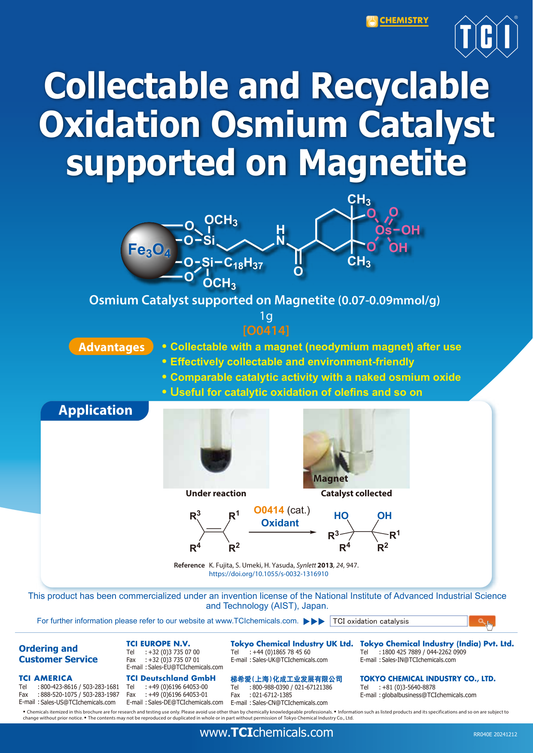
- TCI O0414 Osmium Catalyst supported on Magnetite (0.07-0.09mmol/g)
- TCI K0073 7440-02-0 Skeletal Nickel Catalyst slurry in Water [Active catalyst for Hydrogenation]
- Asymmetric Synthesis: This catalyst is ideal for asymmetric synthesis due to its ability to control stereochemistry, ensuring the production of specific enantiomers with high selectivity.
- Pharmaceutical Research: It is widely used in drug development to synthesize chiral compounds with desired biological activity and pharmacological properties.
- Organic Chemistry Studies: The catalyst supports complex organic reactions, enabling researchers to explore new synthetic pathways and reaction mechanisms.
- Industrial Chemical Production: It is applied in the manufacturing of specialty chemicals, where precise stereochemical control is essential for product quality and functionality.
- Academic Research: It is a valuable tool in educational and research settings, facilitating the study of chiral catalysis and its impact on chemical outcomes.
From the TCI brochure
- Enantioselective cyclopropanation of various olefins using diazoacetates
- Enantioselective cyclopropanation of olefins using diazomethylphosphonates
- Enantioselective Si-H insertion reaction of alpha-diazo esters
| Brand | TCI |
|---|---|
| CAS number | 1259070-80-8 |
| Molecular formula | — |
| Purity | — |
| Category | Chemistry > Asymmetric Synthesis > Chiral Catalysts, Chiral Ligands, Chiral Reagents |
| Pack sizes | Available in various quantities as per supplier specifications |
| Physical form | Solid or powder, depending on the batch |
| Storage | Store in a cool, dry place away from light and moisture |
Data from the TCI brochure
| Yield (cyclopropanation, diazoacetates) | up to 99% (R0196 (1-5 mol%), refs 1-6,8) |
|---|---|
| dr (cyclopropanation, diazoacetates) | up to >99:1 (R0196 (1-5 mol%), refs 1-6,8) |
| ee (cyclopropanation, diazoacetates) | up to 99% (R0196 (1-5 mol%), refs 1-6,8) |
| Yield (cyclopropanation, diazomethylphosphonates) | up to 93% (R0196 (3 mol%), refs 7,8) |
| dr (cyclopropanation, diazomethylphosphonates) | up to >99:1 (R0196 (3 mol%), refs 7,8) |
| ee (cyclopropanation, diazomethylphosphonates) | up to 99% (R0196 (3 mol%), refs 7,8) |
| Yield (Si-H insertion, alpha-diazo esters) | up to 99% (R0196 (1 mol%), ref 9) |
| dr (Si-H insertion, alpha-diazo esters) | up to >79:21 (R0196 (1 mol%), ref 9) |
| ee (Si-H insertion, alpha-diazo esters) | up to 99% (R0196 (1 mol%), ref 9) |
Source: TCI brochure RR120 (2020-09-01)
This catalyst should be stored in a cool, dry environment, away from direct sunlight and moisture to maintain its chemical integrity. It is recommended to use airtight containers made of materials such as glass or high-density polyethylene to prevent contamination and degradation. Due to its chiral nature, it is important to handle the material with care to avoid any physical or chemical alterations that may affect its performance. In laboratory settings, proper personal protective equipment should be worn when handling the catalyst to ensure safety. The material should not be exposed to incompatible substances or extreme temperatures, as this could compromise its effectiveness. Regular inspection of storage conditions is advised to ensure optimal preservation of the catalyst’s properties.
—
Produk Terkait
-
N-BenzylcinchoniniumChloride[ChiralPhase-TransferCatalyst] TCI B1689
Regular price Rp 1.749.300,00Regular price -
N-BenzylquinidiniumChloride[ChiralPhase-TransferCatalyst] TCI B1684
Regular price Rp 8.718.150,00Regular price -
N-BenzylcinchonidiniumChloride[ChiralPhase-TransferCatalyst] TCI B1683
Regular price Rp 3.922.800,00Regular price -
Palladium10%onCarbon(wettedwithca55%Water)[Usefulcatalystforcouplingreaction,etc] TCI P1785
Regular price From Rp 2.041.200,00Regular price -
OsmiumCatalystsupportedonMagnetite(0.07-0.09mmol/g) TCI O0414
Regular price Rp 3.472.350,00Regular price -
SkeletalNickelCatalystslurryinWater[ActivecatalystforHydrogenation] TCI K0073
Regular price Rp 2.041.200,00Regular price -
TetrabutylammoniumFluoride(ca.1mol/LinTetrahydrofuran)[forCatalystofsilylationandcleavageofsilylether] TCI T1125
Regular price From Rp 1.776.600,00Regular price -
TetrabutylammoniumFluorideHydrate[forCatalystofsilylationandcleavageofsilylether] TCI T1037
Regular price From Rp 4.028.850,00Regular price
![69221-14-3 N-Benzylcinchoninium Chloride [Chiral Phase-Transfer Catalyst] - AMI Scientific](http://amiscientific.com/cdn/shop/files/TCI2510B1689.jpg?v=1767087613&width=533)
![77481-82-4 N-Benzylquinidinium Chloride [Chiral Phase-Transfer Catalyst] - AMI Scientific](http://amiscientific.com/cdn/shop/files/TCI2510B1684.jpg?v=1767087609&width=533)
![69257-04-1 N-Benzylcinchonidinium Chloride [Chiral Phase-Transfer Catalyst] - AMI Scientific](http://amiscientific.com/cdn/shop/files/TCI2510B1683.jpg?v=1767087605&width=533)
![7440-05-3 Palladium 10% on Carbon (wetted with ca. 55% Water) [Useful catalyst for coupling reaction, etc.] - AMI Scientific](http://amiscientific.com/cdn/shop/files/TCI2510P1785.jpg?v=1767135226&width=533)

![7440-02-0 Skeletal Nickel Catalyst slurry in Water [Active catalyst for Hydrogenation] - AMI Scientific](http://amiscientific.com/cdn/shop/files/TCI2510K0073.jpg?v=1767121187&width=533)
![429-41-4 Tetrabutylammonium Fluoride (ca. 1mol/L in Tetrahydrofuran) [for Catalyst of silylation and cleavage of silyl ether] - AMI Scientific](http://amiscientific.com/cdn/shop/files/TCI2510T1125.jpg?v=1769143544&width=533)
![22206-57-1 Tetrabutylammonium Fluoride Hydrate [for Catalyst of silylation and cleavage of silyl ether] - AMI Scientific](http://amiscientific.com/cdn/shop/files/TCI2510T1037.jpg?v=1768206363&width=533)
![22206-57-1 Tetrabutylammonium Fluoride Hydrate [for Catalyst of silylation and cleavage of silyl ether] - AMI Scientific](http://amiscientific.com/cdn/shop/files/TCI2510T1037_0351390a-1307-46ee-aff3-d705aa015f4b.jpg?v=1768363189&width=533)