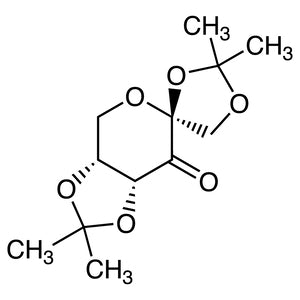
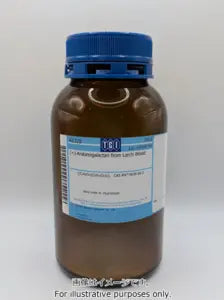
D-Galactan is an organic compound used as a plant-based molecular catalyst in various chemical reactions. It serves as a key reagent in catalytic processes, offering a sustainable and efficient alternative to traditional chemical catalysts. This material is particularly valuable in organic chemistry research, where it facilitates the synthesis of complex compounds through catalytic activation. Its natural origin and biodegradable properties make it an environmentally friendly option for modern laboratory applications. D-Galactan is widely utilized in both academic and industrial settings, supporting a broad range of chemical transformations.
D-Galactan possesses a complex polysaccharide structure that enhances its reactivity under specific conditions. This high reactivity, combined with its ability to bind to various substrates, makes it a preferred choice for catalytic applications. It is stable in neutral or slightly basic environments, which simplifies its handling and storage. Additionally, its biocompatibility and low toxicity contribute to its appeal in both chemical and biochemical research. These properties ensure that D-Galactan remains a reliable and versatile tool for laboratory scientists.
In Indonesian laboratories, D-Galactan is commonly used in organic chemistry research, especially in the synthesis of complex molecules. It is also employed in biochemical and bioinformatics studies to understand natural reaction mechanisms. Its eco-friendly nature aligns with the growing emphasis on sustainable practices in scientific research. As a result, D-Galactan is an essential component in many laboratory workflows across Indonesia.
- Organic synthesis reactions benefit from D-Galactan’s catalytic properties, enabling efficient activation of complex substrates.
- Biochemical studies utilize D-Galactan to investigate natural reaction mechanisms in biological systems.
- Catalytic processes in green chemistry rely on D-Galactan for its sustainable and non-toxic characteristics.
- Biodegradable material applications in environmental research leverage D-Galactan’s eco-friendly properties.
- Industrial-scale chemical processes incorporate D-Galactan for its cost-effective and efficient catalytic performance.
| Brand | TCI |
|---|---|
| CAS number | 9037-55-2 |
| Molecular formula | — |
| Purity | — |
| Category | Chemistry > Catalysis and Inorganic Chemistry > Organocatalysts |
| Pack sizes | Available in various quantities as per supplier specifications |
| Physical form | Powder |
| Storage | Store in a cool, dry place away from moisture and direct sunlight |
D-Galactan should be stored in a cool, dry environment to maintain its chemical stability and prevent degradation. It is recommended to keep it in airtight containers to minimize exposure to moisture and contaminants. Due to its natural origin, it is generally non-toxic but should be handled with standard laboratory precautions to avoid inhalation or skin contact. Proper labeling and storage conditions ensure its effectiveness and safety in laboratory settings. Regular monitoring of storage conditions helps maintain the integrity of the material for optimal performance in chemical reactions.
—
Produk Terkait
-
N-BenzylcinchoniniumChloride[ChiralPhase-TransferCatalyst] TCI B1689
Regular price Rp 1.749.300,00Regular price -
N-BenzylquinidiniumChloride[ChiralPhase-TransferCatalyst] TCI B1684
Regular price Rp 8.718.150,00Regular price -
N-BenzylcinchonidiniumChloride[ChiralPhase-TransferCatalyst] TCI B1683
Regular price Rp 3.922.800,00Regular price -
ShiEpoxidationDiketalCatalyst TCI E1579
Regular price From Rp 2.889.600,00Regular price -
XylanfromCornCore TCI X0078
Regular price From Rp 1.405.950,00Regular price -
XanthanGum TCI X0048
Regular price From Rp 769.650,00Regular price -
GumArabic TCI A3553
Regular price Rp 1.220.100,00Regular price -
(+)-ArabinogalactanfromLarchWood TCI A1328
Regular price From Rp 1.193.850,00Regular price
![69221-14-3 N-Benzylcinchoninium Chloride [Chiral Phase-Transfer Catalyst] - AMI Scientific](http://amiscientific.com/cdn/shop/files/TCI2510B1689.jpg?v=1767087613&width=533)
![77481-82-4 N-Benzylquinidinium Chloride [Chiral Phase-Transfer Catalyst] - AMI Scientific](http://amiscientific.com/cdn/shop/files/TCI2510B1684.jpg?v=1767087609&width=533)
![69257-04-1 N-Benzylcinchonidinium Chloride [Chiral Phase-Transfer Catalyst] - AMI Scientific](http://amiscientific.com/cdn/shop/files/TCI2510B1683.jpg?v=1767087605&width=533)