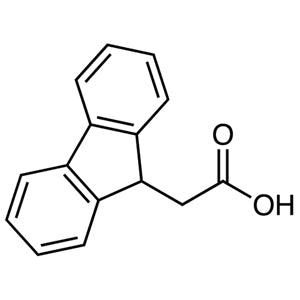
9-Fluoreneacetic Acid is a chemical compound widely used as a foundational building block in the synthesis of complex molecules. It plays a crucial role in organic laboratories, where it serves as a key reagent in various chemical reactions. Its unique molecular structure and chemical properties make it a versatile tool for researchers aiming to create new compounds with specific functionalities. This compound is particularly valuable in the development of heterocyclic structures and other complex organic frameworks, which are essential in pharmaceutical and chemical research.
The compound’s chemical stability and reactivity make it an ideal choice for substitution reactions and other synthetic processes. Its fluorene-based structure provides a degree of stability, which facilitates the synthesis of more complex molecules. Additionally, its solid form and compatibility with a wide range of reagents enhance its usability in different experimental setups. These characteristics allow it to be a reliable and flexible component in laboratory workflows, supporting both research and educational applications.
In Indonesian laboratories, 9-Fluoreneacetic Acid is extensively used in organic chemistry research, especially in projects focused on the synthesis of new compounds. It is also commonly employed in academic settings to teach fundamental concepts of chemical reactions and synthesis techniques. Its availability and reliability make it a preferred material for both practical and theoretical studies in the field of chemistry.
- Organic synthesis of heterocyclic compounds due to its stable fluorene structure and reactivity.
- Development of complex molecular frameworks in pharmaceutical research for drug discovery applications.
- Educational use in teaching chemical reaction mechanisms and synthetic strategies in undergraduate chemistry courses.
- Support for research in structural chemistry to explore molecular interactions and functional group modifications.
- Facilitation of substitution reactions where controlled reactivity and chemical stability are required.
| Brand | TCI |
|---|---|
| CAS number | 6284-80-6 |
| Molecular formula | — |
| Purity | — |
| Category | Chemistry > Building Blocks > Non-Heterocyclic Building Blocks |
| Pack sizes | Available in various quantities as per standard laboratory supply formats |
| Physical form | Solid |
| Storage | Store in a cool, dry place away from direct sunlight and moisture |
9-Fluoreneacetic Acid should be stored in a cool, dry environment to maintain its chemical stability. It is recommended to keep it in a sealed container to prevent exposure to moisture and air. Avoid storing it near heat sources or in areas with high humidity. When handling the compound, it is advisable to use appropriate personal protective equipment, such as gloves and safety goggles, to ensure safety. The compound is generally stable under normal laboratory conditions, but care should be taken to avoid contamination and ensure proper ventilation during use. Proper storage and handling practices help preserve its effectiveness and ensure safe laboratory operations.
—
Produk Terkait
-
2-NaphthaleneaceticAcid TCI N0352
Regular price From Rp 1.298.850,00Regular price -
1-NaphthaleneaceticAcid TCI N0005
Regular price From Rp 769.650,00Regular price -
7-Methoxy-1-naphthaleneaceticAcid TCI M2888
Regular price From Rp 689.850,00Regular price -
2-Acetamidofluorene TCI A0076
Regular price From Rp 3.367.350,00Regular price -
2-Acetyl-7-bromofluorene TCI A3061
Regular price Rp 3.127.950,00Regular price -
2-Acetylfluorene TCI A1069
Regular price From Rp 689.850,00Regular price -
1-AdamantaneaceticAcid TCI A0736
Regular price From Rp 1.988.700,00Regular price -
MesityleneaceticAcid TCI M1218
Regular price Rp 2.704.800,00Regular price